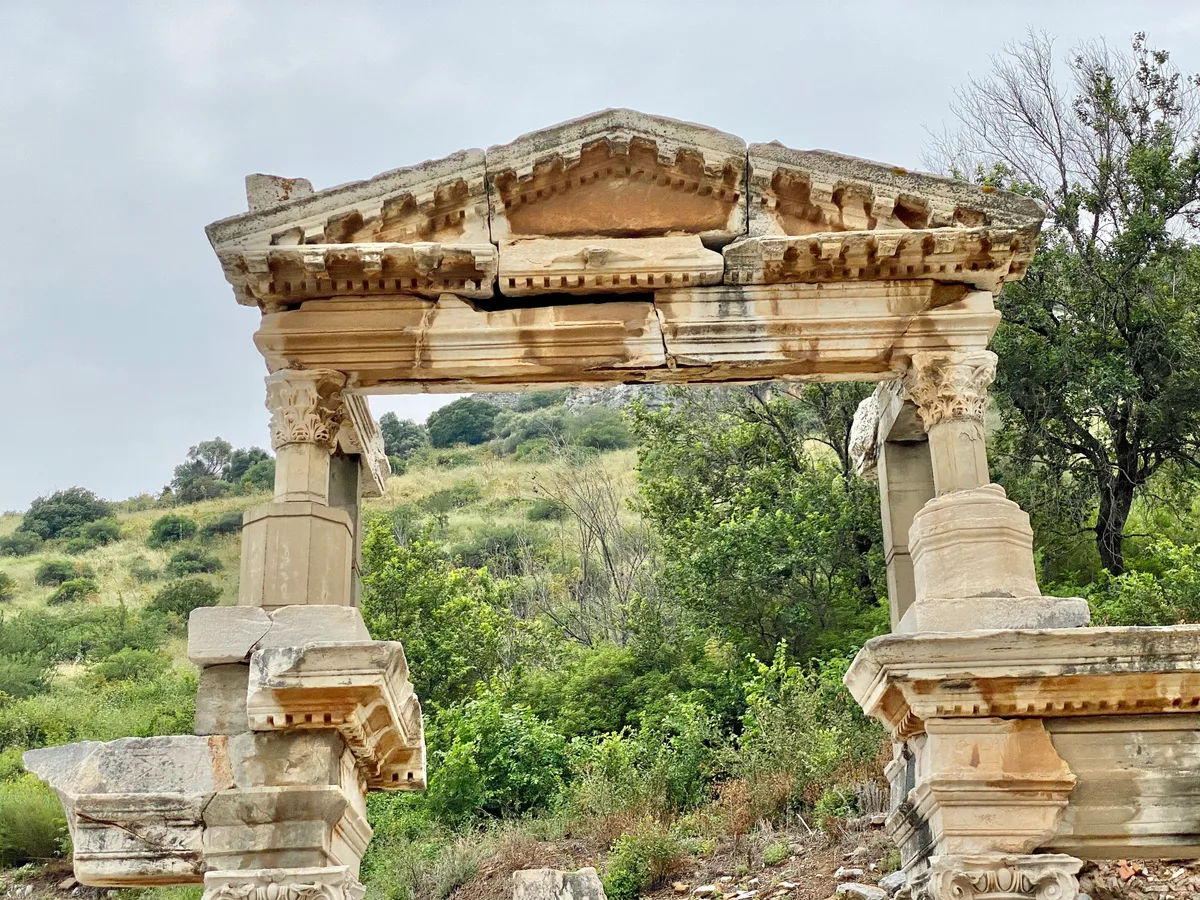
A fountain built to flatter an emperor
Curetes Street slopes downhill in marble, and halfway down a tall columned facade rises on its right-hand side. This is the Fountain of Trajan, Trajan Çeşmesi in Turkish. A wealthy Ephesian named Tiberius Claudius Aristion paid for it in the early 2nd century AD and dedicated it to the emperor who ruled Rome at the time.
It was a nymphaeum, a monumental public fountain. Water poured from the upper levels into a long, shallow basin at street level, where people could fill jugs or simply stand in the cool air off the pool. Statues filled the niches. The dedication was a public show of loyalty, set where the whole city would pass it.
The foot on the globe
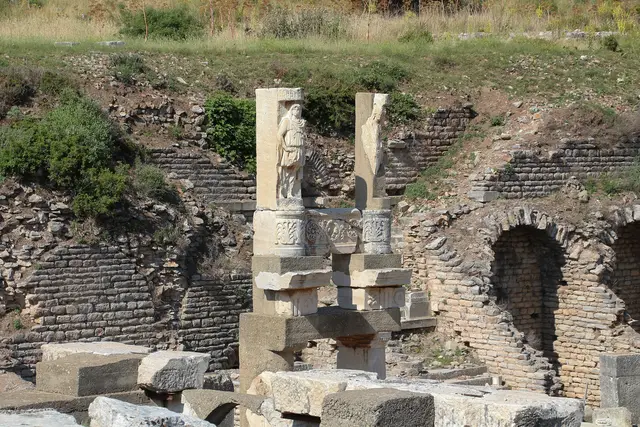
Look for one detail first. In the central niche, a broken statue base still holds a single carved foot resting on a sphere. That foot belonged to a colossal statue of Trajan, and the globe under it stood for the world he governed.
Nothing above the ankle survives. The rest of the figure has to be built up in your head, which turns out to be the most memorable part of standing here. Then step back to the edge of the street and look at the whole structure:
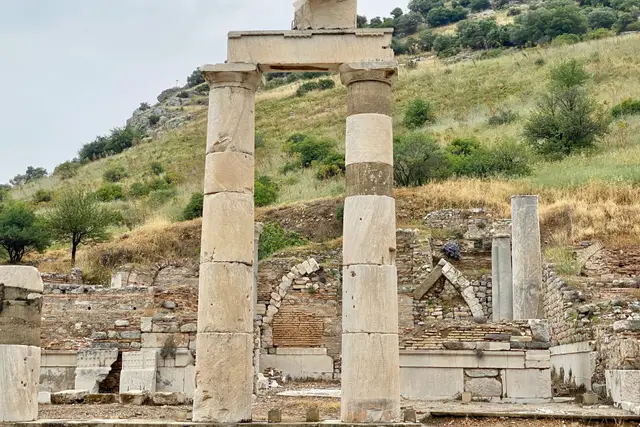
- Two storeys of columns, partly re-erected by archaeologists from original pieces
- The niches that once held sculptures of gods and members of the donor’s circle
- The basin outline in front, marking where the water collected
- The inscriptions, worn but legible in places, naming the emperor and the donor
What you see is a partial reconstruction, called anastylosis. Some blocks are original, others are modern fill. The two colours of stone show you which is which.
Where it sits on the walk
Ephesus is laid out along a slope, so where the fountain sits shapes how you meet it. Coming in from the upper gate, you pass the State Agora, the Odeon and Domitian Square. Then you go through the Gate of Hercules onto Curetes Street. The fountain follows soon after on the right.
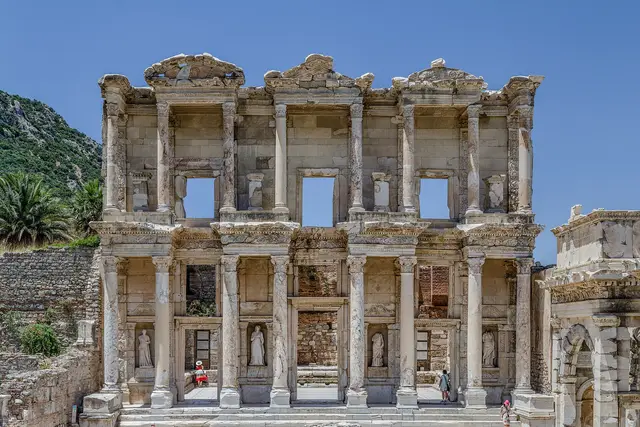
Keep walking downhill and you reach the Temple of Hadrian and the Scholastica Baths. The Terrace Houses come next, under their protective roof, and then the Library of Celsus fills the view at the bottom. The fountain sits right before the stretch everyone has come to photograph. That is why it gets a glance rather than a stop.
That’s the quiet appeal of it. Groups keep moving toward Celsus, and you can often have a stretch of the railing to yourself while they pass.

Getting there from Selçuk town
The fountain is inside the Ephesus archaeological site, about 3 km from central Selçuk. Selçuk has a railway station with regional trains from İzmir, including from the airport. Its bus station takes intercity coaches and local minibuses (dolmuş).
- Walking: the lower gate is a flat walk out of town, though the road has little shade
- Dolmuş: minibuses heading toward Pamucak or Kuşadası can drop you near the lower gate road; tell the driver “Efes”
- Taxi: the simplest way to reach the upper gate, and many people take one there and then walk downhill through the whole site
Going top to bottom means the fountain comes up roughly halfway through. You’ll pass it before your legs and attention are tired, and the walk finishes at the lower gate, closer to town.
Ancient stone, modern sun
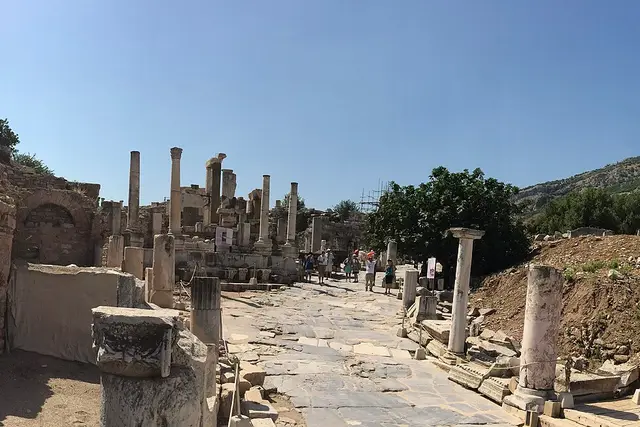
Shade is the thing to plan around. Curetes Street is open marble with almost no cover, and in summer the stone throws heat back up at you. Spring and autumn are much kinder for lingering at the fountain.
Large tour groups, many of them from the cruise port at Kuşadası, tend to arrive mid-morning. Arriving close to opening time usually puts you ahead of most of them, and late afternoon tends to thin out as the coaches leave. Opening hours at Ephesus change with the season, so check the official site for this month’s times rather than relying on an old guidebook.
Walking Ephesus without the herd
Small habits make a big difference here. These are the ones that count at the fountain:
- Let the group pass. When a guided tour stops in front of the facade, carry on to Hadrian’s Temple and come back up a few minutes later. The street clears quickly.
- Stay off the stones. The basin edge and fallen blocks look like benches, but site guards will ask you to move. The marble is part of the monument.
- Read the facade from the far side of the street. You see both storeys only from the opposite kerb, and you’re out of the flow of foot traffic there.
- Pay ahead. Ticket desks at the gates generally take cards. Turkey’s Müzekart museum pass is accepted at state-run sites like Ephesus; check current conditions on the official museum pass site.
- Carry water in. Facilities inside the site are limited, and most of them cluster near the gates.
Check the Terrace Houses before you go. They have a separate ticket, and they sit just downhill of the fountain. If you plan to see them, it’s easier to decide at the gate than halfway down Curetes Street.
Finding Trajan’s missing statues in town
The story finishes back in Selçuk. Several sculptures found at the fountain are now in the Ephesus Museum in the town centre. Seeing them after the site fills the empty niches you just walked past.
Selçuk is compact, so you can combine the museum with a few other stops on foot:
- The Basilica of St John on Ayasuluk Hill, the ruined church over the traditional tomb of the apostle
- İsa Bey Mosque, a 14th-century mosque at the foot of the same hill
- The Temple of Artemis site, once one of the Seven Wonders, now a single re-erected column standing in a marshy field
A full day lets you do Ephesus in the morning and the town in the afternoon. The fountain itself takes only a quarter of an hour, but it’s the stop most people skip, and that is a good reason to give it the time.
Frequently asked questions
Where exactly is Trajan Fountain?
It stands on Curetes Street inside the Ephesus archaeological site, about 3 km from central Selçuk. Coming downhill from the upper gate, it's on your right after the Gate of Hercules, a short way before the Temple of Hadrian and the Library of Celsus.
How long should I spend at the fountain?
Allow 15–20 minutes to find the carved foot on the globe, read the inscriptions and look at the full facade from across the street. Ephesus as a whole usually takes 2–3 hours, or longer if you add the Terrace Houses.
How do I get to Ephesus from Selçuk?
You can walk to the lower gate, take a dolmuş heading toward Pamucak or Kuşadası and ask for "Efes", or take a taxi. Many visitors take a taxi to the upper gate and walk downhill through the whole site, passing the fountain on the way.
When is the best time to visit?
Spring and autumn are the most comfortable, because Curetes Street has almost no shade. Arriving close to opening time usually beats the mid-morning tour groups. Hours change with the season, so check the official site before you go.
Where are the fountain's original statues?
Several sculptures recovered from the fountain are on display at the Ephesus Museum in central Selçuk. It makes a good follow-up visit after the site, along with the Basilica of St John and İsa Bey Mosque nearby.
Plan your trip to Selcuk
Turkey eSIM & staying connected →
Some links above are affiliate links — if you book through them, Wander Atlas earns a small commission at no extra cost to you. It's how we keep every guide free.