Why go
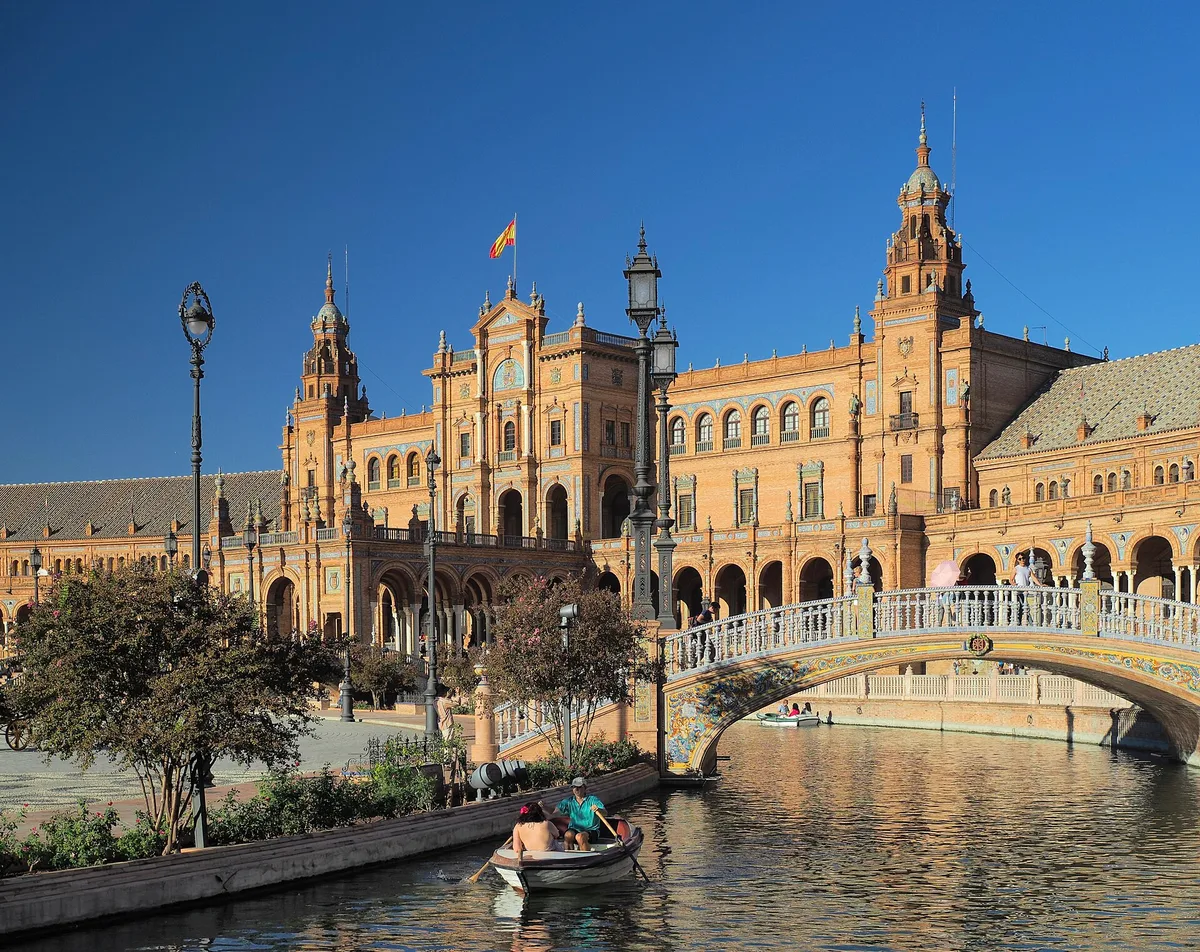
You feel the scale before you understand it. The plaza opens up in a vast brick-and-tile semicircle, a moat-like canal curving in front of it, four bridges representing Spain’s medieval kingdoms crossing the water at intervals. Built for the 1929 Ibero-American Exposition, it was never a palace or a fort. It was a stage set, designed by architect Aníbal González to show off what Andalusian craft could do, and it still works exactly that way.
Sunlight moves across the central tower’s orange-and-yellow tiles through the day, and the whole building seems to change color with it. This isn’t a quiet corner of Seville; it’s one of the most photographed squares in Spain, and it earns that reputation on sight.
What to see
Walk the curve slowly and you’ll find 48 ceramic-tiled alcoves set into the base of the building, one for each Spanish province, arranged alphabetically and each showing a map and a historic scene from that region. Locals and visitors alike hunt for their home province’s bench. It’s the plaza’s quiet running game. Above, painted azulejo tiles wrap the balustrades and staircases in blue, green, and ochre geometric patterns, a technique Seville has practiced since the Moorish period.
The canal itself is rentable by rowboat, a slightly kitsch but genuinely fun way to see the building’s reflection from water level. Overhead, watch for the alcove ceilings and the bridge ironwork, the detail rewards looking up as much as looking straight ahead.
Getting there
The plaza sits at Av. Isabel la Católica, on the southern edge of the historic center, folded into the northern end of the sprawling María Luisa Park. From the Seville Cathedral or Real Alcázar, it’s a flat 15-20 minute walk south along Paseo de las Delicias or through the park itself, genuinely one of the nicer walks in the city, past orange trees and fountains.
If you’d rather ride, city buses C1, C2, C3, and C4 all stop nearby, and the Prado de San Sebastián tram/bus interchange is a five-minute walk away. There’s no metro station directly on the square. Taxis and rideshares can drop you right at Puerta de Jerez or the plaza’s edge.

When to go
This is a very popular stop, with well over 180,000 visitor reviews, it draws large group tours, wedding photographers, and cruise-excursion buses throughout the day, especially from mid-morning through mid-afternoon. Arrive right at opening in the early morning, or come back in the last hour of daylight, when the low sun turns the tilework amber and the crowds thin out.
Midday in summer also means real heat with almost no shade over the water, so an early or evening visit is more comfortable, not just quieter. The plaza is unticketed and technically always accessible, though it’s really an outdoor daytime and early-evening experience, after dark it’s dimly lit and quieter still, mostly locals passing through.
Nearby
María Luisa Park spreads out behind the plaza, worth a wander for its tiled fountains, doves, and the horse-drawn carriages that loop through it. Two other 1929 Exposition buildings, the Museum of Arts and Traditions and the Archaeological Museum, sit a short walk away in Plaza de América. From the plaza it’s an easy walk back into Santa Cruz, the old Jewish quarter, for tapas afterward.
How to visit like a local
Since this is a landmark rather than a hidden spot, the real skill is timing and positioning, not discovery. Skip the group-tour hours by coming before 9am or after 6pm. You’ll get the same tilework with a fraction of the people. There’s no entry fee and no ticket booth, so don’t let anyone try to sell you an “entrance ticket” near the gates; the boat rental and horse-drawn carriage rides are the only things you actually pay for, and those vendors work on cash or card.
Don’t just shoot the wide postmark photo from the center. Walk the full curve to find your own province’s alcove, which is what most Sevillanos do when they bring visiting family here. And resist the urge to rush: the building rewards a slow lap more than a five-minute photo stop.
Frequently asked questions
Is Plaza de España free to visit?
Yes, the square and its walkways are free and open to the public with no ticket required. The only paid extras are canal boat rentals and horse-drawn carriage rides.
How do I get to Plaza de España from central Seville?
It's a 15-20 minute walk south from the Cathedral through María Luisa Park, or you can take bus C1, C2, C3, or C4, or walk five minutes from the Prado de San Sebastián transport hub. There's no direct metro stop.
When is the best time to go to avoid crowds?
Aim for right at opening in the early morning or the last hour before sunset. Mid-morning through mid-afternoon draws heavy tour-group and cruise-excursion traffic.
How long should I spend there?
Plan on 45-90 minutes for a full walk around the alcoves and bridges; add 20-30 minutes if you want to rent a rowboat on the canal.
What else is nearby worth combining with a visit?
María Luisa Park surrounds the plaza with fountains and gardens, the Museum of Arts and Traditions and Archaeological Museum sit a short walk away in Plaza de América, and the Santa Cruz tapas district is an easy walk back toward the center.
Plan your trip to Seville
Spain eSIM & staying connected →
Some links above are affiliate links — if you book through them, Wander Atlas earns a small commission at no extra cost to you. It's how we keep every guide free.