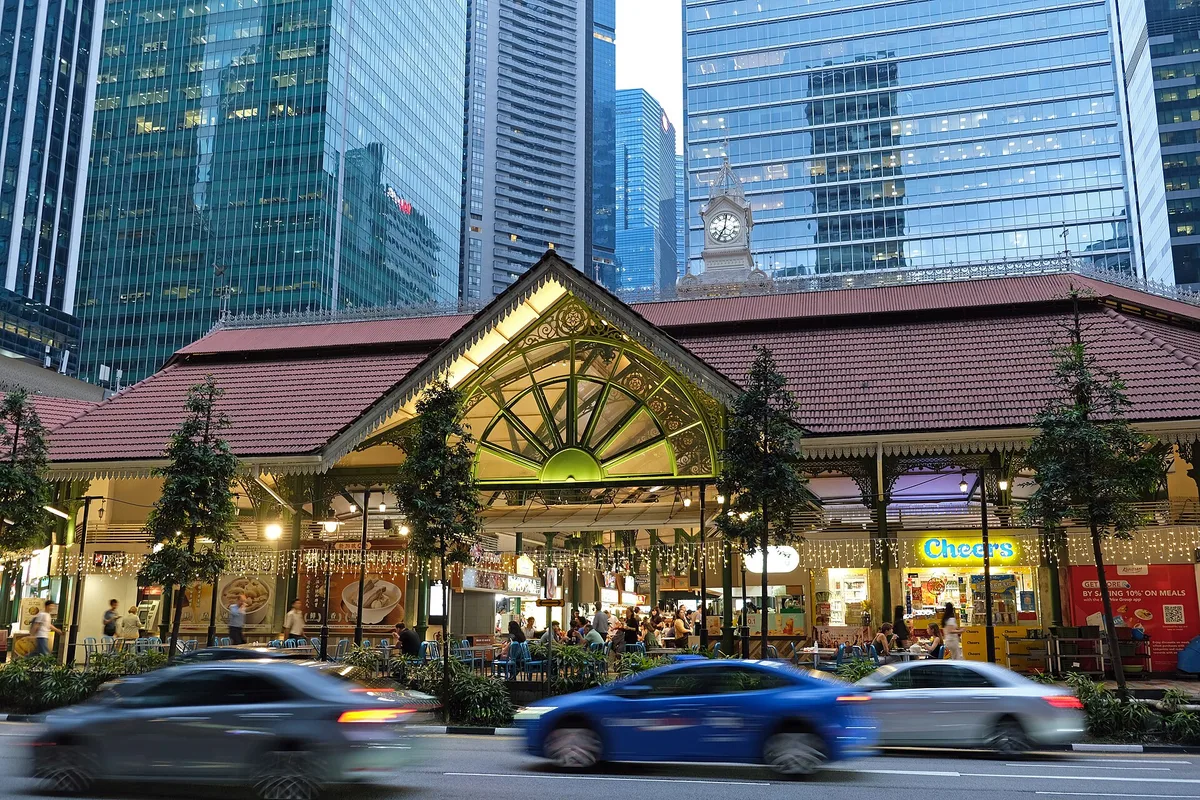
You smell Lau Pa Sat before you see it properly, a wall of charcoal smoke, chilli, and grilled lemongrass drifting out from under the cast-iron canopy onto Raffles Quay. Then the building itself resolves out of the glass-and-steel skyline around it: an octagonal Victorian market hall, its ironwork painted a deep green-and-cream, looking like it wandered in from another century and got surrounded by bank towers.
It has, more or less. The structure dates to the 1890s, prefabricated in Glasgow and shipped out as one of colonial Singapore’s original produce markets, later reassembled and converted into the hawker centre you see today.
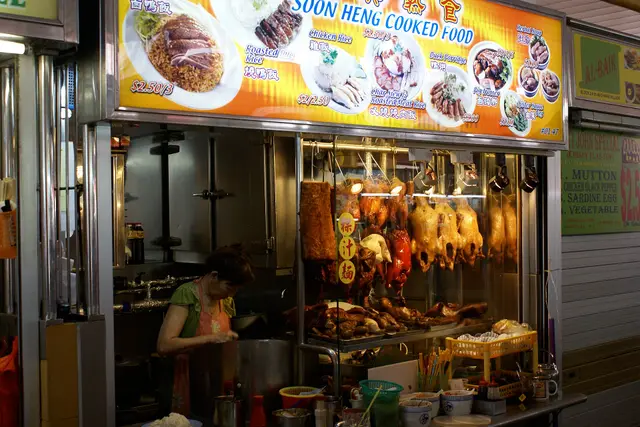
Inside, the roofline soars up into a web of iron trusses and slatted vents, and the light comes in low and slatted through the arched windows. Rows of stalls radiate out from the centre like spokes, each one a family operation with a laminated menu, a portrait of the hawker over the wok, and a queue that swells and shrinks through the day like a tide.
At lunchtime the noise is a wall (cleavers on chopping boards, the hiss of noodles hitting hot oil, chairs scraping on stone) because this is prime real estate for the entire Central Business District, and everyone from bankers to construction crews eats here.
What to eat
This is where you come for hawker classics done at volume: Hainanese chicken rice, char kway teow blackened in a well-seasoned wok, oyster omelette, laksa, carrot cake (the savoury turnip kind, fried with egg and preserved radish), and Hokkien mee with its deep prawn-stock aroma. There are also international stalls (Indian, Japanese, Western grills) reflecting the CBD lunch crowd’s range of cravings.
But the real draw, and the reason people plan an evening around this specific block, is Satay Street: after dark, Boon Tat Street on the market’s south flank closes to cars, and satay stalls wheel out charcoal braziers right onto the tarmac, fanning skewers of chicken, beef, and mutton over open flame, served with peanut sauce, ketupat, and raw onion and cucumber.

Getting there
Lau Pa Sat sits at 18 Raffles Quay, wedged between Robinson Road and the Raffles Place financial cluster. The easiest approach is Raffles Place MRT station (North-South and East-West lines). Take Exit G or H and it’s a flat five-minute walk down Cross Street or Church Street. Downtown MRT station (Downtown Line), Exit A, is similarly close. If you’re coming from Marina Bay Sands or the waterfront, it’s a pleasant 15-minute walk north along the river and through the CBD towers.
When to go
Lunch here, roughly 11:30am to 2pm on weekdays, is the peak crush, office workers pour out of the surrounding towers and stalls sell out of popular dishes fast. If you want to actually sit down without circling for a table, aim for just before noon or after 2pm. Dinner is calmer inside the hall itself but Satay Street doesn’t really light up until around 7–8pm, running late into the night, especially on weekends when it draws a mixed crowd of tourists, locals, and after-work drinkers.
How to visit like a local
Scope your stall before you queue (walk the full loop once, note the handwritten specials and the length of each line, then commit. Order and pay at the stall itself (most take cash, and a growing number take PayNow or card via QR code, but don’t assume every stall does), then grab any open seat in the shared communal seating) table-hunting here is first-come, first-served, not stall-specific.
Tissue packets or umbrellas left on a table mean it’s taken; that’s the local method of reserving a seat while you queue elsewhere. Given how popular and well-reviewed this place already is, don’t expect a quiet, undiscovered corner. The smarter move is timing your visit around the lunch rush rather than hoping to dodge it by luck. At Satay Street, portions are typically sold by the stick, so ask the price per skewer before ordering a stack, and expect servers to tally your bill by counting the skewers left on your table at the end.
Frequently asked questions
How do I get to Lau Pa Sat by MRT?
Take Raffles Place MRT (North-South/East-West lines), Exit G or H, and walk about five minutes down Cross Street or Church Street. Downtown MRT (Downtown Line), Exit A, is an equally short walk.
What's the best time to visit to avoid crowds?
Avoid weekday lunch between 11:30am and 2pm, when the CBD empties out into the hawker stalls. Go just before noon, mid-afternoon, or wait until after the lunch rush clears.
Is Satay Street part of Lau Pa Sat?
It's the section of Boon Tat Street right alongside the market, closed to traffic in the evenings (typically from around 7pm) so satay hawkers can grill outdoors — a separate but adjoining experience to the indoor hall.
How much time should I budget?
45–75 minutes covers a proper meal with time to walk the stalls first and decide. If you're doing both the indoor hall and Satay Street, allow closer to two hours.
Can I pay by card?
Many stalls now accept PayNow or card via QR code, but plenty are still cash-preferred, especially smaller family-run stalls — carry some cash to be safe.
Plan your trip to Singapore
Singapore eSIM & staying connected →
Some links above are affiliate links — if you book through them, Wander Atlas earns a small commission at no extra cost to you. It's how we keep every guide free.