Temple de l'Amour: Strasbourg Travel Guide
✓ Facts verified via Google Places · Sep 18, 2026
At a glance
How this guide is made
Produced with AI assistance and reviewed against live data sources. Facts such as hours, ratings, and location come from Google Places; images are licensed or public domain. Details can change — please verify before visiting. Editorial policy
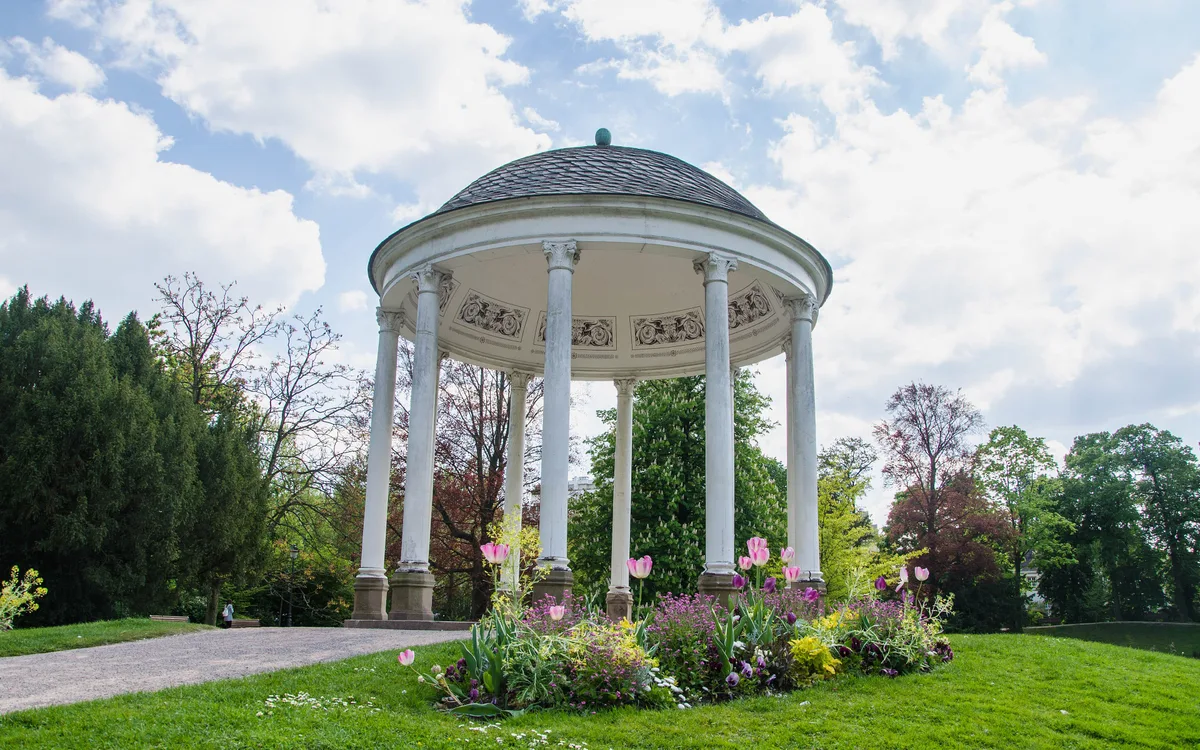
The Parc de l’Orangerie is Strasbourg’s oldest public garden, laid out in the late 1600s and reworked in the early 1800s under Josephine de Beauharnais, and the Temple de l’Amour is one of its quieter architectural leftovers. It’s a small round pavilion, columned in the neoclassical style that was fashionable for garden follies across France in that period, set among trees rather than at any grand axis or entrance. You won’t find it on the park’s main sightlines; it rewards people who wander off the central paths.
Finding it inside the park
Don’t expect signage pointing you straight there.
The Temple sits within the wooded, less-manicured stretches of the Orangerie, away from the stork enclosures and the lake that draw most visitors. Enter from Avenue de l’Europe or Allée de la Robertsau and head toward the park’s quieter interior paths rather than the areas closest to the restaurant and playgrounds. A paper or phone map of the park helps, since the paths curve and there’s no ticket booth or staff to ask.
Why this one is worth the detour
Strasbourg has grander monuments: the cathedral, the Palais Rohan, the half-timbered houses of Petite France. A small garden folly can’t compete with any of those on scale, and it isn’t trying to.
What it offers instead is stillness. Few visitors make it this far into the park, so you often get the structure and the surrounding clearing to yourself. It’s the kind of stop that rewards someone who already knows and loves the Orangerie, not a first-time Strasbourg visitor ticking off landmarks.

When to go
Because it’s open 24 hours every day, there’s no opening rush or closing time to plan around here. That said, the Orangerie itself is a public park, and daylight hours are the practical window: paths can be unlit and uneven after dark, and the folly has no lighting of its own.
Spring and early autumn mornings are pleasant for the walk in, with mild temperatures and fewer joggers and dog walkers on the paths near the temple. Midday in summer brings more foot traffic to the park generally, though the temple’s off-path location means it rarely feels crowded even then.
Making it part of a longer visit
Treat the Temple de l’Amour as one stop on a slower loop of the Orangerie rather than a standalone errand.
A natural route:
- Start near the park’s stork enclosures and lake, the busiest section
- Walk the wooded paths toward the park’s interior, watching for the columned pavilion
- Sit at the Temple de l’Amour for a few quiet minutes
- Loop back past the Pavillon Joséphine, another Napoleonic-era garden structure
This turns a five-minute photo stop into a comfortable hour or more of walking, with the temple as a calm midpoint rather than the whole point.
Getting there and moving through quietly
The Parc de l’Orangerie sits northeast of Strasbourg’s city centre, a walk or short tram ride from the cathedral area. Tram lines serving the Robertsau/Orangerie side of the park are the easiest public transport option; check current routes before you go since tram lines in Strasbourg have shifted numbering over the years.
Once inside, this is a spot to treat gently:
- Keep noise down; there’s no barrier or attendant, and the appeal is the quiet
- Stick to worn paths rather than cutting across planted beds to reach it
- Visit on foot or by bike; the park’s interior paths aren’t set up for cars
- Skip picnicking directly at the structure itself, and use the park’s benches and lawns instead
Because it’s under-the-radar rather than a marked sight, part of the experience is simply the search. Don’t rush it, and don’t expect a plaque with much detail; the pleasure here is a quiet corner of a very old park, not an information point.
Frequently asked questions
Is there an entrance fee for the Temple de l'Amour?
No. It sits inside the Parc de l'Orangerie, which is a free public park with no gate or ticket for the temple itself.
What are the opening hours?
The park and the temple are accessible 24 hours a day, every day. In practice, daylight hours are best since the interior paths have no lighting.
How do I get to the Parc de l'Orangerie?
It's northeast of central Strasbourg, reachable by tram or a roughly 20-30 minute walk from the cathedral area. Check current tram routes before you go, as lines change.
How long should I spend at the Temple de l'Amour?
The structure itself takes five to ten minutes, but it's best enjoyed as part of a longer, hour-plus walk through the wider Orangerie park.
Is it easy to find inside the park?
Not immediately. It's away from the main paths near the stork enclosures and lake, so bring a park map or expect to wander a bit through the wooded interior.
Plan your trip to Strasbourg
Some links above are affiliate links — if you book through them, Wander Atlas earns a small commission at no extra cost to you. It's how we keep every guide free.
Related guides
 attraction
 Parc de l'Orangerie: Strasbourg Travel Guide (4.6★)
 attraction
 Musée de l'Œuvre-Notre-Dame: Strasbourg Travel Guide
 attraction
 Strasbourg Museum of Modern and Contemporary Art: Travel Guide
 hidden gem
 Cathédrale Notre-Dame-de-Strasbourg: Travel Guide
More Strasbourg guides: Christmas in Alsace 2.8 km