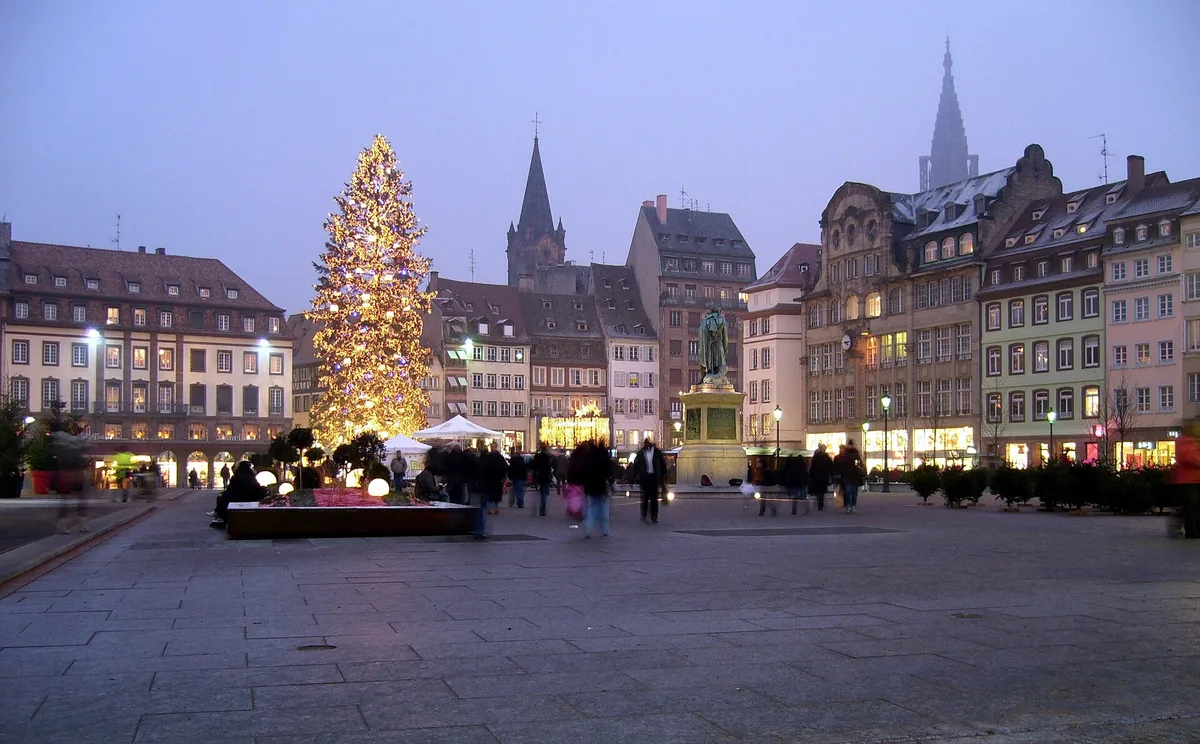
A square built for crossing
Strasbourg funnels through here. Trams glide past the southwest corner and shoppers cut diagonally between the arcaded streets. Café terraces line the edges, and in the middle stands a bronze general on a tall pedestal, looking out over all of it.
Place Kléber is the largest square on the Grande Île, the river-ringed old centre that UNESCO listed in 1988. It is wide, open and paved, with no traffic beyond delivery vans and bicycles. You are never far from its edges: shops and cafés frame all four sides, and the long neoclassical front of the Aubette closes off the north.
As a public square, it never closes. You can walk through at midnight or at dawn, and plenty of people do, because it sits on the most direct line between the tram hub and the cathedral quarter.
The general under the statue
The square takes its name from Jean-Baptiste Kléber, born in Strasbourg in 1753. He rose to general during the Revolutionary Wars and commanded the French army in Egypt after Napoleon left. He was assassinated in Cairo in 1800.
His statue, by the sculptor Philippe Grass, went up in 1840. The detail most visitors miss is underneath: Kléber’s remains lie in a vault below the pedestal. You are standing over his grave when you lean on the railings for a photo.
The square’s name has not always held. Before Kléber it was known as the Place d’Armes. During the German annexation of 1940–1944 the occupiers removed the statue and renamed the square. The general returned to his plinth after the Liberation.
The Aubette’s long façade
The building along the north side is the Aubette. Jacques-François Blondel designed it in the 18th century as part of a plan to give the square a formal military face. Its ground floor of arches and its long, symmetrical front set the tone for the whole space.
Inside is something unexpected. In the late 1920s, the artists Theo van Doesburg, Sophie Taeuber-Arp and Jean Arp redesigned a suite of rooms as an entertainment complex. Their geometric, colour-blocked interiors are now restored as the Aubette 1928, a landmark of avant-garde design.
Opening times for the Aubette 1928 rooms are set by the Strasbourg museums, and they differ from the square’s round-the-clock access. The museums’ official site carries the current schedule.

The Great Christmas Tree
For most of the year, Place Kléber is a crossroads. In Advent, it becomes a destination. The Great Christmas Tree, a tall fir decorated with lights and ornaments, stands at the centre of the square through the season.
The tree anchors the Strasbourg Christmas market, the Christkindelsmärik, which traces its roots to 1570 and calls the city the “Capital of Christmas”. Market chalets spread across several squares in the centre. The tree here is the one that ends up in almost every photo.
This is the square’s peak season by a wide margin. Crowds are thickest in the evenings, when the lights are on, and on weekends. Visitors who want the tree without the crush usually come in the daytime on a weekday. The City of Strasbourg organises the market and sets its dates each year.
Reaching Kléber by tram
Strasbourg’s tram network makes this the easiest square in the city to reach. The Homme de Fer stop, just off the southwest corner, is the main interchange of the whole system. Several lines meet under its circular glass canopy, including A and D from the central station.
From the station, the ride takes a few minutes. Walking is also simple: about 15 minutes east along the old streets. Cars are another matter. The centre is largely pedestrianised, so drivers typically use a park-and-ride on the edge of town and take the tram in.
Crossing the square like a Strasbourgeois
The square looks pedestrian, but it is shared space. A few habits keep you out of trouble:
- Listen for the tram bell. Trams pass close to the Homme de Fer corner and move quietly. A ring of the bell means step aside now.
- Watch for bikes. Strasbourg is one of France’s most cycled cities, and riders cut straight across the paving.
- Say “Bonjour” first. Walking into a shop or up to a café counter without a greeting reads as rude in France.
- Sit, then wait. On the terraces, a server comes to you. Paying at the table by card is normal, and you ask for the bill (“l’addition”) when you’re ready.
- Tipping is optional. Service is included in French prices; leaving small change is a courtesy, not an obligation.
Locals use the statue’s base as a meeting point. “At Kléber” is all the instruction most people need. In Advent, that instruction becomes much harder to follow, so groups tend to pick a nearby side street instead.
Walking out from Kléber
The square works best as a starting point. Most of the Grande Île is within a 15-minute walk:
- Strasbourg Cathedral: east through the old streets, about 10 minutes on foot. Its single spire rises above the rooftops as you go.
- Place Gutenberg: south of the cathedral, with its statue of the printing pioneer, another stop on the Christmas market circuit.
- Petite France: southwest, past the Homme de Fer, where half-timbered houses line the canals of the Ill.
- Place Broglie: a short walk northeast, a long tree-lined square that hosts the largest stretch of Christmas chalets.
A loop of the square itself takes 15 minutes, longer if you stop at the statue and look up at the Aubette. Add the Aubette 1928 rooms or a café terrace and you have a solid hour before setting off for the cathedral.
Frequently asked questions
How do I get to Place Kléber by public transport?
Take the tram to Homme de Fer, the main interchange of Strasbourg's network, which sits just off the square's southwest corner. Lines A and D run there from the central station in a few minutes. You can also walk from the station in about 15 minutes.
When is the Great Christmas Tree on Place Kléber?
The tree stands on the square through Advent as the centrepiece of the Strasbourg Christmas market. The City of Strasbourg organises the market and sets its dates each year. Evenings and weekends draw the biggest crowds, and visitors after a calmer view usually come on weekday daytimes.
Is Place Kléber open at night?
Yes. It's a public square, open 24 hours, and people walk through at all hours. Shops, cafés and the Aubette 1928 interiors keep their own, shorter hours.
How long should I spend at Place Kléber?
Around 15 minutes covers the square, the Kléber statue and the Aubette's façade. Allow an hour if you add the Aubette 1928 rooms or a stop at a café terrace.
What is near Place Kléber?
Strasbourg Cathedral is about a 10-minute walk east. Place Broglie and Place Gutenberg, both Christmas market squares, are close by, and the canals of Petite France lie to the southwest past the Homme de Fer tram stop.
Plan your trip to Strasbourg
France eSIM & staying connected →
Some links above are affiliate links — if you book through them, Wander Atlas earns a small commission at no extra cost to you. It's how we keep every guide free.
Related guides
 attraction
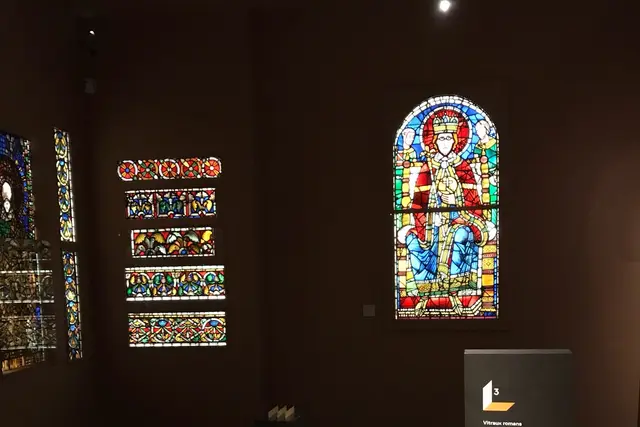
Musée de l'Œuvre-Notre-Dame: Strasbourg Travel Guide
 attraction
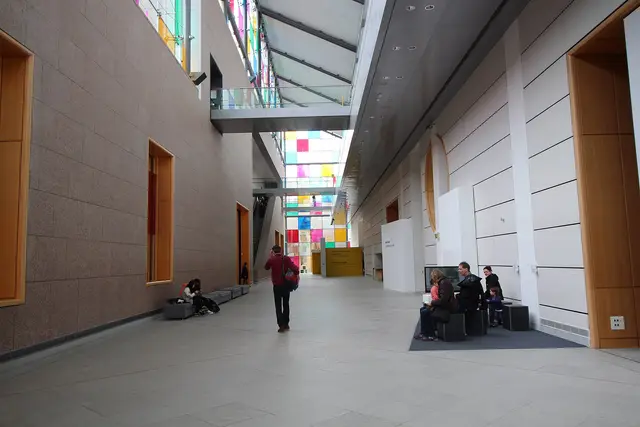
Strasbourg Museum of Modern and Contemporary Art: Travel Guide
 attraction
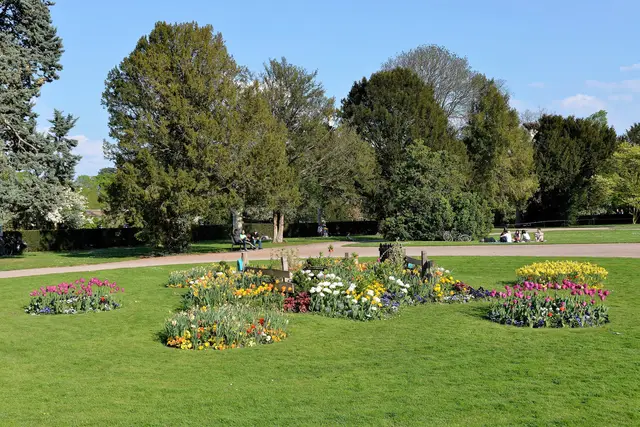
Parc de l'Orangerie: Strasbourg Travel Guide (4.6★)
 attraction