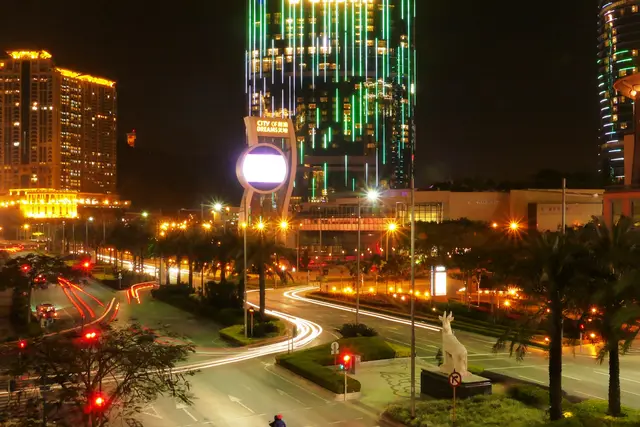
Taipa’s centre is built upward: residential towers, podium shops and traffic on every side. Taipa Central Park is the open space set in the middle of all that, on Rua de Seng Tou. You won’t find it in most visitor itineraries. That gap is the reason to go.
In Cantonese it’s 氹仔中央公園, and in Portuguese it’s Parque Central da Taipa. Learn one of the two before you set off. The Chinese characters are the more useful when you show a taxi driver where you’re going.
What you’re walking into
This is a neighbourhood park, not a showpiece. The people around you are mostly residents of the surrounding blocks using it the way people use a park they live next to. Expect paths, planting, places to sit and space for children, with apartment towers rising above the trees on every side.
That mix is the point of coming. Taipa Village is a few streets away, full of tile-fronted shophouses and visitors carrying snack bags. Here you see Taipa as a place people live in. Reviewers rate it consistently well for that: green, calm, well kept.
The park also houses the Taipa Library, a branch of the Macao Public Library network. If it rains, you can shelter there for a while. Check the Macao Public Library website for its hours, which are separate from the park’s.
Eighteen hours of open gates
The opening times are generous. The park is open every day of the week, 6am to midnight, with no day off. That gives you more ways to fit it in than almost anything else in Taipa.
- 6am onwards: In Macau’s public parks, early mornings usually mean residents out for exercise. You’ll typically see walkers, stretching and tai chi.
- Midday: It’s a shaded break between the Taipa Houses–Museum and lunch in the village.
- After dinner: The restaurants on Rua do Cunha and the streets around it wind down well before midnight. The park doesn’t, so you can walk off a meal here.
Don’t plan on coming after midnight. The gates close then every night, weekends included.
Getting to Rua de Seng Tou
The park sits in the flat, built-up middle of Taipa island. Taipa Village and its main lane, Rua do Cunha, are a short walk to the south. Many visitors combine the two.
From the Macau peninsula, buses and taxis cross to Taipa on the bridges, and the Taipa line of the Light Rapid Transit serves the island. For a taxi, show the driver the Chinese name 氹仔中央公園 and the street, 成都街 (Rua de Seng Tou). It’s quicker than trying to pronounce the Portuguese.
If you’re walking from the village, head north out of the old lanes towards the towers. The streets are grid-like and the walk is flat. A phone map is enough to find the park.
Park manners in Macau
Macau’s municipal parks run on a few unwritten rules. Following them makes the visit smoother.
- Morning exercise has right of way. If a group is doing tai chi or line dancing on an open patch, walk around it, not through it.
- No smoking. Macau’s tobacco law covers public parks. Smokers step outside the gates.
- Benches are shared. Older residents treat certain benches as their own in the morning. Taking a free seat is fine. Spreading out across one isn’t.
- There’s nothing to pay. It’s a public park, so you won’t need cash or a ticket. Bring change for snacks you buy on the way.
- Keep the volume down after dark. These are residential blocks, and windows face the park late into the evening.
Locals pay for buses with a Macau Pass card. It’s also the easiest way for you to get around Taipa if you’re hopping between the park, the village and Cotai.
Pairing it with Taipa Village
Most people come for the old village and stay an hour. The park lets you stretch that into a half day with a change of pace in the middle.
A loop that works on foot:
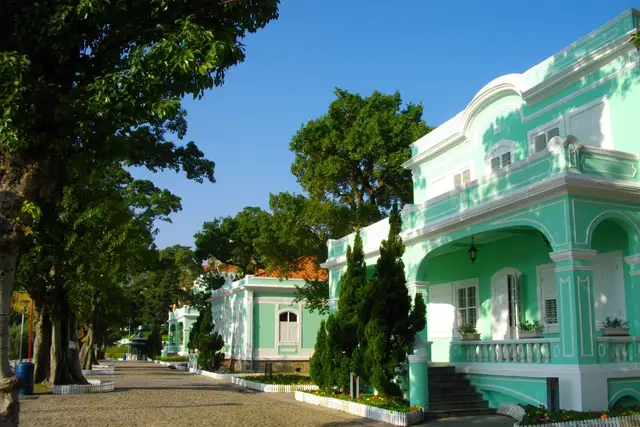
- Taipa Houses–Museum: Five mint-green Macanese villas on Avenida da Praia, facing what used to be the shoreline and now looks towards Cotai.
- Our Lady of Carmel Church: The pale yellow church on the hill above the Houses–Museum.
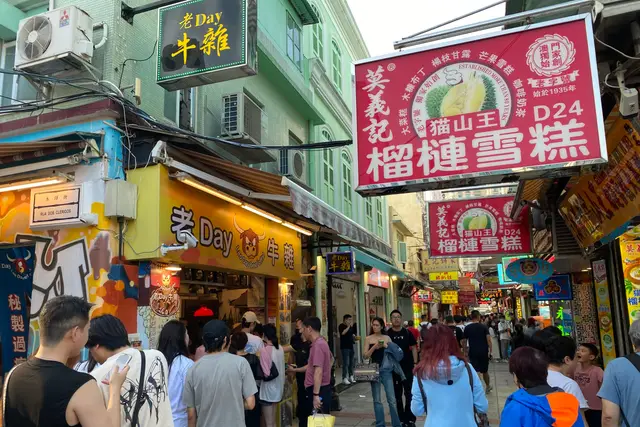
- Rua do Cunha: The narrow pedestrian lane of almond-cookie shops, pork-chop bun counters and souvenir stalls.
- Taipa Central Park: Walk north to sit down somewhere without a queue.
Do it in that order in the morning, and the park is your rest stop before lunch. Reverse it in the evening, and you end on the quiet green rather than the busy lane.
Who it suits
Be honest with yourself about what you’re after. If you want a landmark for photos, the Houses–Museum boardwalk gives you more. If you have children in tow and need them to run off energy, the park is the more useful stop.
It also suits travellers staying in Taipa or Cotai who want an early-morning walk somewhere other than a hotel corridor or a casino concourse. Since the gates open at 6am, you can be out and back before breakfast.
Thirty minutes covers a loop. An hour is enough if you add a sit-down or a look inside the library. Come with low expectations of spectacle and you’ll find exactly what it offers: an ordinary, well-used green space in one of the world’s densest places.
Frequently asked questions
What are Taipa Central Park's opening hours?
It is open every day, Monday to Sunday, from 6am to midnight. It has no weekly closing day. The Taipa Library inside keeps its own hours, so check the Macao Public Library website for those.
How do I get to Taipa Central Park from Taipa Village?
Walk north from Rua do Cunha towards the residential towers. The park is on Rua de Seng Tou, a short, flat walk away. For a taxi, show the driver the Chinese name 氹仔中央公園.
How long should I spend there?
Thirty minutes is enough for a loop of the paths. Allow up to an hour if you want to sit for a while, let children play or look inside the library.
What else is nearby?
The Taipa Houses–Museum, Our Lady of Carmel Church and the snack shops of Rua do Cunha are all in Taipa Village, walking distance to the south. The Cotai casino resorts are a short ride further on.
Is it a good place to visit early in the morning?
Yes. The gates open at 6am, and Macau's public parks are typically used for morning exercise such as walking and tai chi. It's a good start to the day if you're staying in Taipa or Cotai.
Plan your trip to Taipa Village
Macau eSIM & staying connected →
Some links above are affiliate links — if you book through them, Wander Atlas earns a small commission at no extra cost to you. It's how we keep every guide free.