
Eight columns of pink marble run across the front of the Capitole. Each one stands for one of the capitouls, the consuls who governed medieval Toulouse. Behind them is a facade of brick and pale stone, nearly 135 metres long, finished in the 1750s to designs by Guillaume Cammas. In front lies an open rectangle of paving with no fountain, no trees and nothing to get in the way.
That emptiness is why the square works. Stand in the middle and you see the city’s colour scheme in one view: rose-red brick, white stone trim, café awnings along the edges.
The cross under your feet
Look down before you look up. A huge Occitan cross in bronze is set into the paving at the centre of the square. Its twelve points carry the signs of the zodiac, and the design comes from the artist Raymond Moretti.
It is the emblem of the old County of Toulouse, and you will see it again on flags, souvenirs and street signs across the city. People walk the cross’s arms to photograph it. The best overhead view is from a window in the Capitole itself.
Inside the Capitole
The building houses the mairie and the Théâtre du Capitole, one of France’s best-known opera houses. Some of the ceremonial rooms upstairs are open to visitors for free. They are the reason to go inside.
- Salle des Illustres: a long gallery covered in late 19th-century paintings and gilded plaster, built to show off the city’s history.
- Salle Henri-Martin: large canvases by the painter Henri Martin showing the Garonne and country life through the seasons.
- The courtyard: the Cour Henri IV, with its Renaissance gateway, which you pass through on the way in.
Plan on 30–45 minutes indoors. The rooms are still used for weddings and council business, so access can close at short notice. The palace keeps its own hours, separate from the always-open square, and the city’s official site posts them.
Under the arcades
Arcades run along the west side of the square, facing the Capitole. Walk under them and look up. Moretti painted the ceilings with a sequence of panels on the history of Toulouse, from Roman Tolosa through the Cathars to Aéropostale and aviation.
Most people miss these, because the cafés and shopfronts at eye level hold their attention. The arcades also give you shade on a hot afternoon, and you can watch the whole facade from out of the sun.

Getting there and finding your bearings
The metro does most of the work. Capitole station on Line A opens directly onto the square. Jean Jaurès, where Lines A and B meet, is about a five-minute walk east along Rue de Metz and the Allées Jean Jaurès.
Behind the Capitole, in Square Charles-de-Gaulle, stands the Donjon du Capitole. This 16th-century tower is now the main tourist office. Pick up a city map there and ask about the Pass Tourisme if you plan to cover several museums.
How Toulouse uses its square
This is the city’s living room, and it’s very popular, so share it the way residents do.
- Meeting point: “On se retrouve au Capitole” is the default plan in Toulouse. The centre of the cross and the metro exit are where people wait.
- Café terraces: sit down and a waiter comes to you. Ordering at the bar costs less and is faster if you just want an espresso. Cards are widely taken, and leaving the small change is a polite tip, not a duty.
- Weddings: wedding parties often spill out of the mairie onto the steps, especially on Saturdays. Step around the photographs and leave the shot to the couple.
- Evenings: the facade is floodlit after dark, and the square is open around the clock. A late walk-through after dinner in the old town is when Toulousains enjoy it most.
- Seasonal set-ups: in December the Christmas market fills the square with wooden chalets. Expect stalls and crowds rather than open paving.
For an emptier square, come early in the morning before the terraces set up. That’s simply when the cafés are still stacking chairs.
Walking on from the square
The best of the old town is within 15 minutes on foot.
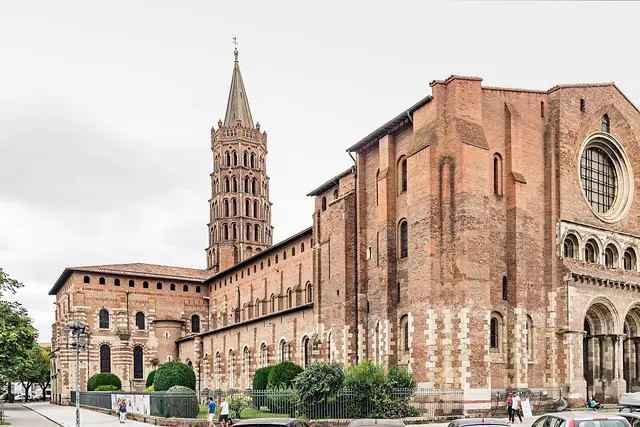
- Basilique Saint-Sernin: go north up Rue du Taur, about ten minutes. It’s a huge Romanesque brick basilica on the Camino de Santiago.
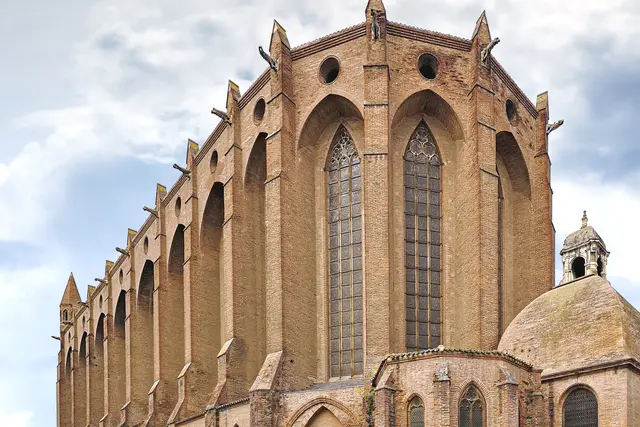
- Couvent des Jacobins: about five minutes west. Its “palm tree” vault rises from a single column.
- Rue Saint-Rome: a narrow pedestrian shopping street running south from the square.
- The Garonne at Pont Neuf: about 15 minutes south-west, for the riverside quays at sunset.
Give the square itself an hour if you go inside the Capitole, or 20 minutes if you are crossing it on the way to somewhere else. Most visitors end up crossing it several times a day anyway.
Frequently asked questions
How do I get to Place du Capitole by public transport?
Take metro Line A to Capitole station, which opens directly onto the square. Jean Jaurès station (Lines A and B) is about a five-minute walk east if you're coming from Line B.
Can I go inside the Capitole building?
Yes. Ceremonial rooms such as the Salle des Illustres and the Salle Henri-Martin are open to visitors for free. The palace has its own visiting hours, separate from the square, and can close for weddings or council business, so check the city's official site first.
How long should I spend at Place du Capitole?
About an hour covers the square, the painted arcade ceilings and the rooms inside the Capitole. Allow 20 minutes if you only want to see the facade and the Occitan cross in the paving.
Is the square worth seeing at night?
Yes. The square is open 24 hours and the Capitole facade is floodlit after dark. A walk across it after dinner in the old town is one of the easiest pleasures in Toulouse.
What is near Place du Capitole?
The Donjon du Capitole tourist office is right behind the building. Couvent des Jacobins is about five minutes away on foot, Basilique Saint-Sernin about ten minutes north up Rue du Taur, and the Garonne at Pont Neuf around 15 minutes.
Plan your trip to Toulouse
France eSIM & staying connected →
Some links above are affiliate links — if you book through them, Wander Atlas earns a small commission at no extra cost to you. It's how we keep every guide free.
Related guides
 hidden gem
Basilique Saint-Sernin de Toulouse: Travel Guide (4.7★)
 attraction
Couvent des Jacobins: Toulouse Travel Guide (4.6★)
 attraction
Musée des Augustins: Toulouse Travel Guide (4.4★)
 attraction