Ulli Hovli: Urgench Travel Guide

✓ Facts verified via Google Places · Sep 13, 2026
At a glance
Live foot-traffic data via BestTime.app
How this guide is made
Produced with AI assistance and reviewed against live data sources. Facts such as hours, ratings, and location come from Google Places; images are licensed or public domain. Details can change — please verify before visiting. Editorial policy
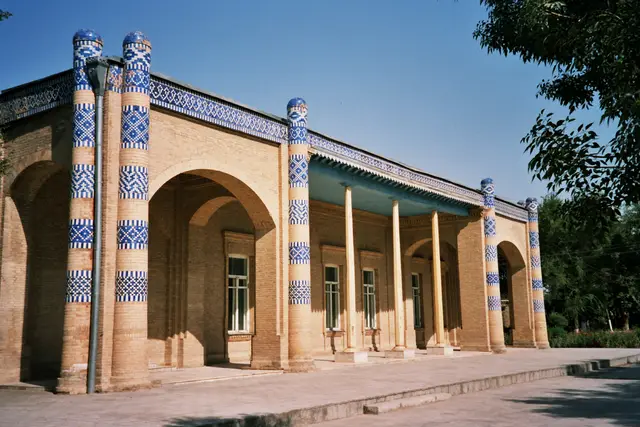
Ulli Hovli means “big courtyard house” in the local Khorezm dialect, and that’s exactly what you find here: a walled family compound built the way homes in this part of Uzbekistan were built for centuries, mud-brick and timber, rooms arranged around a shaded yard instead of facing the street.
There’s no grand facade to photograph from the road. You find it by walking into a mahalla, one of the residential quarters that make up ordinary Urgench, past low garden walls and irrigation ditches, until the lane opens onto the compound gate.
What you’re actually looking at
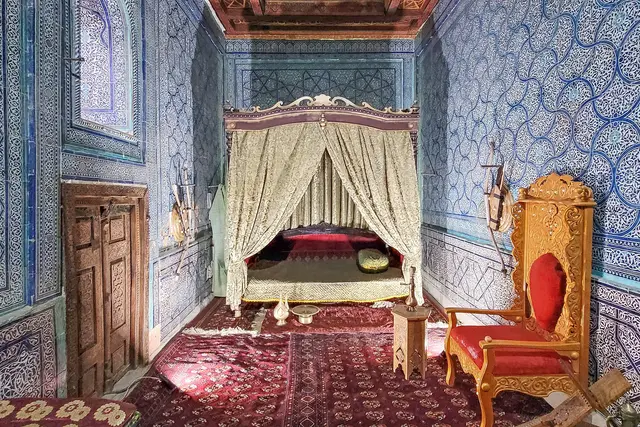
Ulli Hovli is registered as a museum, but it reads more like a preserved household than a formal exhibition hall. The rooms are laid out around the central courtyard in the traditional Khorezm style: a raised guest room (mehmonkhona), a kitchen area, and sleeping quarters, each opening onto the yard rather than a central corridor.
Expect carved wooden columns and ceiling beams, niches built into the clay walls for storing bedding and dishware, and a floor plan that makes sense once you realize the courtyard, not any single room, is the real center of the house. Look for the tandir (clay oven) near the kitchen wall and the low platforms used for sitting and sleeping.
There’s no ticket booth or gift shop pushing you along. What you get instead is quiet, and time to actually look at joinery and plasterwork instead of dodging tour groups.
Getting there from central Urgench
Urgench itself is the transport hub for the Khorezm region, the usual gateway before or after visiting Khiva, 30-35 minutes away by car or shared taxi. Ulli Hovli sits within the Urgench district, in a mahalla rather than downtown, so a taxi or a local driver is the practical way in.
- Tell your driver “Ulli Hovli” or “katta hovli” (big house) plus the mahalla name if you have it; not every app will have it pinned precisely
- A short taxi ride from Urgench’s center or from Urgench International Airport is the most reliable route
- There’s no metro or fixed bus line serving the site directly, so factor in a return trip too, since taxis may not wait around in a residential lane

When to go
The site is open 24 hours every day, but that reflects its status as a residential-style compound with a caretaker rather than a museum with posted hours, so don’t plan on a night visit expecting staff or lighting.
Weekend crowds build steadily and peak anywhere from 11am to 11pm, so if you’re coming on a Saturday or Sunday, arrive before 11am. The calm window is 7am to 9am on weekends, when the courtyard is empty and the light is low and even, good for both looking closely at the woodwork and for photos without other visitors in frame.
Weekday timing is less predictable, but the general rule holds: earlier beats later, and mornings beat the afternoon lull when tour groups doing the Khiva-Urgench circuit tend to swing through.
Reading the courtyard like a local household
Take your shoes off before stepping onto raised wooden platforms or into the mehmonkhona, the same as you would entering any traditional home in the region. If a caretaker or family member is present, a quiet greeting and asking before photographing interior rooms goes a long way; this is still a lived-in style of space, not a roped-off gallery.
Move slowly around the perimeter of the courtyard rather than cutting through the middle. The yard is the working heart of the house, and older Khorezm homes still in use treat it that way, for drying goods, sitting in shade, and moving between rooms.
There’s no entrance fee posted publicly and no fixed staff schedule, so bring small notes in Uzbek som in case there’s a caretaker or a donation box, and don’t count on card payment working here.
Making it part of a Khorezm day
Ulli Hovli is under-the-radar even by Urgench standards, with only a modest number of visitor reviews, so you should expect a genuinely quiet stop rather than a curated tourist experience. That’s the appeal: a real example of Khorezm domestic architecture without an audio guide or a crowd.
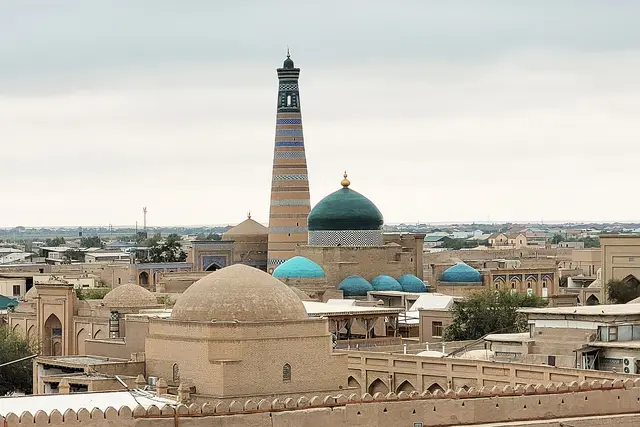
Pair it with Khiva’s walled old town, Ichan Qala, for the contrast between grand civic architecture and ordinary domestic building. Half a day covers both if you start in Urgench in the morning and move on to Khiva by early afternoon.
Frequently asked questions
What are the opening hours for Ulli Hovli?
It's listed as open 24 hours every day, but this reflects a residential-style compound with a caretaker rather than staffed museum hours. Treat it as a daytime visit rather than something to see after dark.
When is the quietest time to visit?
On weekends the calmest window is 7am to 9am. Crowds build through the day and peak between 11am and 11pm on Saturdays and Sundays, so aim to arrive before 11am if you're coming on a weekend.
How do I get to Ulli Hovli from central Urgench?
There's no direct bus or metro line, so a taxi is the practical option. It's a short ride from downtown Urgench or Urgench International Airport into the residential mahalla where the compound sits.
How much time should I plan for the visit?
Most visitors spend 30 to 45 minutes walking the courtyard and rooms. It's a compact site, easy to combine with other stops in a single morning or afternoon.
What else is nearby worth seeing?
Khiva's walled old town, Ichan Qala, is about 30-35 minutes away and pairs naturally with Ulli Hovli as a contrast between grand civic architecture and traditional domestic building.
Plan your trip to Urgench
Some links above are affiliate links — if you book through them, Wander Atlas earns a small commission at no extra cost to you. It's how we keep every guide free.