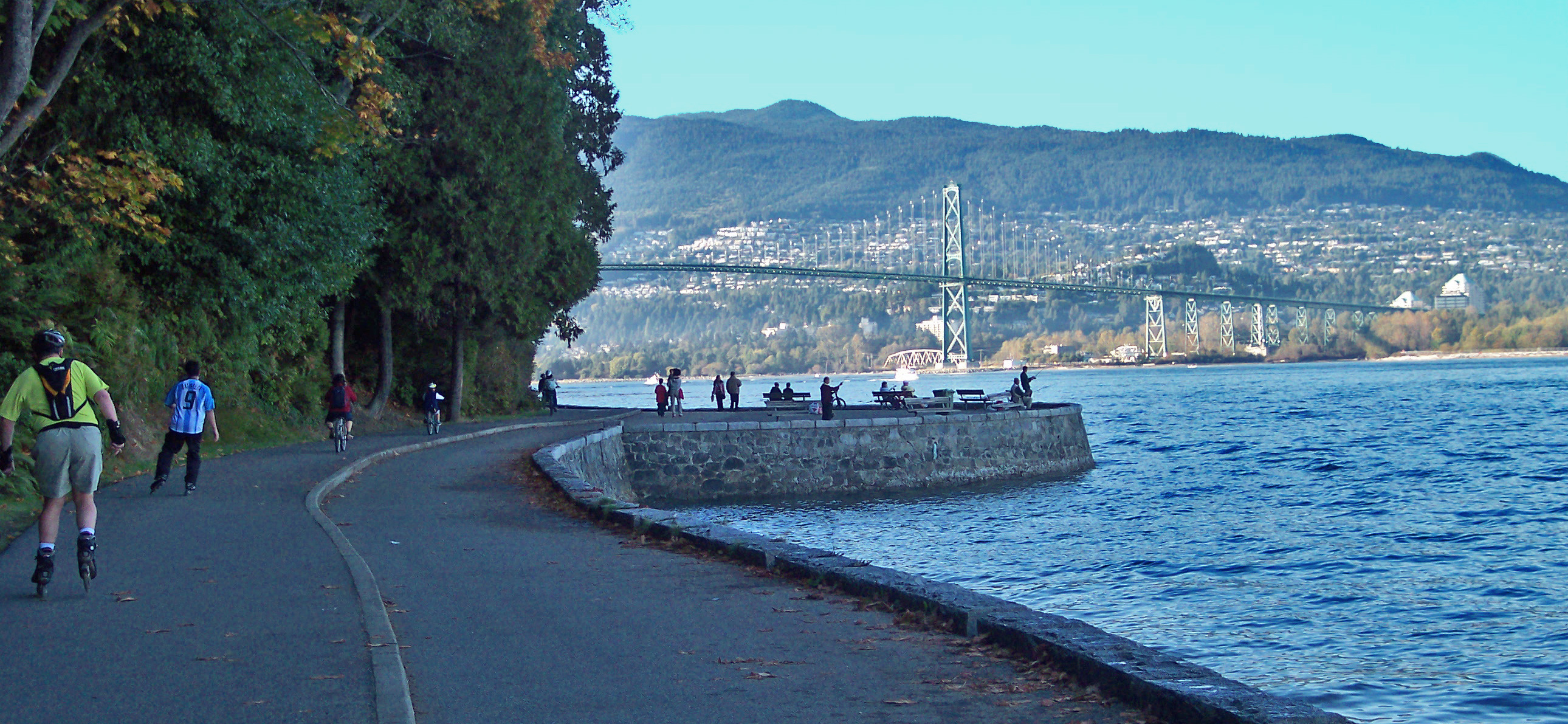
A race with the ocean on one side
The seawall is the whole point. On one side is a stone wall at the water’s edge, and on the other the cedar and fir of Stanley Park climb away from the path. The Vancouver Historic Half Marathon runs on this paved shoreline route on Sunday, November 29, 2026.
There are three distances: a 5K, a 10K and a half marathon. Each one keeps you beside the water rather than out on city streets. The organiser’s official site has the course map, start details and registration.
Three distances, one shoreline
The seawall loop around Stanley Park is roughly 9 km. That means the 5K and 10K are run on part of the loop, and the half marathon needs more distance than one lap gives. The official course map shows exactly how each route is laid out.
These are the landmarks along the full loop:
- Brockton Point, with its small lighthouse and the totem poles nearby
- Lions Gate Bridge, which you pass under on the north side of the park
- Siwash Rock, a sea stack standing just off the western shore
- Third Beach and Second Beach, facing English Bay
The path is mostly flat. Its long, open stretches make it a popular course for runners chasing a personal best.
Reaching Stanley Park on race morning
Stanley Park sits at the northwest tip of downtown, and SkyTrain doesn’t run into it. Most runners come from the Burrard or Waterfront stations on the Expo Line. From there it’s a flat walk along Coal Harbour to the park’s eastern edge, which works as a warm-up.
TransLink buses also reach the park entrance near Lost Lagoon. Inside the park, parking is paid through the Vancouver Park Board’s meters and app, with rates posted at the machines. On race morning the lots near the start usually fill first, so many locals walk, cycle or take transit in.
Plenty of visitors stay in the West End, around Denman Street or Robson Street. From there you can walk to the start in a few minutes.
Running the seawall in late November
Late November is Vancouver’s rainy season. Daytime temperatures usually sit in single digits Celsius and the sky is often low and grey. Stretches of the seawall get no shelter from wind off the water, especially on the western side facing English Bay.
Experienced local runners typically go with:
- A light waterproof shell or a throwaway layer for the start
- Gloves and a cap or headband
- Shoes with decent grip, since wet pavement and fallen leaves can be slippery
- Dry clothes in a bag for after the finish
The days are short this time of year, and the light starts fading by mid-afternoon. Morning races finish well before that.
How the seawall works on race day
The seawall is a shared path all year, and on race morning it also has a race running on it. Year-round, the walkway is separated from a bike lane, and cyclists ride it one way, counterclockwise. During an event, marshals and signs show which sections belong to runners.
For spectators and finishers, a few things help:
- Supporters usually cheer from the grass and viewpoints rather than on the path itself.
- Coal Harbour and the stretch near English Bay are easy for families to reach on foot.
- Contactless card payment is standard at cafés and concessions in and around the park.
- People walking their dogs and early cyclists still use the area, so a quick “on your left” counts for a lot.
Canadians are generous with cheering at small community races. Calling out a runner’s bib number or the name printed on it gets a real reaction.
After the finish line
Once you have your medal, the West End is right there. Denman Street has a run of casual places to eat and warm up within a short walk of English Bay. Many finishers head straight there for something hot.
If your legs can take more walking, Lost Lagoon is at the park’s eastern edge. The Vancouver Aquarium is inside the park near Brockton Point. On clear days, Prospect Point looks out over the Lions Gate Bridge toward the North Shore mountains.
For a slower afternoon, Coal Harbour’s waterfront path heads back toward Canada Place. Floatplanes take off from the harbour there.
Frequently asked questions
When is the Vancouver Historic Half Marathon in 2026?
It takes place on Sunday, November 29, 2026, around the Stanley Park seawall in Vancouver.
What distances are offered?
There are three distances: a 5K, a 10K and a half marathon. All of them are run on the Stanley Park seawall. The organiser's official site has the course maps.
How do I get to the start at Stanley Park?
Most runners take the SkyTrain Expo Line to Burrard or Waterfront station, then walk along Coal Harbour to the park. Buses run to the park entrance near Lost Lagoon. Parking inside the park is paid through Vancouver Park Board meters, with rates posted at the machines.
What is the weather like for a late-November race in Vancouver?
It's usually cool and often wet, with daytime temperatures in single digits Celsius and wind off the water on exposed parts of the seawall. Runners typically wear a light waterproof layer and gloves, and bring dry clothes for afterwards.
What is there to do nearby after the race?
The West End's Denman Street and the English Bay beach are a short walk away. Inside Stanley Park you'll find Lost Lagoon, the Brockton Point totem poles, Prospect Point and the Vancouver Aquarium.
Plan your trip to Vancouver
Canada eSIM & staying connected →
Some links above are affiliate links — if you book through them, Wander Atlas earns a small commission at no extra cost to you. It's how we keep every guide free.
Related guides
 event
Astra Lumina Light Festival: Dates, Tickets & Venue (Vancouver)
 event
Big Elf Run: Dates, Tickets & Venue (Vancouver)
 event
BOYNEXTDOOR Concert (Queen Elizabeth Theatre): Dates, Tickets & Venue (Vancouver)
 Ended