Arena di Verona Opera Festival: What to Know (Verona)
When to visit Italy: month-by-month weather, crowds and holidays →
How this guide is made
Produced with AI assistance and reviewed against live data sources. Facts such as hours, ratings, and location come from Google Places; images are licensed or public domain. Details can change — please verify before visiting. Editorial policy
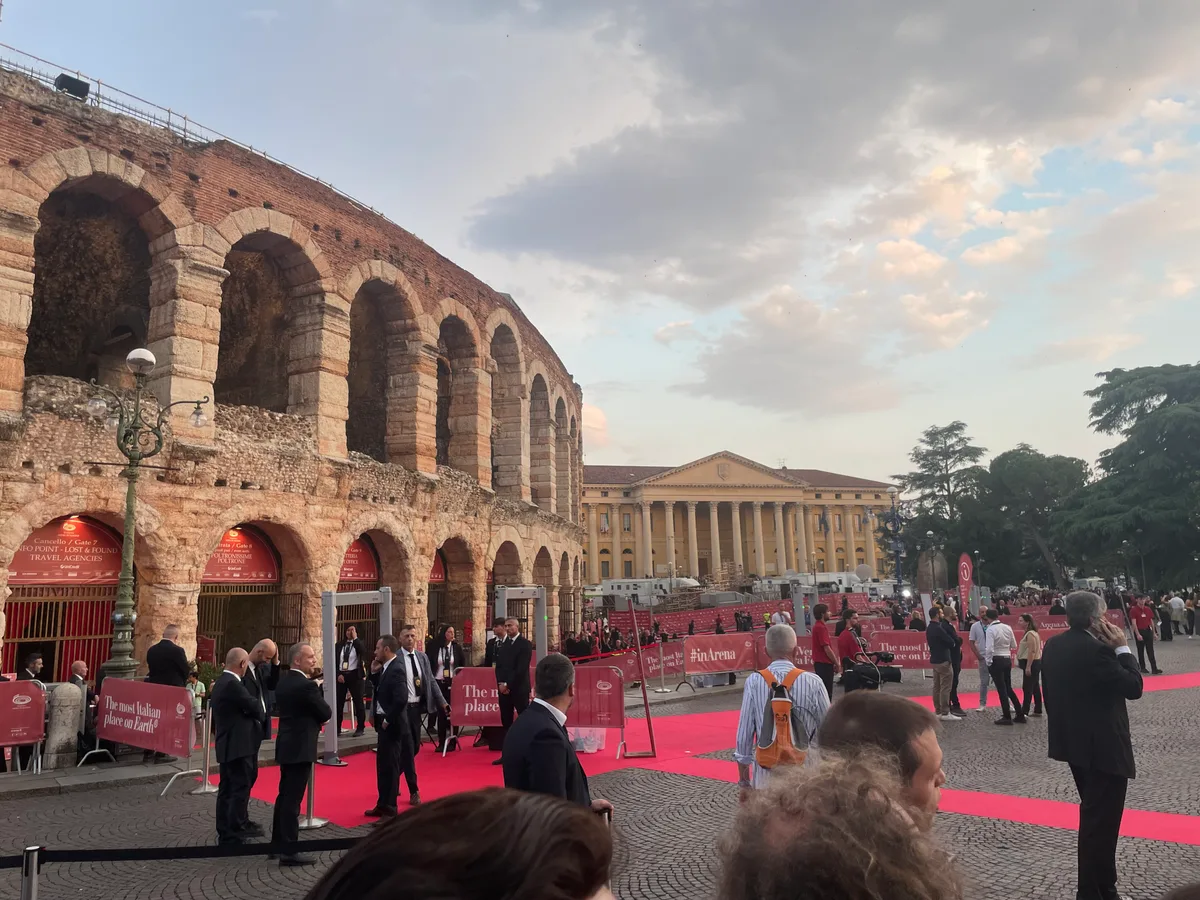
You feel it before you see it: the low murmur of a crowd gathering on pink-hued cobblestones, cushions tucked under arms, as the sun drops behind the rooftops of Piazza Bra. Then the amphitheatre itself comes into view, tiers of pale limestone stacked in a vast oval, worn smooth by nearly two thousand years of use. This is the Arena di Verona, and for one of Italy’s great summer traditions, it becomes an opera house without a roof.
Why go
Few opera experiences anywhere compare to hearing a full orchestra and chorus fill a Roman amphitheatre built in the 1st century AD. The scale is the point: sets for Aida can include full-size columns and processions of performers, voices rising unamplified (for the most part) into open air, with the night sky as a backdrop instead of a gilded ceiling.
This was the 103rd edition of the festival, spread across the summer months, with multiple titles in rotation: Turandot, Nabucco and La Traviata alongside Aida.
Getting there
The Arena sits directly on Piazza Bra, in the heart of Verona’s historic center, an easy walk from Verona Porta Nuova train station, roughly 15-20 minutes on foot, or a short bus ride into the pedestrianized old town. Coming from Venice, Milan or Bologna, Verona is a straightforward stop on the main rail lines, which makes a day-trip-plus-evening-performance itinerary very doable.
The whole area around the amphitheatre is pedestrian-only in the evenings, so the final stretch is on foot however you reach town.
What to expect inside
Seating ranges from the numbered stone steps (the gradinata, where cushion rental is customary and the view is still remarkably good) up to reserved chairs closer to the stage. Performances are long by design: a full opera with intervals can easily last three-plus hours, and they begin once dusk has properly settled, since the productions rely on stage lighting against a dark sky.
A layer helps even in summer; stone holds the day’s heat but the night air over an open-air bowl cools quickly once the sun is fully down. Binoculars earn their space for anyone seated higher up the tiers, since the stage sits a long way below the upper rows.
When to go
With the festival spanning June through mid-September, both early and late summer dates carry appeal. Early in the season there is longer daylight before curtain and the nights are warmer; by September, evenings are cooler and the crowds in Verona overall tend to thin slightly compared to peak July and August tourist season. The lineup of which opera played on which night rotated throughout the 2026 edition, so each title had its own set of dates.
How to visit like a local
Regular festival-goers buy the unnumbered stone-step seating and bring or rent a cushion at the entrance. It’s a far more comfortable few hours than the bare stone suggests, and it’s how generations of Veronese have watched opera here. Doors typically open a couple of hours before showtime, and locals use that window to grab a pre-opera bite at one of the trattorias ringing Piazza Bra rather than rushing in, since the stone seats fill gradually rather than all at once.
Payment for tickets and most nearby restaurants is standard card/cash Italian practice, nothing opera-specific there. The etiquette to know: audiences settle into their seats before the lights dim, and flash photography is out once the performance begins. First-timers most often underestimate the evening chill and the length of the program.
Tickets and the schedule
Opera dates at the Arena rotate between titles across a season, and ticket categories, curtain times and prices shift from year to year. For the 103rd edition, four titles — Aida, Turandot, Nabucco and La Traviata — were spread over the June 12 to September 12 run, each with its own dates, and seating was sold from the unnumbered stone steps up to reserved chairs near the stage.
Frequently asked questions
How long does the festival run in 2026?
The 103rd edition was set for June 12 through September 12, 2026, with different operas rotating through the schedule.
How do I get to the Arena from the train station?
Verona Porta Nuova station is about a 15-20 minute walk to Piazza Bra, where the Arena is located, or a short local bus ride into the pedestrianized center.
How long does a typical performance last?
Full productions like Aida or Turandot commonly last three hours or more including intervals, so finishes are late.
What should I bring for the stone-step seating?
A cushion, rentable at the venue, is standard for the unnumbered stone steps, and a light jacket suits the evenings, which cool off after sunset even in summer.
Where can I check the exact program and buy tickets?
Tickets for the 103rd edition were sold through the Arena di Verona's own festival ticketing, in categories from stone steps to reserved chairs, with Aida, Turandot, Nabucco and La Traviata rotating by date.
Plan your trip to Verona
Some links above are affiliate links — if you book through them, Wander Atlas earns a small commission at no extra cost to you. It's how we keep every guide free.