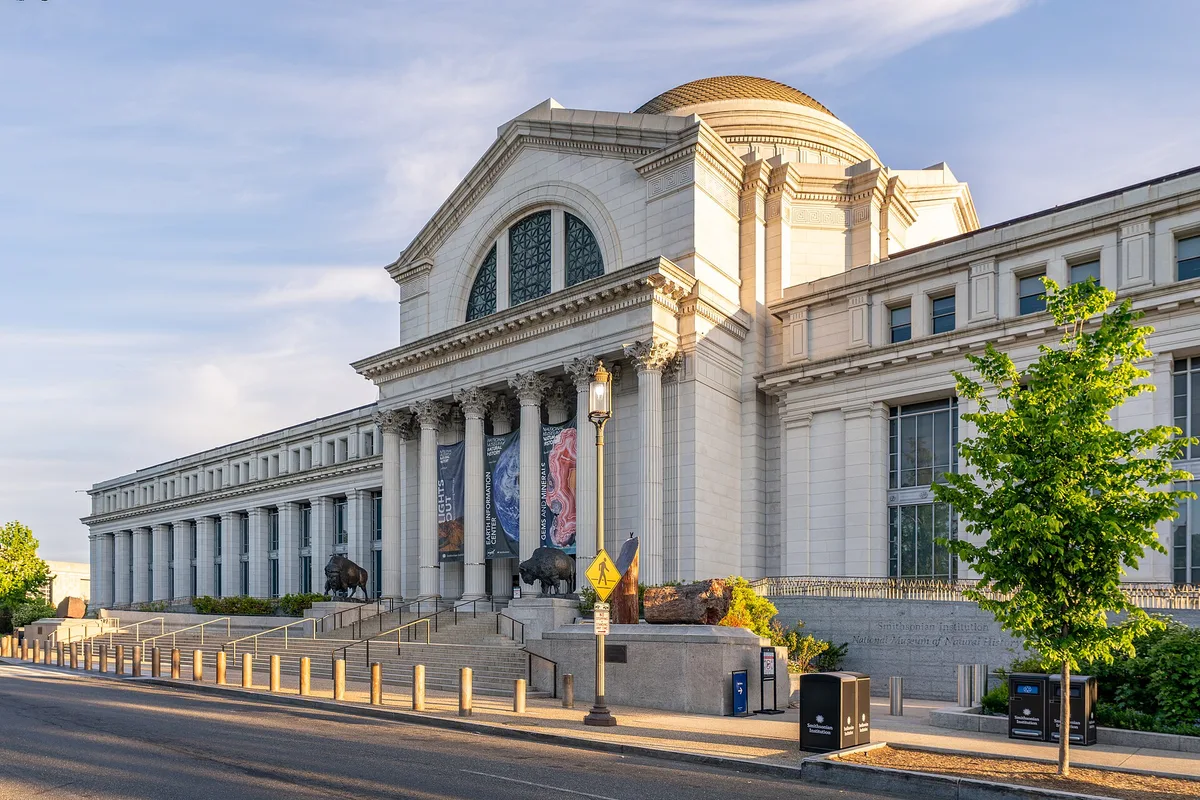
You feel the scale of this place before you even read a label. Under the rotunda, a 13-foot African bush elephant faces the entrance, tusks curved, standing on a base that’s been there since 1959. It’s the kind of first impression that tells you exactly what the Smithsonian National Museum of Natural History is about: big, old, and unapologetically full of stuff.
This is one of the most-visited museums on earth, and the crowds are real. Weekday mornings right at opening are your best shot at quiet galleries, the crowd data pegs 10am to 11am as the calmest stretch, both on weekdays and weekends. By noon on a Saturday, the halls thicken fast and stay busy until closing at 5:30pm.
Getting there
The museum sits on the National Mall at 10th Street and Constitution Avenue NW, wedged between the National Museum of American History and the National Gallery of Art’s Sculpture Garden. The closest Metro stop is Smithsonian station on the Blue, Orange, and Silver lines. Take the Mall exit and walk east about ten minutes. Federal Triangle, on the same three lines, works almost as well and drops you a block closer to Constitution Avenue.
Street parking around the Mall is scarce and metered; most visitors take the train or walk from a downtown hotel. There’s no general admission fee. It’s free every day, same as most Smithsonian museums.

What to see
Give yourself two to three hours minimum; a full visit with kids in tow can easily stretch past four.
- Fossil Hall – Deep Time: a dinosaur wing with mounted skeletons, plus fossils tracing 3.7 billion years of life.
- Hope Diamond: a famous blue diamond anchors the Harry Winston Gallery, alongside a rotating cast of rare gems and minerals.
- Ocean Hall: a 45-foot North Atlantic right whale model hangs overhead, with tanks and specimens covering deep-sea life.
- Butterfly Pavilion: a living exhibit that may require a separate ticket, worth checking current details at the museum’s info desk.
- Objects of Wonder and the Mammal Hall: quieter rooms that reward visitors who wander past the headline exhibits.
The building itself, a Beaux-Arts limestone landmark finished in 1911, is worth a slow look too, the rotunda’s dome and marble columns feel more like a cathedral than a museum lobby.
When to go
Every day runs the same hours, 10am to 5:30pm, so there’s no early or late day to chase. What matters more is which hour you arrive. Weekday mornings between opening and 11am are consistently the quietest; weekend afternoons from noon to 5pm are the busiest stretch of the week.
If you’re visiting in spring during cherry blossom season or over summer break, expect the busy window to start even earlier and last longer. Winter weekdays, outside school holidays, are your best bet for a near-empty rotunda.
How to visit like a local
Arrive right at 10am on a weekday and head straight for the Fossil Hall or Hope Diamond before tour groups arrive, both draw the thickest lines by midday. Because this museum is genuinely one of the most popular stops on the Mall, don’t expect a secret entrance or a hidden hour; the smart move is timing, not avoidance.
Security screening at the door means bags get checked, so travel light to skip the bottleneck. There’s no ticket to book and no admission fee, so the only real cost is your time. Budget it wisely. Most visitors pair this museum with the American History or Air and Space museums next door, so if you’re museum-hopping, hit Natural History first while it’s calm and save the others for the afternoon crush.
Food inside is cafeteria-style and pricier than the neighborhood; a lot of locals bring a snack or duck out to the food trucks lining Constitution Avenue instead. Restrooms and coat check are near the rotunda, use them before diving into the exhibit wings, since the museum’s layout sprawls across two floors and doubling back eats up time.
Frequently asked questions
Is the Smithsonian National Museum of Natural History free?
Yes, general admission is free every day. Some special exhibits, like the Butterfly Pavilion on non-Tuesday days, may have a small separate ticket — check at the info desk.
What time is the museum least crowded?
Data shows 10am–11am is the quietest window, both on weekdays and weekends. Avoid weekend afternoons from noon to 5pm, which are consistently the busiest.
How do I get there by Metro?
Take the Blue, Orange, or Silver line to Smithsonian station and walk about ten minutes east, or to Federal Triangle station, a block closer to the museum entrance on Constitution Avenue.
How long should I plan to spend inside?
Budget two to three hours for the highlights — Fossil Hall, Hope Diamond, and Ocean Hall. Families or those wanting a full look at every wing should allow four hours or more.
What's nearby if I want to combine museums?
The National Museum of American History and the National Gallery of Art's Sculpture Garden are both immediate neighbors on the Mall, easy to add to the same day.
Plan your trip to Washington DC
United States eSIM & staying connected →
Some links above are affiliate links — if you book through them, Wander Atlas earns a small commission at no extra cost to you. It's how we keep every guide free.
Related guides
 attraction
 National Mall: Washington DC Travel Guide
 attraction
 United States Botanic Garden: Washington DC Travel Guide
 attraction
 Lincoln Memorial: Washington DC Travel Guide (4.8★)
 restaurant