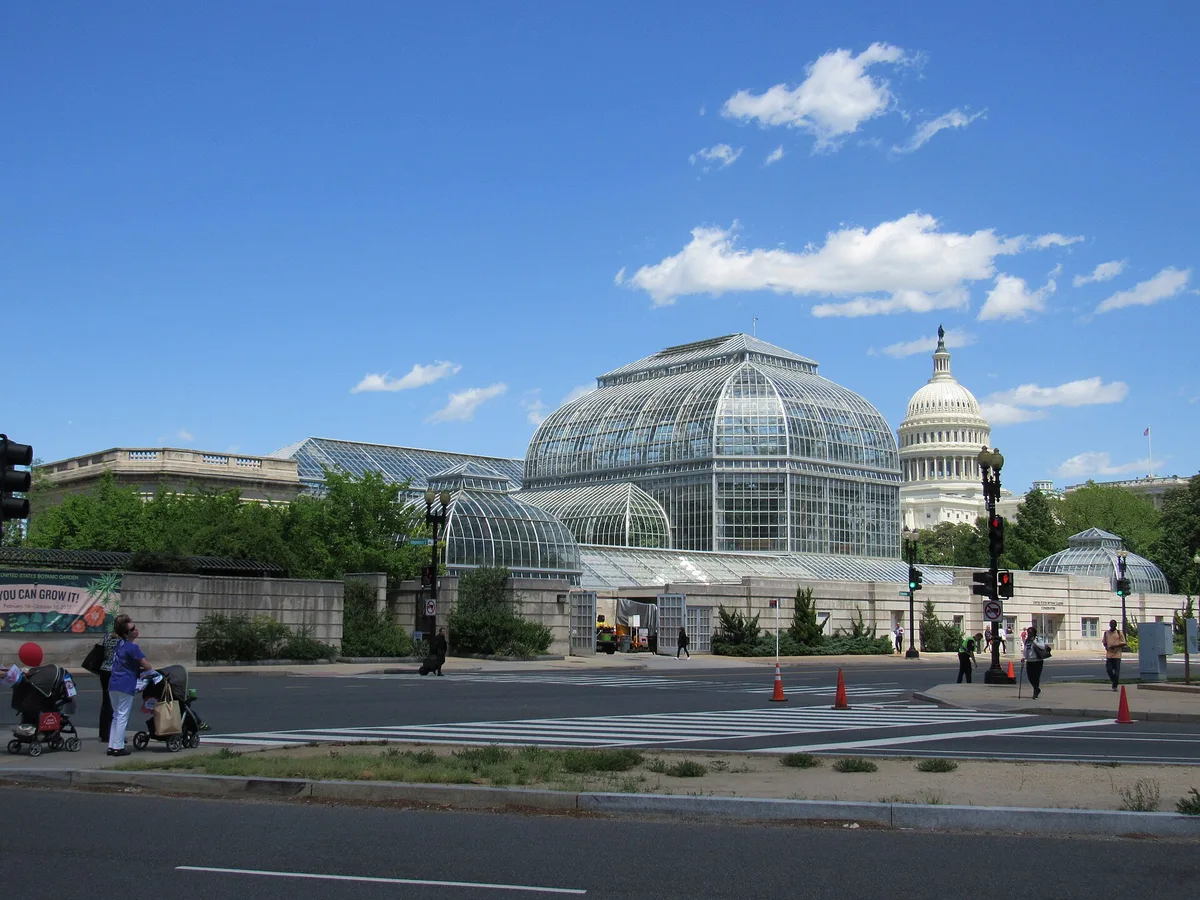
You come off the National Mall expecting more grass and gravel paths, and instead find a Victorian-style glasshouse standing right against the Capitol grounds, its steel-ribbed dome visible from the Capitol Reflecting Pool. That’s the Conservatory, the heart of the United States Botanic Garden, and it’s easy to miss if you’re focused on the museums further up the Mall.
Finding the entrance on Maryland Avenue SW
The garden’s address is 100 Maryland Ave SW, wedged between the Capitol and the Mall’s western lawns. The nearest Metro is Federal Center SW on the Blue, Orange, and Silver lines, a short walk north.
If you’re coming from the Smithsonian museums, it’s a flat 10-15 minute stroll east along the Mall. There’s no dedicated visitor parking lot, so Metro or a walk from a nearby garage is the practical option.
Inside the glasshouse
Step through the doors and the temperature and humidity jump immediately: the Conservatory is divided into distinct rooms, each holding its own climate. The Jungle room has a two-story canopy walk that puts you eye-level with palm fronds and epiphytes clinging to tree trunks.
Elsewhere you’ll find a Desert room thick with cacti and succulents, a Medicinal Plants room organized by what each species treats, and an Orchid house rotating its display so there’s usually something in bloom. The Rare and Endangered Species room is smaller and easy to walk past, but worth slowing down for: it holds plants that are extinct or nearly gone in the wild.
The butterfly garden’s short season
Just outside the Conservatory, the outdoor Butterfly Garden is planted specifically to attract pollinators, with milkweed, coneflower, and other nectar plants chosen for the purpose. It’s most active in the warmer months when the plants are flowering and butterflies are actually working the beds.
Come in winter and the garden itself still stands, but you won’t see the same activity. Check the season before you build your visit around it.

Beating the weekend crush
This is one of the most visited botanical gardens in the country, and weekends show it. Crowd patterns here are clear: weekdays stay manageable across the full 10am-5pm day, but weekends spike hard from noon to 5pm.
If you’re visiting on a Saturday or Sunday, arrive right at opening and use the 10-11am window before the midday surge. A weekday visit at almost any hour is your easiest bet if your schedule allows it.
- Weekday: quiet all day, 10am-5pm
- Weekend early: 10am-11am is calmest
- Weekend to avoid: noon-5pm gets busy
The National Garden and its rooftop view
West of the Conservatory, the outdoor National Garden includes a Rose Garden, a Regional Garden of Mid-Atlantic natives, and a First Ladies Water Garden with a circular reflecting pool. It’s a good spot to decompress after the Conservatory’s warm, humid air.
Don’t skip the Conservatory’s rooftop garden if it’s open during your visit; it’s a smaller space but gives you a rare elevated look back toward the Capitol dome. Staff can tell you at the entrance whether it’s accessible that day.
Reading the plant labels like a horticulturist
Every specimen in the Conservatory carries a small label with its common name, scientific name, and native region, the same system botanic gardens worldwide use. Take the time to read a few in each room; it’s the fastest way to understand why the Jungle room’s canopy looks so different from the Desert room’s ground-level sprawl.
Photography is generally welcome throughout, though tripods can be awkward in the narrower jungle walkways during busy hours. If a room feels crowded, loop back to it later in your visit rather than fighting through; the layout is compact enough that backtracking costs you almost no time.
Planning around the free admission
There’s no admission fee, which is part of why it draws such steady foot traffic year-round. That also means there’s no ticket line to manage, but it removes the usual crowd-control mechanism, so timing your visit matters more than booking ahead.
Budget 60 to 90 minutes to see the Conservatory rooms and the National Garden without rushing. Pair it with a walk to the nearby Capitol grounds or a longer Mall itinerary, since it sits close enough to fold into either without much extra travel time.
Frequently asked questions
Is the United States Botanic Garden free to visit?
Yes, admission is free every day, with no tickets required. It's open daily from 10am to 5pm.
When is the quietest time to visit?
Weekdays stay calm throughout the 10am-5pm day. On weekends, arrive between 10am and 11am before the midday crowds build.
What's the nearest Metro station?
Federal Center SW, served by the Blue, Orange, and Silver lines, is a short walk from the garden's entrance on Maryland Avenue SW.
How long should I plan for a visit?
Most visitors spend 60 to 90 minutes seeing the Conservatory rooms and the outdoor National Garden without rushing.
Is the butterfly garden worth visiting in winter?
Not particularly. The outdoor Butterfly Garden is most active in warmer months when its nectar plants are flowering and attracting pollinators.
Plan your trip to Washington DC
United States eSIM & staying connected →
Some links above are affiliate links — if you book through them, Wander Atlas earns a small commission at no extra cost to you. It's how we keep every guide free.
Related guides
 attraction
 Smithsonian National Museum of Natural History: Washington DC Travel Guide
 attraction
 National Mall: Washington DC Travel Guide
 attraction
 Lincoln Memorial: Washington DC Travel Guide (4.8★)
 hidden gem