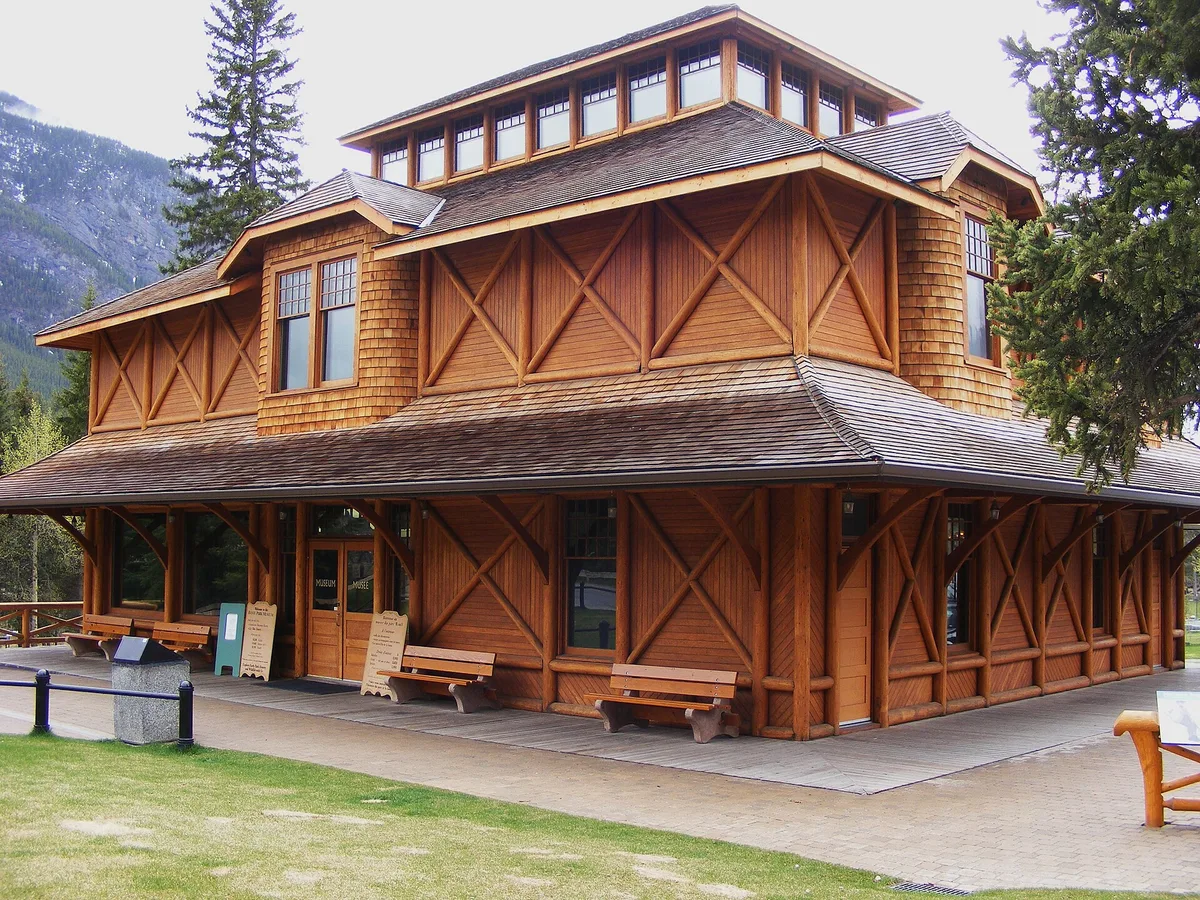
A timber pagoda where Banff Avenue ends
Walk south down Banff Avenue and the shops run out at the river. Just before the Bow River Bridge, set back among trees on the edge of Central Park, there is a building that looks nothing like the rest of the street. It is dark timber, built in layers, with flared rooflines that people often call “railway pagoda” style.
It went up in 1903, and it is the oldest natural history museum in western Canada. It is also a National Historic Site, protected for the building itself as much as for what is inside. It is small and easy to walk past on the way to the bridge, and plenty of people heading for Cascade Gardens do exactly that.
Inside the wooden hall
The interior is all wood. Varnished Douglas fir covers the walls and ceiling, and an upper gallery runs around the main hall. Light comes in from above, which is how museums were lit before electric display lighting was the norm.
The cases are the old-fashioned kind: glass fronts in wooden frames, packed tight with specimens and handwritten-style labels. Expect:
- Large mammals of the Rockies, including bears, elk and bighorn sheep
- Smaller mammals such as marmots, pikas and weasels
- Cabinets of mounted birds, grouped by type
- Rock, mineral and insect displays in drawers and cases
Nothing here is interactive. The building is the exhibit as much as the animals are.
Taxidermy as a time capsule
This is a museum of a museum. Most of the collection was gathered in the early twentieth century, when the job of a park museum was to catalogue everything that lived in the park. Norman Sanson, the curator for decades, built up much of it. He is the same man remembered for walking up Sulphur Mountain to read the weather station.
So read the cases two ways. One is natural history: you can study a grizzly or a mountain goat at arm’s length, which you should never do in the wild. The other is how people thought about parks back then. Predators were culled in that era, and the way the animals are shown reflects it. Parks Canada’s interpretation is open about how wildlife thinking has changed since.
Getting there on foot, by bus or by car
From anywhere downtown, walk. The museum is at the south end of Banff Avenue, so most hotels and restaurants on the main street are a few minutes away. Look for the trees and the timber roof just before the bridge.
Roam Transit buses run along Banff Avenue if you are staying further out, on Tunnel Mountain or near the Banff Springs Hotel. Driving from Calgary takes about 90 minutes west on the Trans-Canada Highway (Highway 1). You need a valid Parks Canada pass to stop anywhere in Banff National Park, the townsite included.
Parking in the downtown core fills up and the rules change, so check the Town of Banff parking map before you go. Many visitors park on the edge of town and walk or take the bus in.
Planning around a five-day week
The schedule catches people out. Right now the museum opens 9:30am–5pm on Monday, Thursday, Friday, Saturday and Sunday, and it is closed Tuesday and Wednesday. If your Banff trip falls midweek, plan it for the start or end of your stay.
These are this week’s hours, not fixed ones. Parks Canada sites change their schedules by season and may close on some holidays, so check the official Banff Park Museum page for this month’s times. Admission is charged. The current fee is posted there and at the door.
An hour is enough for most people. Allow longer if you read every label or come back down to the main floor after the gallery. It suits a wet afternoon well, when the trails are poor and the town is full of people with nowhere to go.
Taking your time with the cases
It is a quiet, slow room and it rewards a slow pace. A few things make the visit better:
- Talk to the Parks Canada staff. Interpreters are usually in the hall, and they know which specimens have the best stories. Ask about Sanson and how the collection was put together.
- Ask about guided tours. Parks Canada sometimes runs talks or tours here. Check at the door or online for what is scheduled.
- Go upstairs. The gallery cases get less attention than the big mammals on the ground floor, and you get a view down over the whole timber hall.
- Keep your voice down. It is one wooden room, so sound carries. People treat it more like a library than a busy attraction.
Your Parks Canada Discovery Pass may cover entry, so bring it if you have one and ask at the desk. Arriving close to 9:30am usually means a quieter hall, before people walking Banff Avenue start coming in through the day.
The river end of town
The museum makes a good starting point for this end of Banff. Cross the Bow River Bridge and walk up to Cascade of Time Garden, the terraced gardens below the Parks Canada administration building, with a straight view back up Banff Avenue to Cascade Mountain.
The Bow River trail runs along the bank right below the bridge, an easy flat walk in either direction. Central Park, next to the museum, has grass and riverside benches.
For more Rockies history, the Whyte Museum of the Canadian Rockies on Bear Street is a short walk back into town. Cave and Basin National Historic Site, where Canada’s national park system began, is about 2km west along Cave Avenue. Together with this museum, it shows how the park started.
Frequently asked questions
What days is Banff Park Museum open?
At the moment it opens 9:30am–5pm on Monday, Thursday, Friday, Saturday and Sunday, and is closed Tuesday and Wednesday. Parks Canada changes hours through the year, so check the official site for this month's schedule before you go.
How long do I need at Banff Park Museum?
About an hour covers both floors at a steady pace. Allow longer if you want to read the labels closely or talk to the Parks Canada interpreters.
Where is it and how do I get there?
It is at 91 Banff Ave, at the south end of the main street, just before the Bow River Bridge and beside Central Park. From downtown it is a short walk. Roam Transit buses run along Banff Avenue, and Calgary is about 90 minutes' drive west on Highway 1.
What will I actually see inside?
Mounted Rockies wildlife (bears, elk, bighorn sheep, small mammals and birds) in old glass-and-wood cases, mostly collected in the early twentieth century. They are displayed in a 1903 Douglas fir hall with an upper gallery. There are no interactive exhibits.
What is nearby to combine with a visit?
Cross the Bow River Bridge to Cascade of Time Garden, walk the Bow River trail from the bridge, or head to the Whyte Museum of the Canadian Rockies on Bear Street. Cave and Basin National Historic Site is about 2km west.
Plan your trip to Banff
Canada eSIM & staying connected →
Some links above are affiliate links — if you book through them, Wander Atlas earns a small commission at no extra cost to you. It's how we keep every guide free.