National Museum: Bangkok Travel Guide (4.7★)
When to visit Thailand: month-by-month weather, crowds and holidays →
✓ Facts verified via Google Places · Aug 28, 2026
At a glance
Opening hours
- Monday: Closed
- Tuesday: Closed
- Wednesday: 8:30 AM – 4:00 PM
- Thursday: 8:30 AM – 4:00 PM
- Friday: 8:30 AM – 4:00 PM
- Saturday: 8:30 AM – 4:00 PM
- Sunday: 8:30 AM – 4:00 PM
How this guide is made
Produced with AI assistance and reviewed against live data sources. Facts such as hours, ratings, and location come from Google Places; images are licensed or public domain. Details can change — please verify before visiting. Editorial policy
Why go
Most visitors come to this stretch of Rattanakosin Island for the Grand Palace and Wat Phra Kaew, snap their photos, and leave without realizing that a few hundred meters north, inside a converted 18th-century palace, sits one of Asia’s great collections of Siamese art and history. The National Museum Bangkok occupies the former Wang Na, the “Front Palace” built in 1782 for the deputy king, and that alone makes it worth the detour. You’re walking through royal architecture, not a purpose-built exhibition hall.
Inside are Buddha images spanning two thousand years, gilded funeral chariots the size of small buildings, ceremonial weapons, royal furniture, and traditional Thai musical instruments, all displayed in a series of halls and pavilions connected by open courtyards.
Getting there
The museum sits on Na Phra That Road, across from Sanam Luang, the large public field beside the Grand Palace. There’s no MRT or BTS station within easy walking distance, so most people arrive by river or road: take the Chao Phraya Express Boat to Tha Chang pier and walk about ten minutes north, or take a taxi or tuk-tuk directly to the museum gate, traffic in this old quarter can be slow, so budget extra time.
If you’re already visiting the Grand Palace or Wat Pho, it’s an easy add-on to the same half-day out, since everything sits within a 15–20 minute walk of each other.

What to see
Start in the Buddhaisawan Chapel, just inside the main entrance, where the revered Phra Buddha Sihing image sits beneath ceiling murals depicting the Buddha’s life, this alone is worth the visit even if you skip everything else. From there, the main exhibition buildings hold the museum’s chronological survey of Thai art history, moving from prehistoric Ban Chiang pottery through Dvaravati, Khmer, Sukhothai, and Ayutthaya-era sculpture.
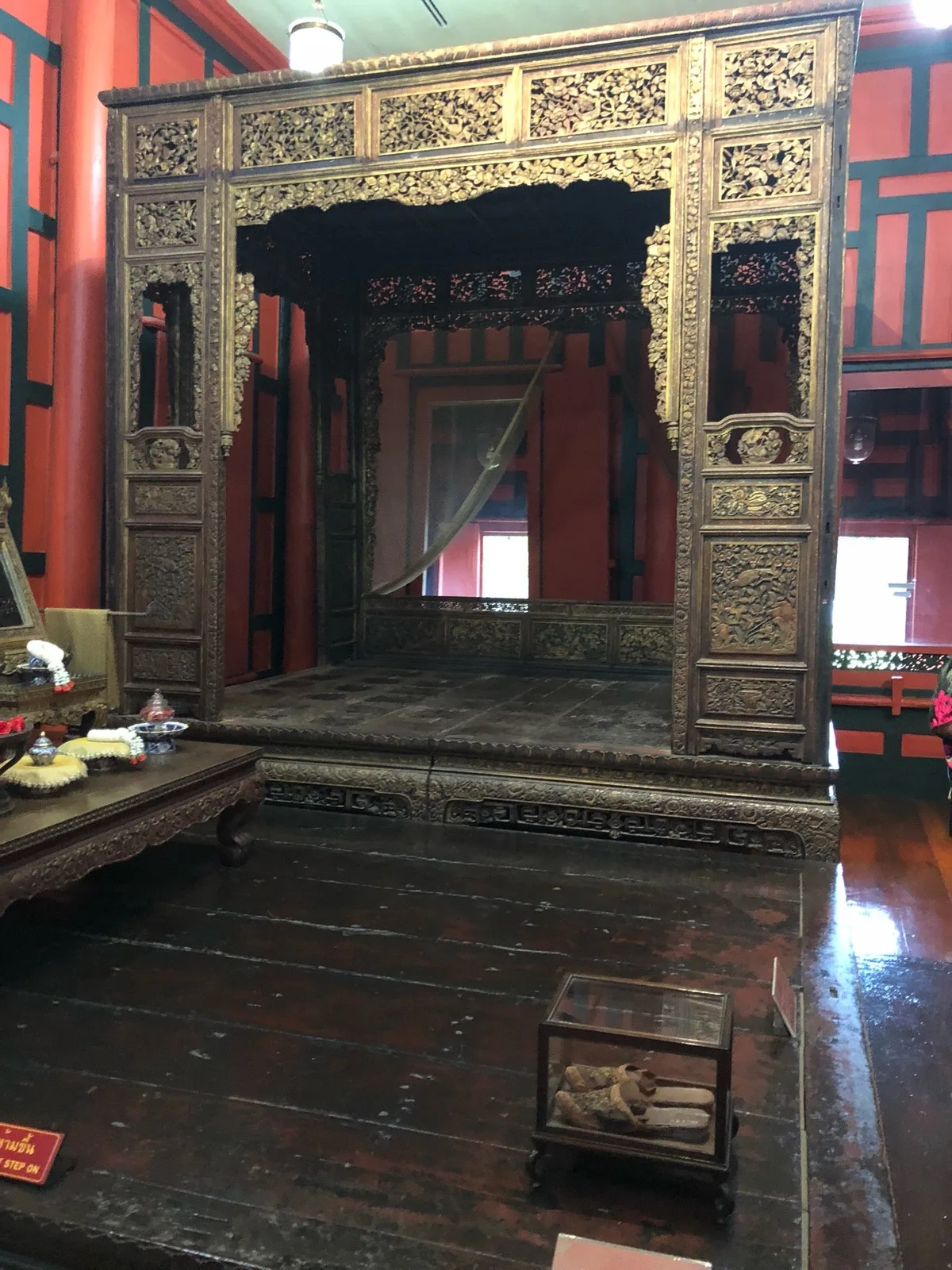
Don’t miss the Red House (Tamnak Daeng), a teak royal residence moved here from the old Grand Palace, and the Chariot Hall, where enormous gilded funeral chariots, used to carry royal remains in cremation ceremonies, tower overhead. The weapons and decorative arts galleries, full of mother-of-pearl inlay, ivory, and ceremonial regalia, round out a visit that easily fills two to three hours if you read the labels.
When to go
The museum is closed Mondays and Tuesdays, so plan your visit for Wednesday through Sunday. Free English-language guided tours have traditionally run on Wednesday and Thursday mornings, and Thai tours are more frequent. Check the schedule posted at the entrance or ask at the ticket counter when you arrive, since these can shift. Mornings are cooler and calmer than afternoons, and going earlier also means better natural light for the murals in the un-air-conditioned pavilions.
Because the buildings are spread across open courtyards, an overcast morning or one just after the midday heat breaks is far more comfortable than a midday visit in the dry season.
How to visit like a local
Dress as you would for any Thai temple or palace: shoulders and knees covered, no flip-flops if you can help it, since some halls still enforce this strictly even though it’s a museum rather than an active temple. Buy your ticket at the counter just inside the gate. This is a cash-friendly, low-tech operation, so bring small notes rather than expecting card payment throughout.
There’s no elaborate queueing system; you simply pick up a site map at the entrance and wander the courtyards at your own pace, so don’t feel obligated to follow a strict route, locals and repeat visitors tend to head straight for the Buddhaisawan Chapel and the Red House first, then loop back through the chronological galleries if time allows.
The single biggest mistake visitors make is treating this as a quick 30-minute add-on before or after the Grand Palace; the complex is large and spread outdoors between buildings, so it deserves its own unhurried half-day rather than being squeezed in at the end of a tiring temple circuit.
Frequently asked questions
How much time should I set aside?
Plan for two to three hours to see the main halls properly, longer if you take a guided tour or linger over the chronological art galleries.
What days is it open?
The museum is closed Monday and Tuesday; visit Wednesday through Sunday.
Is it worth combining with the Grand Palace?
Yes — it's a 15-20 minute walk from the Grand Palace and Wat Pho, making it an easy add-on to a Rattanakosin Island temple day.
Are there English tours?
Free English-language guided tours have traditionally been offered on Wednesday and Thursday mornings; confirm the current schedule at the entrance since timing can change.
How do I get there without a car?
Take the Chao Phraya Express Boat to Tha Chang pier and walk about 10 minutes, or take a taxi directly to Na Phra That Road, since no BTS/MRT station is within easy walking distance.
Plan your trip to Bangkok
Some links above are affiliate links — if you book through them, Wander Atlas earns a small commission at no extra cost to you. It's how we keep every guide free.
Related guides
 attraction
 The Temple of the Emerald Buddha: Bangkok Travel Guide
 attraction
 The Grand Palace: Bangkok Travel Guide
 attraction
 The Reclining Buddha: Bangkok Travel Guide
 attraction