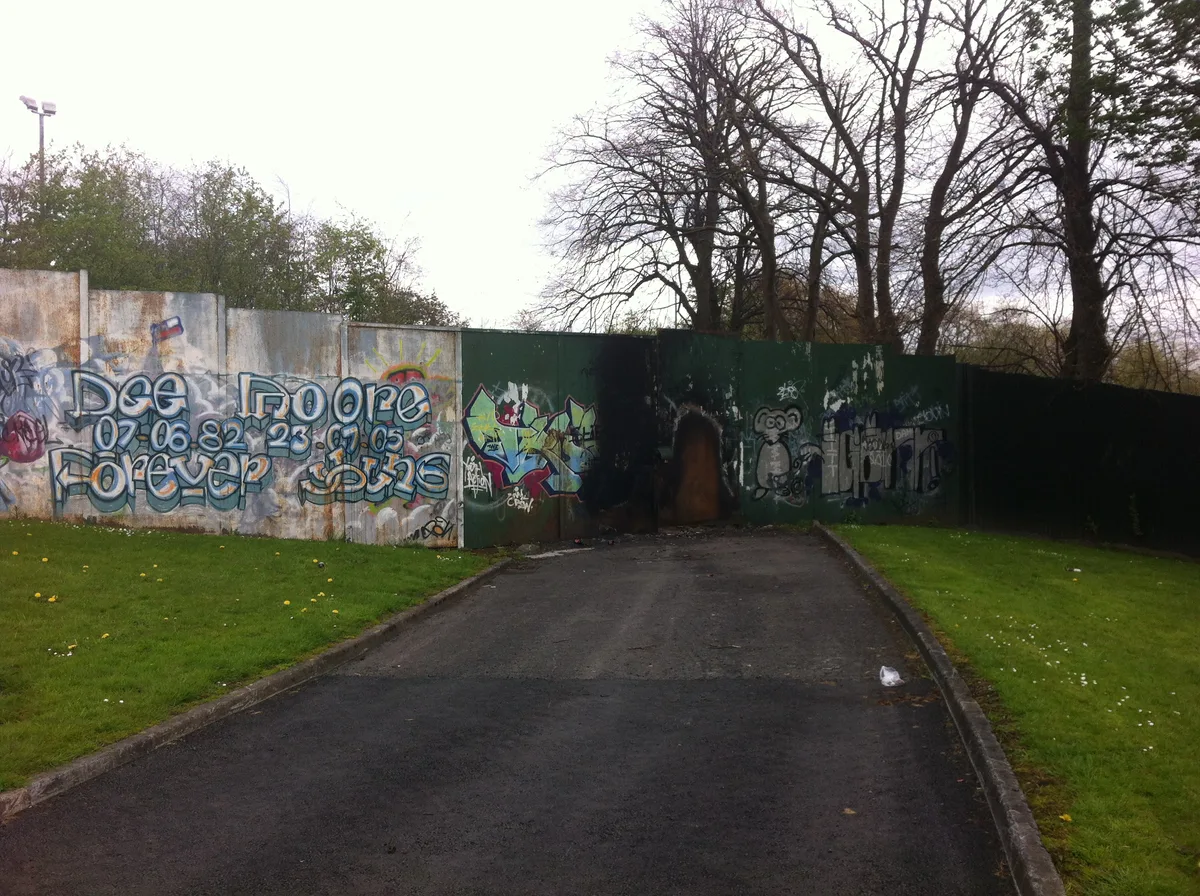
Concrete below, steel above, mesh on top
The wall is taller than the houses behind it. The base is a concrete barrier and the middle is sheet steel. Above that, tall wire mesh climbs well past the roofline of the terraces on the far side. You stand on an ordinary pavement on Cupar Way with a road beside you, and the structure blocks the whole sky to one side.
Almost every reachable surface is covered. You’ll see murals, painted slogans and thousands of handwritten messages in marker pen, layered so thickly that older ink shows through the newer writing. Most are about peace and reconciliation. Some are just names and dates from visitors who have come from all over the world.
Why a wall still divides two streets
The first barriers here went up in 1969, after the riots of that August set the start of the Troubles. They were meant to be temporary. Over the following decades the Cupar Way section was extended and raised again and again, which is why it rises in layers of different materials.
To one side is the Shankill, a mostly unionist and loyalist community. To the other is the Falls, a mostly nationalist and republican one. The 1998 Good Friday Agreement ended the large-scale violence, but the walls stayed up. Some residents still say they feel safer with them standing.
Several gates in the interface network still close at night. That’s the most direct way to understand that this is a working barrier and not a monument. Treat the listed 7am to 7pm hours as the window when the area is open and active, and plan your visit inside it.
Bring a marker: signing the wall
What the editorial summary calls “a repository for art & messages” is something you can add to. Writing on the wall is expected, and it’s the reason many people come.
- Bring your own pen. A thick permanent marker works best on the painted steel. Don’t count on buying one nearby.
- Find clear space. Low down is usually packed, so look along the less crowded stretches.
- Don’t write over someone else’s message. Writing across another person’s words or a painted mural is the one thing that reliably upsets people here.
- Keep it in the spirit of the wall. Messages of peace fit. Partisan slogans don’t.
Taxi tour drivers usually hand out pens and give each group a few minutes to write. If you came on foot, you can take as long as you like.
Getting to Cupar Way
The wall is in west Belfast, about a 20–25 minute walk from City Hall. One route goes out along Divis Street onto the Falls Road. The other goes up the Shankill Road. Either way, you pass through the mural districts on the way, so the walk is part of the visit.
The Glider G1 rapid bus runs west along the Falls Road from the city centre and saves you the walk out. From the Falls side you cut north on foot towards Cupar Way. Put “15 Cupar Way, BT13 2RX” into your map app, because the interface streets around here twist and change names.
Most visitors come on a black taxi political tour. A driver from one community, or sometimes guides from both, takes you through the Falls and the Shankill and stops here. Book ahead in summer and check the operator’s site for current prices.
Weekday mornings versus the weekend taxi rush
Crowds here follow the tour schedule. On weekdays the wall is quiet right through its open hours, from 7am to 7pm. You’ll often have long stretches of it almost to yourself.
Weekends are different. Try not to arrive between 11am and 5pm on Saturday or Sunday. That’s when the black taxis pull up in convoys and the groups stack up at the most photographed panels. If a weekend is your only option, go before 11am or in the last couple of hours before 7pm.
Walking it with respect: this is someone’s back fence
People live right behind the steel. The houses on the far side have gardens that run up to the wall, and some still have cages over the back windows. Visitors forget this more often than anything else.
- Keep your voice down and don’t climb on the barriers or the gates.
- Point your camera at the wall, not into gardens or at residents going about their day.
- Leave football shirts at the hotel. Celtic and Rangers tops carry sectarian meaning in these streets.
- Ask questions, but don’t take sides. Taxi drivers are usually happy to explain their own community’s view. Pushing a guide to condemn the other side is unwelcome.
- Pay tour drivers as their booking terms say. Many take cards, but check when you book.
If a local wants to talk, listen. If they’d rather not, leave it.
Either side of the wall
Don’t head straight back to the city centre. The streets around Cupar Way hold Belfast’s densest collection of political murals, and they read differently once you’ve stood at the wall.
- The International Wall, on the Falls Road near Divis Street, has murals that change regularly and cover causes far beyond Ireland.
- The Bobby Sands mural is on Sevastopol Street, on the side wall of the Sinn Féin office off the Falls Road.
- Clonard Monastery, just off the Falls, is a red-brick church. It played a quiet part in the back-channel talks that led to the peace process.
- Shankill Road murals show the loyalist side: paramilitary imagery, memorials, and tributes to the Somme and the British royal family.
You can walk a loop out along one road, along Cupar Way and back down the other in about two hours at an easy pace. That’s long enough to see how close the two communities sit, and how much the wall between them still shapes daily life.
Frequently asked questions
When is the quietest time to visit the Peace Wall?
On weekdays it stays quiet across the whole of its listed hours, from 7am to 7pm. On weekends, avoid 11am to 5pm, when the taxi tours bunch up. Come before 11am or late in the afternoon instead.
How do I get to the Peace Wall from Belfast city centre?
Walk about 20–25 minutes from City Hall, out along the Falls Road or up the Shankill Road. You can also take the Glider G1 bus west along the Falls Road and walk north to 15 Cupar Way. Most visitors come as part of a black taxi political tour.
Can I write on the Peace Wall?
Yes, adding a message is expected. Bring your own thick permanent marker, find clear space, and never write over someone else's message or a mural. Messages of peace fit the wall. Partisan slogans don't.
How long should I spend at the Peace Wall?
Allow 30–45 minutes at the wall itself. A walking loop that takes in the Falls Road and Shankill Road murals takes about two hours.
What is near the Peace Wall?
The International Wall and the Bobby Sands mural on Sevastopol Street are on the Falls side, along with Clonard Monastery. The Shankill Road murals are on the other side. Everything is within walking distance of Cupar Way.
Plan your trip to Belfast
United Kingdom eSIM & staying connected →
Some links above are affiliate links — if you book through them, Wander Atlas earns a small commission at no extra cost to you. It's how we keep every guide free.