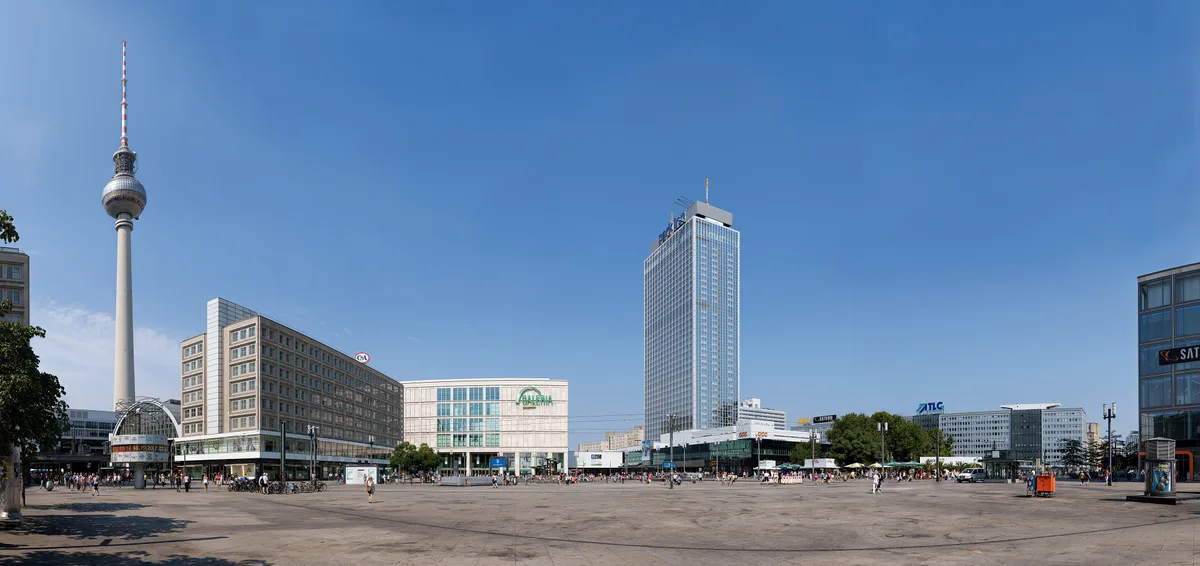
Come up the steps from the station and the square opens out flat and grey, paved edge to edge, with the TV tower’s concrete shaft standing just west of it. Trams cut across the paving with a warning bell. Berliners call the place “Alex”, and most of them are only crossing it on the way somewhere else.
It isn’t pretty and it isn’t quiet. It is one of the most heavily used places in the city, and in a small area it shows you more of Berlin’s twentieth century than almost anywhere else.
A square built twice
Alexanderplatz began as a market and parade ground outside the old city walls. It took its name from Tsar Alexander I of Russia, who visited Berlin in 1805. By the 1920s it was the busy, rough centre of working Berlin. Alfred Döblin’s 1929 novel Berlin Alexanderplatz made it famous.
The war left most of it in ruins. In the 1960s the East German government rebuilt it as a showcase of socialist modernism, much larger and emptier than before. The wide open paving you walk across today comes from that plan, and so does most of what stands around it.
One more date is worth knowing. On 4 November 1989, hundreds of thousands of people gathered here for the largest demonstration in East German history. Five days later the Wall opened.
The tower and the cross on the ball
The Fernsehturm, roughly 365 metres tall, opened in 1969. You can see it from almost everywhere in Berlin. A lift takes you up to the viewing deck and revolving restaurant inside the steel sphere.
Look at the sphere on a sunny afternoon. Sunlight on its faceted panels throws a bright cross onto the ball, a side effect the officially atheist state never intended. Berliners nicknamed it Rache des Papstes, the Pope’s revenge.
For the tower itself:
- Book a timed ticket on the official Fernsehturm website; current prices are posted there.
- Clear days are best for the view. On low-cloud days you can end up looking at the inside of a cloud.
- At ground level, the folded white entrance pavilion sits right at the tower’s base, between the station and Marienkirche.
Meet me at the World Clock
The Weltzeituhr, the World Clock, went up in 1969. It’s the square’s real meeting point. A drum on a column is marked with the world’s time zones and city names, and a simple model of the solar system turns on top. “Under the clock” is the usual thing Berliners say when they arrange to meet here.
A few steps away is the Brunnen der Völkerfreundschaft (Fountain of Friendship between Peoples), from 1970. It’s a tiered copper and enamel fountain, and in warm months people sit along its rim. Between the two, look up at these:
- Haus des Lehrers: its band of mosaic mural by Walter Womacka wraps the lower floors and shows GDR scenes of work and learning.
- Haus des Reisens: a former travel-agency block with a copper relief on its facade.
- The tall hotel tower on the square’s north side, a 1970 slab that still dominates the skyline at ground level.

Getting to and through Alex
Alexanderplatz station is one of the city’s biggest interchanges, which makes the square easy to reach from anywhere in Berlin.
- U-Bahn: U2, U5 and U8 all stop here. The U5 runs straight west under Unter den Linden towards the Brandenburg Gate.
- S-Bahn: the east–west lines on the elevated viaduct (S3, S5, S7, S9) connect you with Hackescher Markt, Friedrichstraße and Hauptbahnhof.
- Regional trains also stop on the viaduct, and several tram lines cross the square.
On foot, Museum Island is about 10–15 minutes west along Karl-Liebknecht-Straße. Hackescher Markt is a similar walk northwest, under or beside the S-Bahn arches.
Riding and walking the Berlin way
Most of what trips visitors up here comes down to transport habits.
- Validate your ticket. Berlin’s S-Bahn and U-Bahn have no barriers. A paper ticket has to be stamped in the small machines on the platform before you board, and plain-clothes inspectors fine anyone holding an unstamped one. App tickets are valid from purchase.
- Mind the tram tracks. Trams cross the open square, and they’re quieter than you’d expect. If you hear a bell, step aside.
- Stay out of the red lanes. On the surrounding pavements, cyclists use marked lanes and won’t slow down for you.
- Stand right on escalators in the station so people can walk past on the left.
- Carry a little cash. Shops and chains take cards. Snack kiosks and seasonal market stalls are more mixed, so having both covers you.
The station and square are crowded, so keep bags zipped and phones out of back pockets. The police post on the square, known as the Alexwache, is a sign of how seriously the city takes this.
Shopping, sausages and the December market
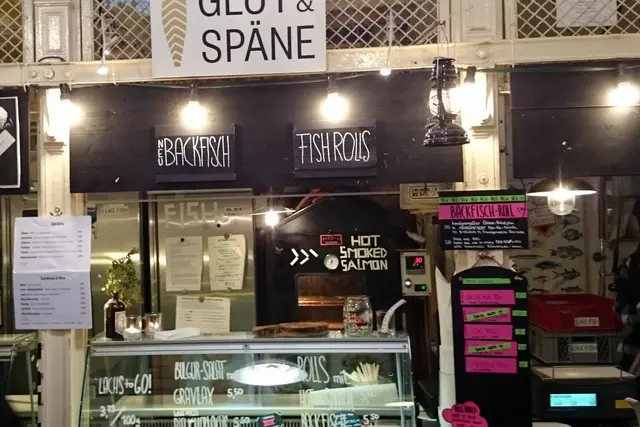
Shopping is a big reason people come. The department store on the square’s western edge and the large Alexa mall a few minutes southeast cover the basics. Snack stands near the station sell currywurst and other quick bites for people grabbing food on the move.
In December the square fills with a Christmas market: wooden huts, mulled wine and fairground rides. It’s one of the most central markets in the city, and among the busiest. Evenings are the most atmospheric, and also the most crowded.
Walking west towards the old centre
The best way to finish is to walk away from the square. Head under the S-Bahn viaduct, past the TV tower, and the city’s older layers come back.
- Marienkirche (St. Mary’s Church): a medieval brick church at the tower’s foot, among the oldest still in use in Berlin.
- Neptunbrunnen: a large bronze fountain on the open ground between the church and the Rotes Rathaus.
- Rotes Rathaus: Berlin’s red-brick town hall, home of the city’s mayor.
- Nikolaiviertel: the small, rebuilt old-town quarter just south, with narrow lanes along the Spree.
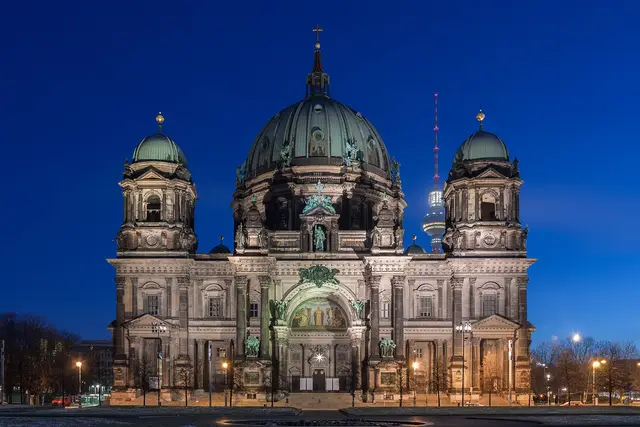
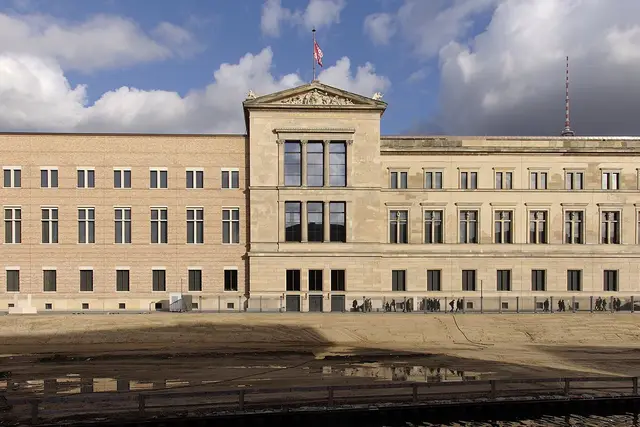
- Museum Island: just over the river, with the Berlin Cathedral and five major museums.
Taken together, that route covers about seven centuries in less than a kilometre, with Alex as the GDR-era starting point.
Frequently asked questions
How do I get to Alexanderplatz?
Take the U2, U5 or U8 U-Bahn, or the S3, S5, S7 or S9 S-Bahn, to Alexanderplatz station. Regional trains and several tram lines also stop there, and you come out directly onto the square.
How long should I spend at Alexanderplatz?
30–60 minutes covers the World Clock, the Fountain of Friendship between Peoples and the GDR-era buildings. Add a timed TV tower visit, or the walk west to Marienkirche, the Rotes Rathaus and Museum Island, and it easily fills half a day.
Do I need to book the TV tower in advance?
Booking a timed ticket on the official Fernsehturm website is the reliable option, especially on clear days and weekends. Current prices and opening times are posted there.
Is there a Christmas market at Alexanderplatz?
Yes. In December the square hosts a Christmas market with wooden stalls, mulled wine and rides. It's one of the most central in Berlin and gets very busy in the evenings.
What is nearby?
St. Mary's Church, the Neptune Fountain and the Rotes Rathaus are just west of the TV tower. Beyond them are the Nikolaiviertel and Museum Island, about 10–15 minutes on foot, and Hackescher Markt is a similar walk northwest.
Plan your trip to Berlin
Germany eSIM & staying connected →
Some links above are affiliate links — if you book through them, Wander Atlas earns a small commission at no extra cost to you. It's how we keep every guide free.