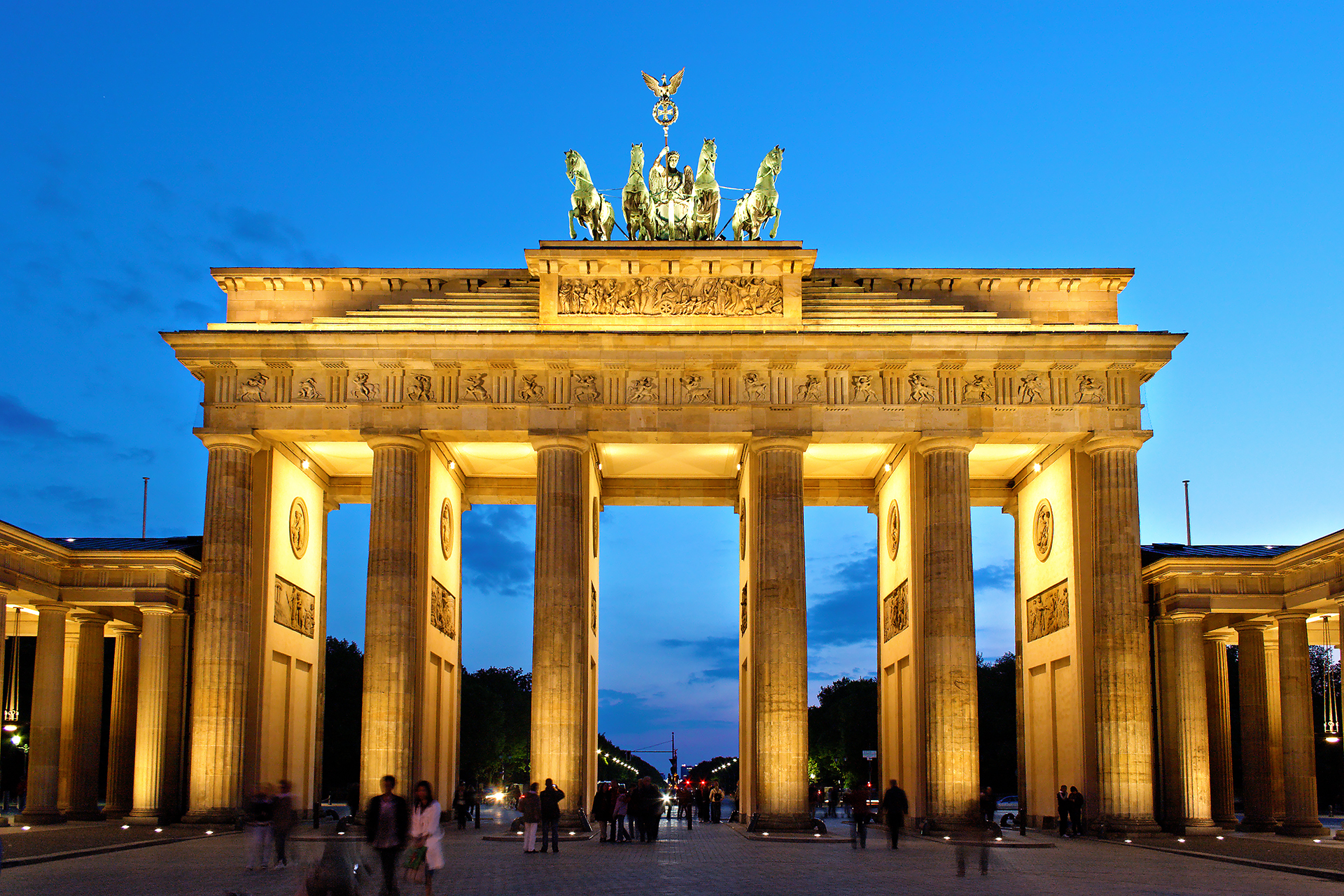
Twelve sandstone columns, six on each side, carry a flat entablature across the eastern end of the Tiergarten. On top, a goddess drives four bronze horses toward Unter den Linden. You approach across a wide cobbled square closed to traffic, with embassies and grand hotels on three sides. Nothing stands between you and the columns except other visitors.
A gate built for peace
Carl Gotthard Langhans designed it between 1788 and 1791 for the Prussian king Frederick William II. He modelled it on the Propylaea, the monumental gateway to the Athenian Acropolis. The Doric columns form five passages. The wide central one was once reserved for the royal family.
Johann Gottfried Schadow sculpted the Quadriga on top. The charioteer was first meant as Eirene, goddess of peace. That meaning did not survive long. Napoleon carted the whole group off to Paris in 1806. When it came home in 1814, the figure became Victoria, and an iron cross and Prussian eagle were added to her staff.
The gate came through the Second World War badly scarred. The Quadriga you see today was recast in the 1950s from plaster moulds of the original. The sandstone was given a full restoration between 2000 and 2002.
The Wall years, written in the pavement
From 1961 to 1989 the gate stood in the death strip, sealed off on both sides by the Berlin Wall. Nobody could walk through it. In 1987 Ronald Reagan stood on the western side and called on Gorbachev to “tear down this wall.” The gate reopened to pedestrians on 22 December 1989.
Look down on the western side of the gate. A double row of cobblestones runs through the paving and marks where the Wall once stood. Most people step over it without noticing. Standing with one foot on either side is the quickest way to make sense of the Cold War map.
Which side to stand on
The gate has two faces, and each frames a different photo.
- East side (Pariser Platz): the Quadriga faces this way, so this is the classic shot with the horses coming toward you. Morning sun falls on this side.
- West side (Platz des 18. März): the view runs along Straße des 17. Juni through the Tiergarten to the Victory Column. Late-afternoon light comes from behind you here.
- Through the central passage: stand well back on Pariser Platz and frame the Tiergarten trees through the columns.
After dark the gate is floodlit, and the square empties out a good deal. If you only have one free slot, a walk past late in the evening gives you the sandstone glowing and far fewer elbows in the frame.

Getting to Pariser Platz
Brandenburger Tor station sits right under Unter den Linden. It is served by the U5 and by the S-Bahn lines S1, S2, S25 and S26. Follow the signs for Pariser Platz and you surface a short walk east of the columns. From Berlin Hauptbahnhof it is just a few stops on the U5 or S-Bahn.
Bus 100, the double-decker that runs between Zoologischer Garten and Alexanderplatz, also passes nearby. It doubles as a cheap sightseeing ride. On foot, the gate sits at the western end of Unter den Linden, so walking from Museum Island down the boulevard brings you straight to it.
Crossing the square without getting caught out
Pariser Platz gets busy, and a few habits will keep your visit smooth.
- Costumed performers in soldier or bear outfits pose for photos and expect money afterwards. If you photograph them, you are expected to pay. A polite “nein, danke” works if you would rather not.
- Clipboard petitioners sometimes approach visitors near the big landmarks asking for signatures, followed by a donation request. Keep walking.
- Bikes and scooters do pass through, so look both ways before stepping into the central passage for a photo.
- The Raum der Stille (Room of Silence) in the northern guardhouse is a small, plain room set aside for quiet reflection. Talking and phone calls are not welcome there, and visitors keep to that.
Most cafés and shops around the square accept cards. The usual habit in German cafés is to round up the bill or add about ten percent, and you tell the server the total when paying rather than leaving coins on the table.
Tour groups tend to arrive mid-morning and stay through the afternoon, so arriving early or coming back after dinner usually beats them.
What frames Pariser Platz
The square was rebuilt after reunification, and its buildings are worth a slow lap.
- Hotel Adlon Kempinski, on the south-east corner, rebuilt on the site of the famous prewar hotel.
- The US Embassy, on the south side, and the French Embassy on the north.
- Akademie der Künste, with its glass façade, next to the Adlon.
- Max Liebermann Haus, beside the gate’s north side, named for the painter who lived there.
- DZ Bank building by Frank Gehry. It looks restrained from the street, but the atrium inside holds a curving steel sculpture.
Where to walk next
The gate works best as one stop on a loop through central Berlin. The Reichstag, with its glass dome, is a few minutes’ walk north; dome visits need advance registration on the Bundestag website. A short walk south brings you to the Memorial to the Murdered Jews of Europe, with its field of 2,711 concrete stelae.
West of the gate, the Tiergarten opens up, and Straße des 17. Juni leads to the Victory Column. East, Unter den Linden runs past the Humboldt University and the State Opera towards Museum Island.
Big events also land here. The Berlin Marathon finishes just past the gate, and the New Year’s Eve party fills the stretch towards the Victory Column. On those days access is fenced and controlled, so check the city’s event notices before planning around them.
Frequently asked questions
How do I get to the Brandenburg Gate by public transport?
Take the U5 or the S-Bahn (S1, S2, S25 or S26) to Brandenburger Tor station and follow the signs for Pariser Platz. Bus 100 also stops nearby on its route between Zoologischer Garten and Alexanderplatz.
Can I visit the Brandenburg Gate at night?
Yes. It stands on an open public square with no gate or ticket, so you can walk through at any hour. It is floodlit after dark, and late evening is one of the calmest times to see it.
How long should I spend there?
Allow 30 to 45 minutes for the gate, the Wall cobblestone line and a lap of Pariser Platz. Add an hour or two if you go on to the Reichstag and the Memorial to the Murdered Jews of Europe, which are both a short walk away.
When is the best time for photos without crowds?
Early morning is best, before the tour groups arrive, and morning light falls on the Quadriga side facing Pariser Platz. Late evening is the other good option, when the gate is lit up and the square is quieter.
What else is within walking distance?
The Reichstag is just north and the Holocaust Memorial just south. The Tiergarten and the Victory Column are to the west, and Unter den Linden leads east to Museum Island.
Plan your trip to Berlin
Some links above are affiliate links — if you book through them, Wander Atlas earns a small commission at no extra cost to you. It's how we keep every guide free.