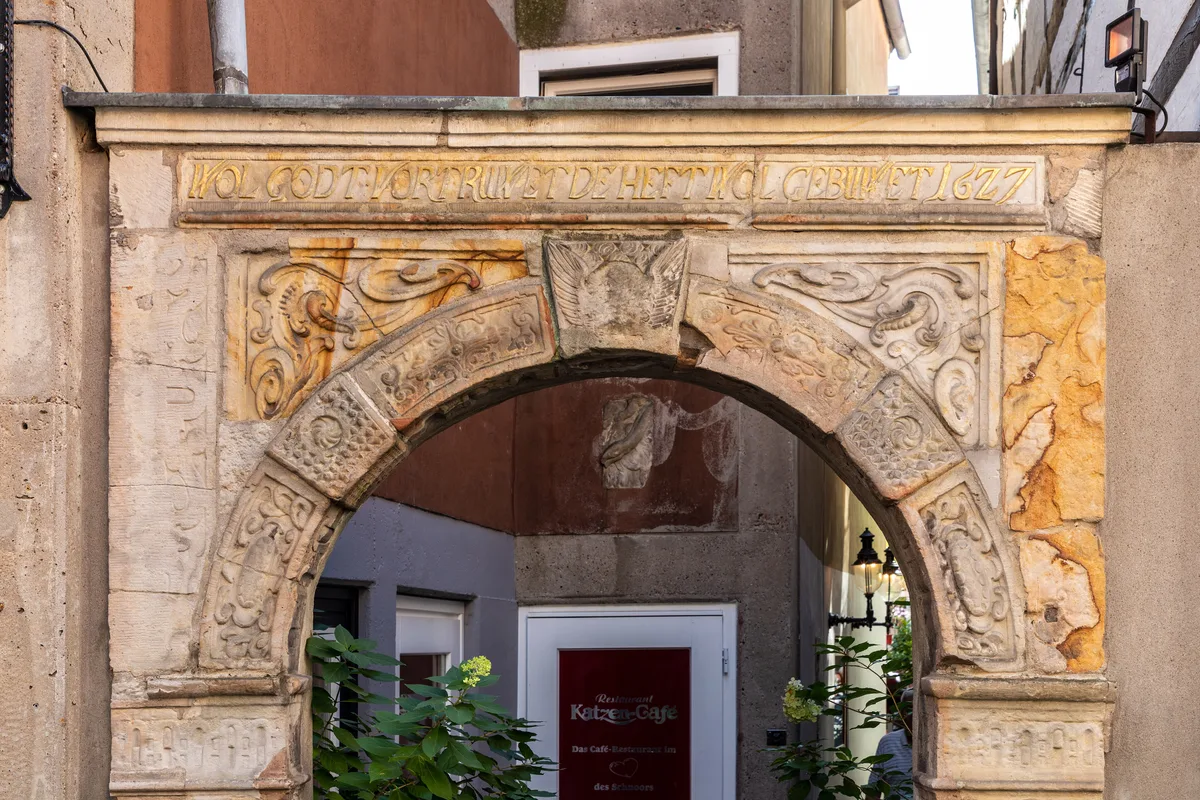
Your shoulders are the measuring stick here. Some of Schnoor’s alleys are so narrow that two people coming from opposite directions have to turn sideways to pass. Above you the houses lean in close, low gabled fronts in brick and painted plaster. Many have doorways you would duck through. Then the alley opens onto a slightly wider lane with café tables and shop windows, and you’re back in the flow of people.
A fishermen’s quarter that got left alone
Schnoor began as the home of Bremen’s boatmen, fishermen and craftsmen. It sits on the strip of land between the old town centre and the Weser. Most of the houses you see date from the 17th and 18th centuries, and a few are older still. Bremen was heavily bombed in the Second World War, so a whole quarter of this age surviving here is unusual.
The name is Low German. Schnoor means string or cord. One explanation is the rope-makers who once worked here. The other is the way the little houses line up along the lanes like beads on a cord. You’ll hear both, and once you’re standing in the main lane, the second one makes sense.
Walking the lanes
There’s no ticket, gate or set route. Schnoor is a public neighbourhood and the lanes are open 24 hours. The shops and cafés keep their own hours, so check each one before you plan around it. The whole quarter is compact, and a slow loop with stops for browsing takes one to two hours.
What you’ll find along the way:
- The main Schnoor lane, which gives the quarter its name and has the densest run of shops and cafés
- Side passages such as Wüstestätte and Marterburg, where the houses crowd closest together
- Small galleries, craft and gift shops, many in ground floors not much bigger than a living room
- Propsteikirche St. Johann, a Gothic brick church at the quarter’s edge, plainer and quieter than the cathedral
Look up as well as along. The best details are in the carved door frames, hanging shop signs and window boxes at first-floor height.
The 7am Schnoor
Schnoor’s timing quirk is that it belongs to two different crowds. On weekdays it’s calmest between 7am and 8am. At weekends the quiet windows are 7am–9am and again 10pm–11pm. At those hours you’ll mostly share the cobbles with residents taking out bins or walking dogs, and the narrow passages are clear enough to photograph end to end.
Try not to arrive on a weekend between 11am and 9pm. That’s the busiest stretch. The narrowest alleys turn into single-file queues and the café terraces fill up. If a weekend is your only option, see the lanes early and come back after dark. Late in the evening the quarter is lit by lamps and shop windows, and it’s quiet again.

Getting into the quarter
The tram stop is Domsheide, served by several Bremen tram lines. From there it’s a short walk south-east into Schnoor. From Bremen Hauptbahnhof you can take a tram to Domsheide or walk through the Altstadt in roughly 15–20 minutes.
Wear shoes with some grip, because the cobbles are uneven and can be slick after rain. Pushchairs and wheelchairs manage the main lane, but the tightest side passages are a squeeze. Cars don’t belong in the lanes, so leave the car in one of the city-centre garages.
Living lanes, not a stage set
People really live in Schnoor, and visiting well mostly comes down to remembering that.
- Keep doorsteps clear. The front doors open straight onto the lane, and a group stopping for a photo can block someone’s way home.
- Step aside in the narrow alleys. Let people coming the other way through, and don’t stop in the middle to take pictures.
- Pay the German way. Cards are widely taken, but smaller shops and cafés may still prefer cash, so have some on you. At cafés, the usual habit is to round up the bill and tell the server the total when you pay, rather than leaving coins on the table.
- Ask for the bill. Staff won’t bring it until you do; “Zahlen, bitte” does the job.
- Keep your voice down in the evening. The lanes are an echo chamber and bedrooms are only a few metres up.
Linking it to the rest of the Altstadt
Schnoor works best as one stop on an old-town walk, because everything nearby is close. The Marktplatz is a few minutes away. That’s where you’ll find the Gothic and Weser Renaissance Rathaus and the stone Roland statue, both UNESCO-listed. Next to them is the Bremen Town Musicians bronze, with its donkey’s front legs polished by visitors who rub them for luck.
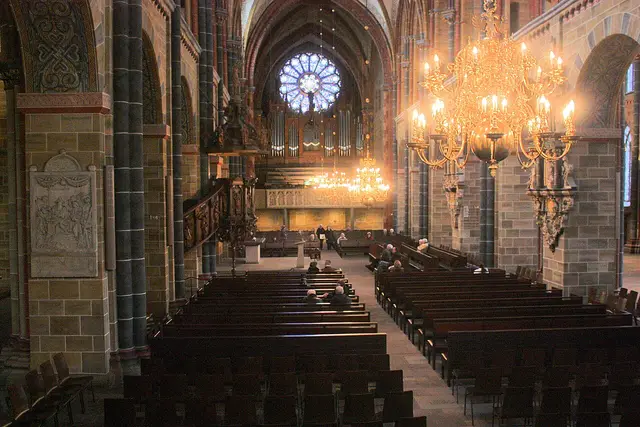
St. Petri Dom rises right above the quarter’s northern edge. A short walk west brings you to Böttcherstraße, a narrow brick street remodelled in the 1920s and 30s in a dramatic Expressionist style. Head south and you reach the Weser, where the Schlachte riverside promenade has a line of bars and boats. It’s a natural place to end the day.
A good order is the Marktplatz and cathedral first, Schnoor second, Böttcherstraße third and the Schlachte as the light goes. All of it fits into a single unhurried day on foot.
Frequently asked questions
When is the quietest time to visit Schnoor?
On weekdays it's usually calmest from 7am to 8am. At weekends the quiet windows are 7am–9am and 10pm–11pm. Avoid weekends between 11am and 9pm, when it's busiest and the narrow alleys back up.
How do I get to Schnoor by public transport?
Take a tram to Domsheide, which several Bremen lines serve. From there it's a short walk south-east into the quarter. From Bremen Hauptbahnhof you can also walk through the Altstadt in about 15–20 minutes.
How long do I need in Schnoor?
Allow one to two hours to wander the lanes, browse the small shops and stop at a café. Add more time to combine it with the Marktplatz, St. Petri Dom and Böttcherstraße, which are all a short walk away.
Is Schnoor open at night?
Yes. The lanes are public streets and open 24 hours. The shops and cafés keep their own hours, so check each one. The quarter is lamp-lit and quiet late in the evening, but people live here, so keep the noise down.
Is Schnoor accessible with a pushchair or wheelchair?
The main lane is cobbled but manageable. Some side passages are only shoulder-width, and the cobbles are uneven and can be slippery when wet, so expect to skip the tightest alleys.
Plan your trip to Bremen
Germany eSIM & staying connected →
Some links above are affiliate links — if you book through them, Wander Atlas earns a small commission at no extra cost to you. It's how we keep every guide free.