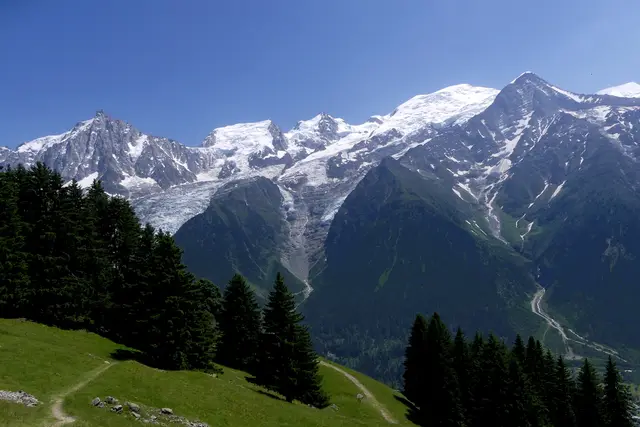
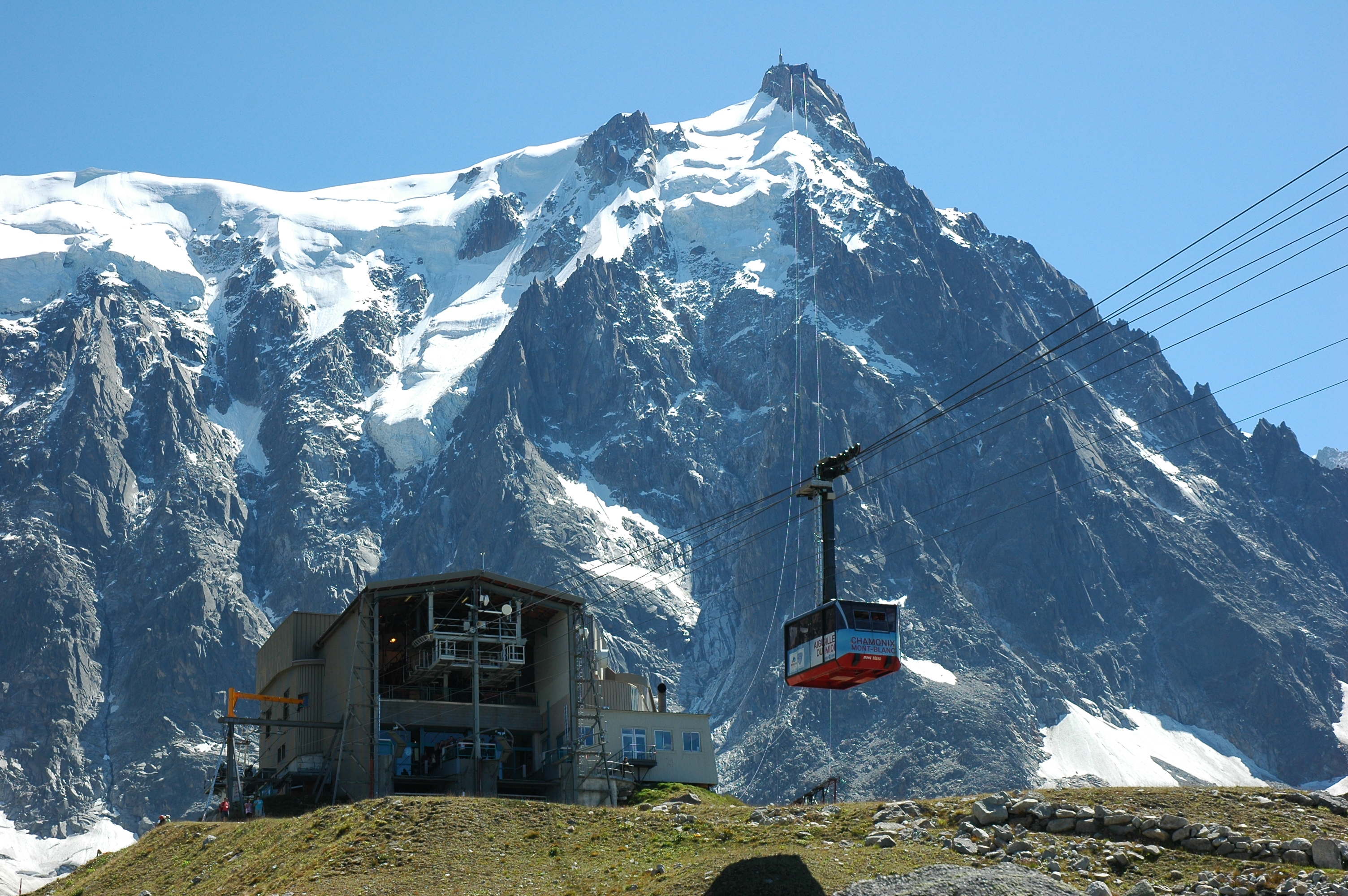
Stand on the Place de l’Aiguille du Midi and look straight up. The cables leave the station roof and run towards a granite needle so high it looks painted onto the sky. That needle is where you are going: 3,842 metres up, directly across the glaciers from Mont Blanc. The trip takes about twenty minutes. You start among Chamonix’s bakeries and finish in air that makes a flight of stairs feel like work.
Two lifts, one enormous gain
The ride comes in two stages. The first cabin runs from the valley floor, at roughly 1,035 metres, to the Plan de l’Aiguille station at 2,317 metres. Here you change cabins, walking across the platform to the second car.
The upper section is the part people remember. It climbs a single long span to the summit rock with no support pylon in between, so the cabin seems to hang in open space above the Glacier des Pèlerins. Stand near the valley-side windows on the way up; the drop opens up behind you as the car rises.
The line opened in 1955 and has been updated many times since. For most of its life it has been counted among the highest cable cars in the world.
Finding the departure hall
The lower station sits at 100 Place de l’Aiguille du Midi, at the southern edge of the pedestrian centre. It is a flat walk of around 10 to 15 minutes from Chamonix-Mont-Blanc train station, which is served by the Mont-Blanc Express line from Saint-Gervais and Martigny.
- On foot from town: follow the signs south along the Arve past the Chamonix Sud apartment blocks.
- By car: there are public car parks close to the station, but they fill up on clear summer mornings. Staying in town and walking is simpler.
- By local bus: Chamonix’s valley buses stop nearby. Visitors who stay in the valley generally get a guest card that covers local transport, so ask your hotel for one.
At the summit: terraces, tunnels and the glass box
From the top station, a network of walkways, bridges and tunnels is cut into the rock of the peak. Metal staircases lead out to open terraces. A lift carried up inside the rock takes you to the highest viewing platform at 3,842 metres.
What you see from up there:
- Mont Blanc, straight ahead, its summit dome close enough to trace the climbers’ route.
- The Vallée Blanche, the glacier basin where the famous off-piste ski descent begins.
- The Grandes Jorasses and the Aiguilles de Chamonix, the rocky spires lining the Italian border.
- The Chamonix valley, nearly 3,000 metres below, with the town shrunk to a grey smudge.
The best-known stop is Step into the Void (Le Pas dans le Vide). It is a glass cube fixed to the rock face, with a glass floor and roughly a kilometre of air under your feet. It usually has its own queue; people wait their turn, step in for a photo and step out.
You will also see roped mountaineers in crampons leaving through an ice tunnel onto the knife-edge ridge that leads down to the glacier. Only equipped, experienced climbers or guided groups go past that gate. For everyone else it is a spectator view, and a memorable one.
What 3,842 metres does to you
The altitude matters more here than anywhere else on your trip. You go from valley level to nearly 4,000 metres in about twenty minutes, with no time to adjust. Light-headedness, a mild headache or breathlessness on the stairs are all common.
- Move slowly on the staircases and take breaks on the terraces.
- Drink water and skip the celebratory beer until you are back down.
- Head down if dizziness or headache gets worse. Descending is the cure.
- Ask a doctor first if you have heart or breathing conditions, or if you are pregnant. The same goes for very young children.
The cold catches people out too. Even in August, the summit can sit well below freezing with wind across the terraces. Bring a warm jacket, a hat and gloves. Glacier glare is fierce, so wear sunglasses and sunscreen.
Chasing a clear morning
Weather decides the whole visit. Alpine peaks often start the day clear, and cloud tends to build around the summits as the afternoon warms. That is why the first cabins are the most sought-after.
Check the summit webcams and conditions on the Compagnie du Mont-Blanc website before you commit. If the needle is hidden in cloud from town, you will almost certainly see nothing but white at the top. Since the ride exists for the view, a flexible day is worth more than a fixed plan. Wind can also stop the lift altogether.
In summer, a separate gondola, the Panoramic Mont-Blanc, crosses the glaciers from the summit to Pointe Helbronner on the Italian side. If that crossing is on your list, go early; the queues for it build later in the day.
Getting your slot and boarding smoothly
This is one of the most visited attractions in the French Alps, and the system is built to handle crowds. Here is how it works.
- Book a timed slot online. The cable car is run by the Compagnie du Mont-Blanc. Their website sells tickets with a boarding time, and current prices are posted there and at the ticket office. In peak summer weeks, the walk-up slots can be gone before mid-morning.
- Think about a multi-lift pass. Staying several days? The Mont Blanc Multipass covers this lift and others in the valley, including the Montenvers train to the Mer de Glace. Compare it against single tickets on the official site.
- Arrive a little before your time. Boarding goes in order of slot number, and the staff hold each group until its time comes up.
- Dress in the valley. The cabins are packed and standing-room only, so there is no space to pull on layers inside. Put them on or have them in hand before you board.
- Pay by card. It is accepted at the ticket office and in the summit café. There is no tipping culture for the lift staff.
- Mind the climbers. On the ridge side, mountaineers carrying ice axes and ropes ride alongside sightseers. Give their gear room in the cabin.
Stopping at Plan de l’Aiguille on the way down
Many visitors ride straight back down, but the middle station is a good place to get off. At 2,317 metres it sits on open alpine meadow and rock under the Aiguilles, with far more breathable air.
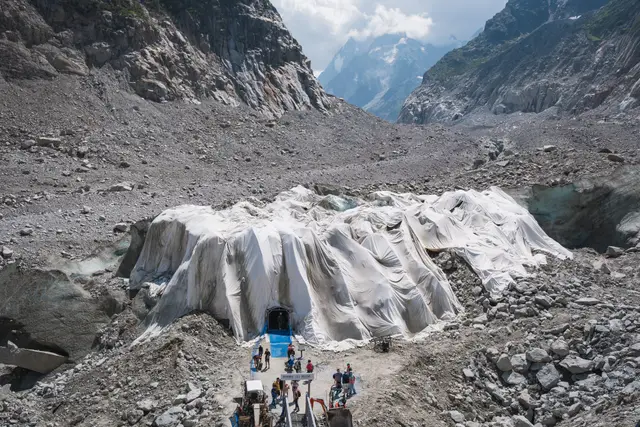
Two walks start here. A short path leads to the Lac Bleu, a small tarn below the peaks. The longer Grand Balcon Nord trail runs across the mountainside to Montenvers, where you can see the Mer de Glace glacier and ride the rack railway back to Chamonix. That route takes a few hours. Take proper boots and check with the Office de Haute Montagne in town about snow on the path before you set off.
For a straight there-and-back trip, allow around half a day, including time on the terraces and waiting at each stage. If you add the Italy crossing or the walk to Montenvers, plan for a full day.
Frequently asked questions
How do I get to the Aiguille du Midi cable car station?
The lower station is at 100 Place de l'Aiguille du Midi, at the southern edge of Chamonix's pedestrian centre. From Chamonix-Mont-Blanc train station (Mont-Blanc Express line) it is a flat walk of about 10 to 15 minutes. Car parks nearby fill up early on clear days.
What is the best time of day to go up?
Early morning. Alpine peaks are often clear at the start of the day, and cloud tends to build later. Check the summit webcams on the Compagnie du Mont-Blanc website first. If the peak is in cloud from town, choose another day.
How long should I allow for the visit?
About half a day for the round trip, including time on the summit terraces and the lift change at Plan de l'Aiguille. Plan for a full day if you add the summer gondola to Pointe Helbronner in Italy or the Grand Balcon Nord walk to Montenvers.
Will the altitude affect me?
Possibly. You climb to 3,842 metres in about twenty minutes, and light-headedness or a headache is common. Move slowly, drink water and go down if symptoms get worse. People with heart or breathing conditions should get medical advice before going.
Do I need to book in advance?
In peak season, yes. Tickets with timed boarding slots are sold on the Compagnie du Mont-Blanc website, and current prices are posted there. Walk-up slots on clear summer days can sell out early.
Plan your trip to Chamonix
Some links above are affiliate links — if you book through them, Wander Atlas earns a small commission at no extra cost to you. It's how we keep every guide free.