Why go
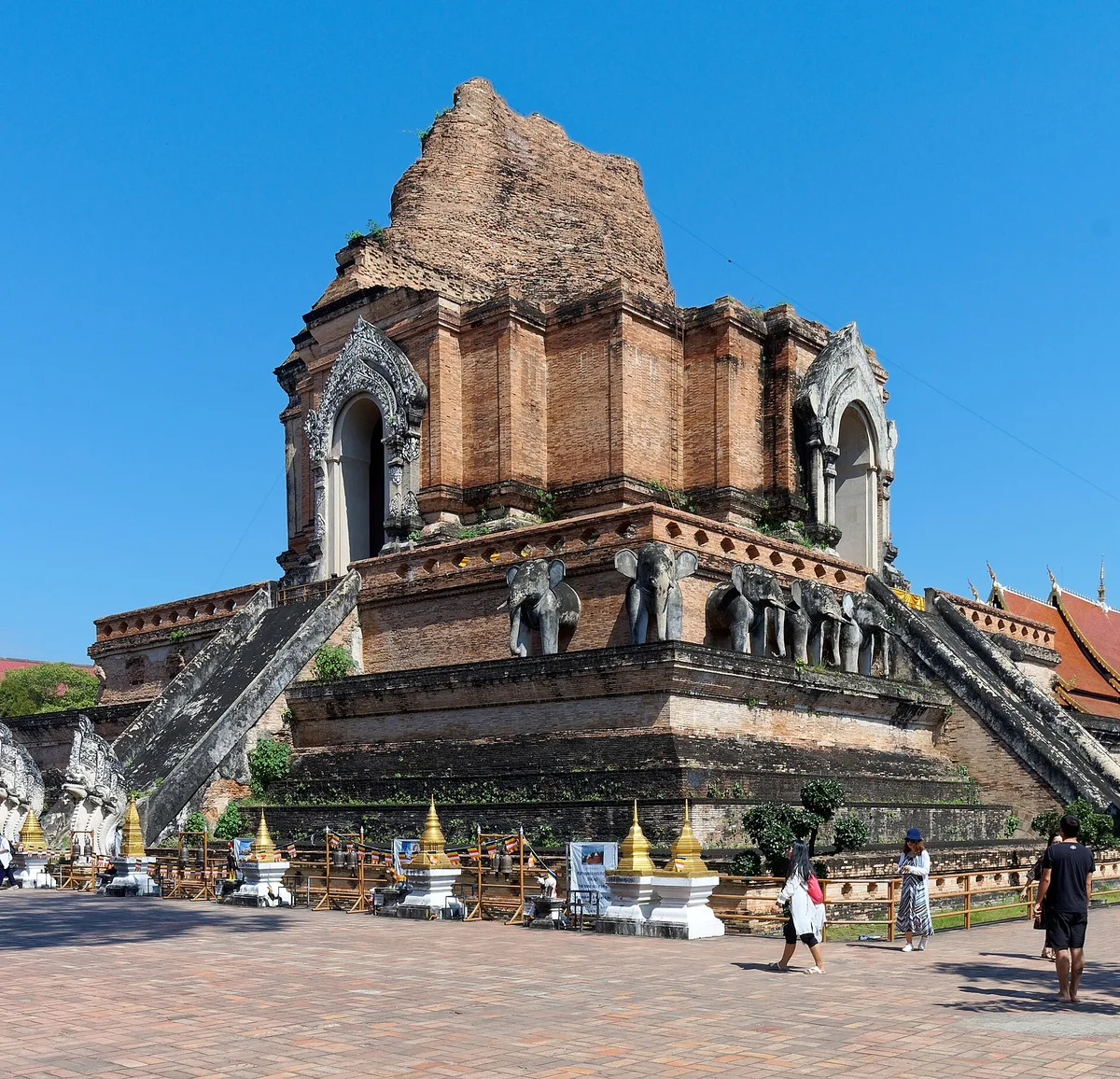
Wat Chedi Luang is one of the most historically important temples in northern Thailand, built around a colossal chedi (stupa) that once stood over 80 meters tall before a 16th-century earthquake, and possibly cannon fire during a later Burmese siege, brought down its upper section. What remains is still an imposing, weathered brick-and-stucco mass ringed by naga serpent staircases and elephant sculptures at its base, giving it a gravitas that Chiang Mai’s more polished, gilded temples don’t quite match.
The complex also houses the city’s lak mueang, the guardian pillar believed to protect Chiang Mai, sheltered in a small structure beside a sacred gum tree (sadeu mueang) said to be as old as the city itself. Rated 4.7 from over 18,500 reviews, it’s consistently one of the highest-regarded sights in the Old City.
Getting there
The temple sits at 103 Prapokklao Road, right in the walled Old City, roughly midway between Wat Phra Singh and the Three Kings Monument. It’s eminently walkable from most Old City guesthouses. Expect a 10–20 minute stroll depending on where you’re based. If you’re coming from outside the walls, a songthaew (red truck) or Grab ride from Chiang Mai’s Nimman or Riverside areas typically takes 10–15 minutes and costs a small, negotiable fare.
There’s no train or BTS-style system in Chiang Mai, so taxis, songthaews, or a rented bicycle/scooter are the practical options. Many visitors fold it into a walking loop of Old City temples, since Wat Phra Singh, Wat Chiang Man, and Wat Inthakhin are all within 10–15 minutes on foot.

What to see and do
- The Lanna-style viharn (assembly hall) at the front houses the principal Buddha image and is where locals come to make merit, worth pausing here before heading to the ruined chedi behind it.
- The Great Chedi itself: walk the full perimeter to see the different restoration states, one side rebuilt with UNESCO-consulted work in the 1990s, others left deliberately weathered to preserve historical authenticity. Look for the elephant caryatids and naga balustrades flanking the staircases.
- The city pillar shrine: tucked to one side, marked by a large gum tree. Local belief holds that if this tree falls, misfortune will befall the city. It’s fenced and protected accordingly. Non-Buddhists can view but sometimes access to the inner shrine building is restricted to men only or closed to visitors on certain days; check signage on arrival.
- Monk Chat: on many afternoons, young monks studying English sit in a designated area to converse with visitors, a low-key, genuinely interesting way to ask questions about temple life.
- Photographers should note the chedi is at its most atmospheric in soft early or late light, when the brickwork’s texture and shadow play are most visible.
When to go
Aim for early morning (soon after opening) or late afternoon to avoid both the midday heat and tour-bus crowds, which peak around midday. The temple is busiest during Songkran (mid-April) and Loy Krathong/Yi Peng (November), when it’s beautifully decorated but considerably more crowded. Cooler months, November through February, make walking the grounds and nearby streets more comfortable than the hot season (March–May).
Nearby & tips
Cover shoulders and knees (sarongs are sometimes available to borrow near the entrance, but it’s easier to dress appropriately beforehand. Bring small cash bills for the entry fee, since card payment isn’t standard practice at temple gates. Budget 45 minutes to an hour for a relaxed visit, longer if you linger for Monk Chat. Afterward, it’s a short walk to Wat Phra Singh, the Three Kings Monument, and the Old City’s many café and noodle-shop strips) a natural way to spend a half-day exploring on foot.
Frequently asked questions
How much does it cost to enter Wat Chedi Luang?
There's a modest entrance fee payable in cash at the gate; exact prices can change, so confirm current rates on arrival, and bring small Thai baht notes since card payment isn't typical.
How long should I plan to spend there?
Most visitors spend 45 minutes to an hour walking the chedi, viharn, and city pillar shrine; add extra time if you want to join a Monk Chat session in the afternoon.
What's the best time of day to visit?
Early morning right after opening or late afternoon offers cooler temperatures, softer light for photos, and fewer tour groups than midday.
How do I get to Wat Chedi Luang from central Chiang Mai?
It's inside the Old City on Prapokklao Road, walkable from most Old City accommodation in 10–20 minutes, or a short songthaew/Grab ride (10–15 minutes) from Nimman or the Riverside area.
What else is nearby?
Wat Phra Singh, Wat Chiang Man, and the Three Kings Monument are all within a 10–15 minute walk, making it easy to combine into an Old City temple-hopping route.
Plan your trip to Chiang Mai
Thailand eSIM & staying connected →
Some links above are affiliate links — if you book through them, Wander Atlas earns a small commission at no extra cost to you. It's how we keep every guide free.
Related guides
 attraction
 Wat Phra Singh Woramahawihan: Chiang Mai Travel Guide (4.7★)
 attraction
 Chiang Mai National Museum: Travel Guide (4.2★)
 attraction
 Wat Phra That Doi Suthep: Chiang Mai Travel Guide
 attraction