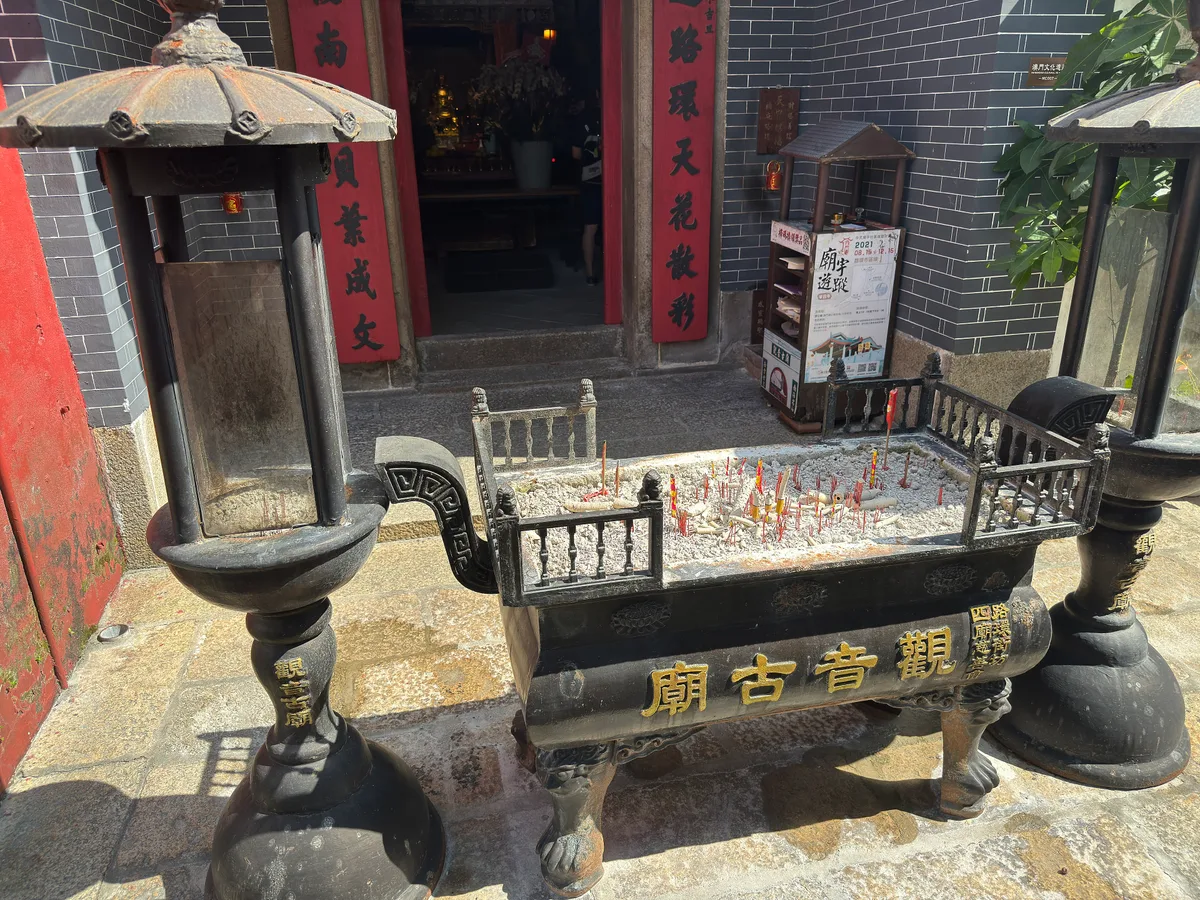
A shrine at village scale
Most visitors to Macau never come this far south. Coloane is the greener, slower end of the territory, past the Cotai casino strip. Its old village still runs at the pace of a fishing settlement.
Kun Iam Temple, Coloane is one of the small places of worship there, and it gets few visitors. Online it has a modest number of reviews, but they are consistently good. If you have already queued at the Ruins of St Paul’s, this temple shows you the quieter end of the scale.
Who you’re visiting
Kun Iam is the Cantonese name for Guanyin, the bodhisattva of compassion. In English she is usually called the Goddess of Mercy. Across southern China, people pray to her for health, children, safe journeys and relief from trouble.
In a fishing community like Coloane, that protective role matters a great deal. Kun Iam shares the village’s devotion with Tin Hau, goddess of the sea, and Tam Kung, a patron of fishermen. Each has a temple within walking distance of the others.
When you stand in front of the altar, look for the usual signs of a working shrine:
- the figure of the goddess, often shown holding a vase
- offerings of fruit and flowers
- incense ash building up in the burners
This is a place people come to pray, not a museum exhibit.
Not the Kun Iam you’re thinking of
This is the mistake that costs visitors the most time. Macau has several sites named for Kun Iam, and maps and taxi drivers can send you to the wrong one.
- Kun Iam Tong (Templo de Kun Iam) is the big, famous temple complex in Mong Ha on the Macau peninsula. In 1844 it hosted the signing of the first treaty between China and the United States.
- The Kun Iam Statue is the bronze figure on a lotus-shaped base on the NAPE waterfront, near the Macau Science Center.
- Kun Iam Temple, Coloane is the small village shrine this guide covers, at the far southern tip of the territory.
When you ask for directions, say “Coloane” clearly, or show the plus code 4H82+FF9. Dropping that pin into a map app beats any spoken description.
Getting to Coloane Village
Public buses run from the peninsula and Taipa to the Coloane Village stop. Routes 15, 21A, 25 and 26A all serve the village. Check the current timetable on the Macau transport information site before you set off, because routes do get revised.
A taxi from Cotai is short and direct. Once you’re in the village, walk. The lanes are narrow and the whole historic core is small enough to cover on foot in under an hour, temple stops included.
Coming back, buses fill up in the late afternoon with people heading home from the beaches. A taxi rank isn’t guaranteed, so allow some slack in your evening plans.

The goddess’s three feast days
Kun Iam’s calendar runs on the lunar months, so the dates move against the Western calendar every year. Three days are traditionally set aside for her:
- the 19th day of the 2nd lunar month, marking her birth
- the 19th day of the 6th lunar month, marking her enlightenment
- the 19th day of the 9th lunar month, marking her renunciation
On these days, Guanyin shrines across the Cantonese-speaking world draw more worshippers and more offerings than usual. If you visit on one of them, expect more incense and more people in a small space.
If you would rather have the place quiet, pick an ordinary weekday and look up the lunar dates before you book.
Inside without intruding
A small shrine has no crowd to hide in, so how you behave is more visible here than at a big temple.
- Stay out of the way of worshippers. If someone is kneeling or bowing with incense, wait at the side or step back outside until they finish.
- Ask before photographing people. Wide shots of the building are generally fine. A close-up of someone praying is not.
- Don’t touch the altar or the offerings. Fruit and food placed there belong to the goddess.
- Step over the raised threshold, not on it. Many Chinese temples have a raised sill at the door, and stepping on it is considered disrespectful.
- Leave something if you wish. There is usually a donation box. A small offering is a polite way to thank a shrine kept up by its community.
- Dress modestly. Coming straight off the sand at Hac Sa, throw on a shirt first.
No opening hours have been confirmed for this temple. Plan a daytime visit and check locally before you make a special trip.
Making a half-day of the south
The temple is a short stop, so build an afternoon around it. Coloane Village has a cluster of sights within a few minutes’ walk of each other:
- Chapel of St Francis Xavier. A small, cream-and-blue Portuguese-era chapel on a square paved with wave-patterned stone, and the most photographed spot in the village.
- Tam Kung Temple. At the end of the waterfront road. It is known for a model boat carved from a whale bone.
- Tin Hau Temple. The village shrine to the sea goddess, worth seeing alongside Kun Iam’s.
- Lord Stow’s Bakery. The Coloane bakery credited with popularising the Portuguese-style egg tart in Macau. Expect a line.
- The waterfront promenade. It looks across a narrow channel to the mainland city of Hengqin.
Beyond the village, Cheoc Van and Hac Sa beaches are a short bus ride or taxi away. Hac Sa is known for its dark sand. The hiking trails of Coloane’s hills give you a green, woodland side of Macau that most visitors never suspect exists.
Done in that order, the temple becomes a quiet pause between the busy bakery and the beach. That is about the right weight for a village shrine.
Frequently asked questions
Is Kun Iam Temple, Coloane the same as the famous Kun Iam Temple in Macau?
No. The famous complex is Kun Iam Tong in Mong Ha on the Macau peninsula, where the 1844 treaty between China and the US was signed. This is a small village shrine in Coloane at the southern tip of Macau. Use the plus code 4H82+FF9 to navigate.
How do I get to Coloane Village by public transport?
Buses 15, 21A, 25 and 26A serve the Coloane Village stop from the Macau peninsula and Taipa. Check current routes on the Macau transport information site. A taxi from Cotai is quick and direct.
How long should I spend at the temple?
About 15 to 20 minutes. Combine it with the Chapel of St Francis Xavier, Tam Kung Temple, Tin Hau Temple and Lord Stow's Bakery to make a half-day in Coloane.
When is the best time to visit?
On an ordinary weekday in daylight. Kun Iam's feast days fall on the 19th day of the 2nd, 6th and 9th lunar months, when worshippers are more numerous. Opening hours are not confirmed, so check locally before making a special trip.
Are there rules for visitors inside the temple?
Dress modestly and step over the raised threshold rather than on it. Don't touch offerings, give worshippers space, and ask before photographing anyone praying.
Plan your trip to Coloane
Macau eSIM & staying connected →
Some links above are affiliate links — if you book through them, Wander Atlas earns a small commission at no extra cost to you. It's how we keep every guide free.