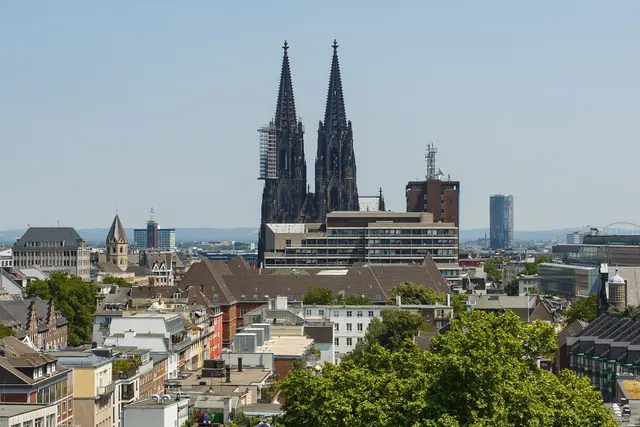
The cathedral’s twin spires stand 157 metres high, directly above the stall roofs. Every year this is the first major Christmas market in Germany to open. In 2026 it runs from November 16 to December 23 on Roncalliplatz, the paved square on the cathedral’s south side.
Dates for the 2026 season
The season lasts a little over five weeks, with one gap. The market closes on Totensonntag, November 22, the Protestant day of remembrance for the dead, when German Christmas markets traditionally stay shut. It reopens the following day and keeps trading until December 23.
There is no Christmas Eve trading here. Anyone arriving in the final days of December will find the square empty of stalls.
Roncalliplatz: what you walk into
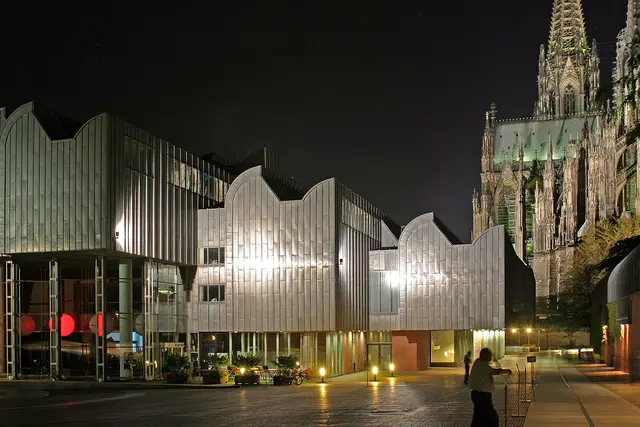
The market is small enough to cover in about an hour. A tall Christmas tree stands at its centre. The stalls are wooden huts with red roofs, packed tightly between the cathedral’s flank and the museum buildings on the square’s far edge.
Above the lanes hangs a canopy of small lights, so the whole square glows once darkness falls. Expect the classic stall mix:
- Glühwein (mulled wine) and hot punch
- Reibekuchen, the Rhineland’s fried potato pancakes, usually eaten with apple sauce
- Roasted almonds, gingerbread and bratwurst
- Handmade decorations, candles and woodwork
The cathedral is a few steps away, and the nave is free to enter outside services. Many visitors pair the two, going inside first and then out to the stalls once the lights are on.
Mugs, deposits and the crowd
Glühwein comes in a ceramic mug, and you pay a deposit (Pfand) on top of the drink. You get the deposit back when you return the mug to any stall on this market. Or you can keep the mug: each market prints its own design, and many people take one home as a souvenir.
Cash still moves fastest at the smaller huts, although plenty of stalls take cards. Order in German if you like: “Einen Glühwein, bitte.”
The location makes it one of Cologne’s busiest markets. The main station empties straight onto the cathedral plaza, so weekend evenings and the Saturdays before Christmas are the most crowded. Weekday afternoons are usually easier, and the lanes thin out again late in the evening. Pickpockets work crowded markets like this one, so locals keep bags zipped and closed in front of them.
Getting there and the markets beyond
Take any train to Köln Hauptbahnhof. Leave by the cathedral-side exit, climb the steps to the Domplatte and walk round to the south side of the cathedral. Driving into the old town in December is slow, and most visitors come by rail or tram.
This is one of several large markets in the city centre, and plenty of visitors walk between them:
- Heinzels Wintermärchen: Alter Markt and Heumarkt in the old town, with an ice rink
- Markt der Engel: Neumarkt, with stall staff dressed as angels
- Hafen-Weihnachtsmarkt: on the Rhine beside the Chocolate Museum
The old-town markets are a short walk south of the cathedral along the river.
Frequently asked questions
When does the Cologne Cathedral Christmas Market run in 2026?
It runs from November 16 to December 23, 2026. It is closed on Totensonntag, November 22, and there is no trading on Christmas Eve.
Do I need a ticket?
No. Roncalliplatz is an open public square, so there is no entry ticket. You pay at each stall for what you buy. Glühwein comes with a mug deposit, which you get back when you return the mug.
How do I get to the market?
Take a train to Köln Hauptbahnhof and leave by the cathedral side. The market is on Roncalliplatz, on the south side of the cathedral, a few minutes' walk from the station.
When is it least crowded?
Weekend evenings and the Saturdays before Christmas are usually the busiest times. Weekday afternoons tend to be calmer, and the crowds thin again late in the evening.
What other Christmas markets are nearby?
Heinzels Wintermärchen fills Alter Markt and Heumarkt in the old town, and Markt der Engel is at Neumarkt. The harbour market is beside the Chocolate Museum on the Rhine. All are walkable from the cathedral.
Plan your trip to Cologne
Germany eSIM & staying connected →
Some links above are affiliate links — if you book through them, Wander Atlas earns a small commission at no extra cost to you. It's how we keep every guide free.