Where the city meets the water
You walk down from the cathedral and Cologne opens out onto lawns, trees and the brown, fast-moving Rhine. Rheingarten is the green strip along the Altstadt bank. It has paths for walking and cycling, grass for sitting, and a long view of barges heading upstream past the Deutz side.
It exists because of a road. Traffic on the riverbank was moved into the Rheinufertunnel in the early 1980s, which gave the old town its river back. The promenade on top is now one of the most-visited open spaces in the city. Expect company, not solitude.
What you see from the grass
The view does most of the work. Look north and the steel arches of the Hohenzollern Bridge carry trains across the river, with the cathedral’s twin spires behind. Look across and you get the Deutz bank, the LANXESS Arena roof and the KölnTriangle tower.
Behind you are the Altstadt landmarks within a few minutes’ walk:
- Groß St. Martin, the Romanesque church with the square crossing tower, just above the Fischmarkt
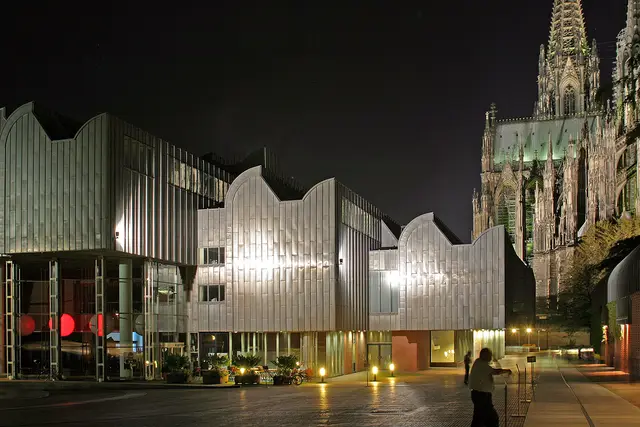
- Museum Ludwig, the modern art museum by the cathedral
- Heinrich-Böll-Platz, the plaza above the Philharmonie concert hall
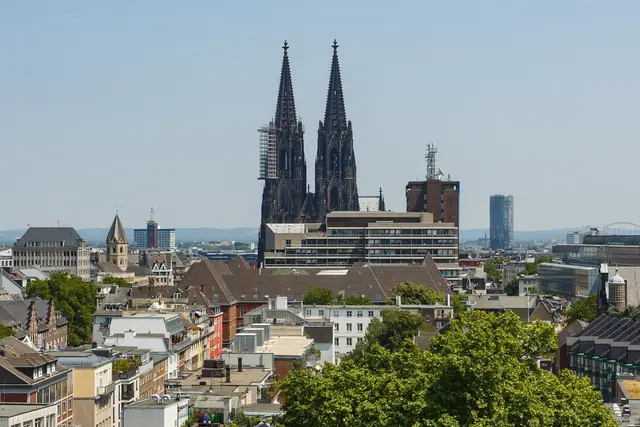
- Kölner Dom, a five-minute walk uphill
The river traffic is the moving part. Cargo barges, passenger boats and cruise ships use this stretch all day. The boat landings for Rhine excursions sit along the Frankenwerft edge of the old town.
Getting onto the promenade
Köln Hauptbahnhof is the easiest start. Leave by the cathedral side and head right of the Dom towards Museum Ludwig, then down to the river. It takes around five to ten minutes on foot.
From the south end, take the U-Bahn to Heumarkt (lines 1, 7 and 9). Walk east through the old-town lanes to the Rhine. Cyclists arrive along the riverbank route, which forms part of the long-distance Rhine cycle path.
There’s no gate, no ticket and no closing time. The park is open around the clock, every day.

Sharing the riverbank like the Kölner do
The paths carry walkers, joggers and cyclists at the same time. Bikes come through quickly, so keep to the walking side and look before you step out to photograph the bridge. Groups that spread across the full width are the ones that get rung at.
Drinking outdoors is legal in Germany, and a bottle of Kölsch on the grass is a normal evening here. A few habits help:
- Leave empty bottles beside the bin, not inside it. Deposit collectors return them for the Pfand, and this is the accepted courtesy.
- Pack out what you bring. Lawns next to a busy old town fill with litter fast on summer nights.
- Buy drinks before you sit down. Kiosks and shops in the Altstadt lanes behind are the usual source.
- Keep music low. Residents live in the buildings facing the river.
If you’d rather sit at a table, the brewhouses of the Altstadt are a short walk uphill. Kölsch comes in narrow Stange glasses. Waiters keep replacing them until you put your beer mat on top of the glass.
Picking your hour
Timing matters more here than anywhere else in the old town. It’s calmest between 7am and 10am on weekdays and 7am and 9am at weekends. At those times the lawns are mostly joggers and dog walkers, and the bridge photographs have no crowds in them.
Don’t plan a relaxed weekend sit between 11am and 11pm. That’s the busiest window, and on warm Saturdays and Sundays the grass fills shoulder to shoulder. Afternoon tour groups coming down from the cathedral add to it.
Evening is the trade-off. After dark the Hohenzollern Bridge and the Deutz skyline light up, which is the classic view, but on weekends you’ll share it with everyone else.
How long to stay and what to pair it with
A walk along the length takes 20 to 30 minutes at an easy pace. Give it an hour if you want to sit down and watch the boats. Most people treat it as a link between sights rather than a destination on its own.
A good loop from the river:
- Walk the Rheingarten south from the Hohenzollern Bridge
- Climb into the Fischmarkt beneath Groß St. Martin
- Weave through the Altstadt lanes to the Heumarkt
- Cross the Hohenzollern Bridge on foot to Deutz for the reverse view, passing the love-lock railings
Doing the bridge walk at dusk and coming back to the Rheingarten afterwards gives you both sides of the river in one evening.
Frequently asked questions
When is the quietest time to visit Rheingarten?
Early morning. It's calmest from 7am to 10am on weekdays and 7am to 9am at weekends. The busiest stretch is 11am to 11pm on weekends, so avoid that window if you want space on the lawns.
How do I get to Rheingarten from Cologne's main station?
From Köln Hauptbahnhof, exit on the cathedral side and walk past the Dom towards Museum Ludwig, then down to the river. It's roughly five to ten minutes on foot. From the south, take the U-Bahn to Heumarkt (lines 1, 7 and 9) and walk east to the Rhine.
Is Rheingarten open at night?
Yes. It's a public riverside park, open 24 hours every day with no gate or ticket. Evenings are popular for views of the lit-up Hohenzollern Bridge and the Deutz bank.
How long should I spend at Rheingarten?
Walking the length takes 20 to 30 minutes. Allow about an hour if you want to sit and watch the river traffic. Most visitors combine it with the cathedral, Groß St. Martin and a walk across the Hohenzollern Bridge.
Can I cycle through Rheingarten?
Yes. The promenade has walking and cycling paths, and it's part of the riverbank route used by the Rhine cycle path. Watch for pedestrians, especially at busy weekend times.
Plan your trip to Cologne
Germany eSIM & staying connected →
Some links above are affiliate links — if you book through them, Wander Atlas earns a small commission at no extra cost to you. It's how we keep every guide free.