A park the city grew around
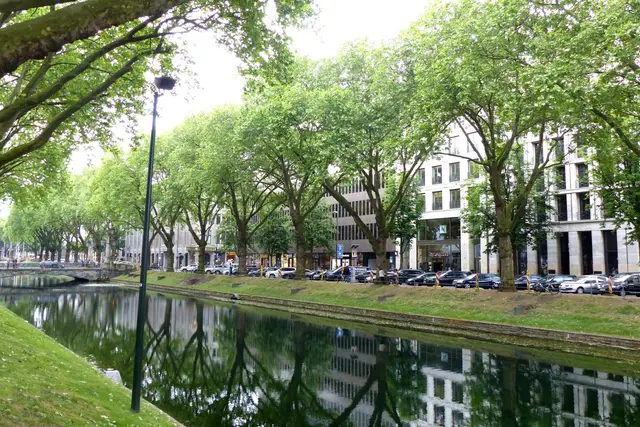
The Hofgarten is older than most of central Düsseldorf. It was laid out in the late 18th century and is often called Germany’s first public park. Maximilian Friedrich Weyhe later reshaped it in the English landscape style. That is why you get winding paths, open meadows and water instead of strict geometry.
Today it runs as a green band from the edge of the Altstadt and the Kö-Bogen out towards Schloss Jägerhof. The formal flowerbeds sit beside rough lawns. Ponds and old trees break up the views. A couple of hours lets you walk the length at an easy pace with stops.
What you walk past
Start near the Kö-Bogen, where glass-and-stone office blocks face directly onto the trees. From there the paths fan out. Look for:
- The Landskrone pond, the largest stretch of water, with ducks and swans along the banks
- The bandstand, an open pavilion on the lawn that occasionally hosts summer music
- A Henry Moore sculpture, bronze set among the grass
- The Ananasberg, a small landscaped hill from the old garden design
- Schloss Jägerhof, the pale rococo palace at the eastern end, home to the Goethe-Museum
The Hofgärtnerhaus, the old gardener’s house near the park’s western side, holds the Theatermuseum. K20, the Kunstsammlung’s modern art building on Grabbeplatz, is a short walk south-west.

Timing your walk around the crowds
This is one of Düsseldorf’s most-used parks, and weekends show it. From 11am to 9pm on Saturdays and Sundays the lawns fill with picnics and the main paths get crowded with strollers and cyclists. Arrive later than 11am and you will be sharing the pond edge with half the city.
The quietest window on weekdays is 7am to 8am; at weekends, 7am to 9am. Early morning is when joggers have the gravel to themselves and the Moore bronze has no one posing beside it. Since the park never closes, a dawn loop before breakfast in the Altstadt is easy.
Late spring and early summer bring the flowerbeds into colour. Autumn turns the plane and beech canopy amber.
How Düsseldorfers use the lawns
The nearest U-Bahn stop is Heinrich-Heine-Allee, served by the Rhine-side U-Bahn lines. Exit towards the Kö-Bogen and you are at the park’s edge within a few minutes. Trams stopping on Jacobistraße put you near Schloss Jägerhof if you want to walk the park in reverse.
A few habits keep you in step:
- Picnics are normal on the open meadows; take every scrap of rubbish away with you.
- Stay off the formal beds, which are tended and fenced in places.
- Watch for cyclists on the wider paths, and keep to the side when you stop.
- Don’t feed the waterfowl bread; it fouls the ponds.
- Dogs belong on leads around the busier lawns.
There is no entry ticket and no gate. Food is better bought beforehand in the Altstadt or at the shops around Schadowstraße, then carried in.
Frequently asked questions
When is the quietest time to visit the Hofgarten?
Between 7am and 8am on weekdays and 7am to 9am at weekends. Try not to come on weekends between 11am and 9pm, which is when it is busiest.
Is the Hofgarten open at night?
Yes. It is a public park, open 24 hours every day of the week.
How do I get to the Hofgarten?
Take the U-Bahn to Heinrich-Heine-Allee and walk towards the Kö-Bogen; the park starts there. Trams on Jacobistraße serve the Schloss Jägerhof end.
How long should I spend there?
Allow one to two hours to walk from the Kö-Bogen to Schloss Jägerhof, with stops at the Landskrone pond, the bandstand and the Henry Moore sculpture.
What is near the Hofgarten?
The Altstadt, Königsallee and the Kö-Bogen border it. The Goethe-Museum in Schloss Jägerhof, the Theatermuseum and K20 on Grabbeplatz are all within walking distance.
Plan your trip to Düsseldorf
Some links above are affiliate links — if you book through them, Wander Atlas earns a small commission at no extra cost to you. It's how we keep every guide free.