Water down the middle of the Kö
Most people come to the Königsallee for the shop windows. The best part is the strip of water between them.
The Stadtgraben is a straight stone-edged canal running roughly a kilometre down the centre of the Kö. Rows of mature trees line it, and low arched bridges cross it at intervals. It began as part of the moat around Düsseldorf’s old fortifications. Today it gives one of Germany’s best-known shopping streets a calm green spine.
Ducks and swans work the surface. Moss and ivy cling to the stone walls just above the waterline. Step off the pavement onto the canal path and the street noise drops a notch, even with traffic and trams a short walk away.
Walking it from end to end
Start at the south end near Graf-Adolf-Platz and walk north. The water then leads you toward its finest moment.
On the way you are choosing a bank. The east side is the luxury shopping side, with flagship fashion stores and their doormen. The west side is lined mostly with banks and office buildings, so it stays quieter. Cross the bridges back and forth and you get both.
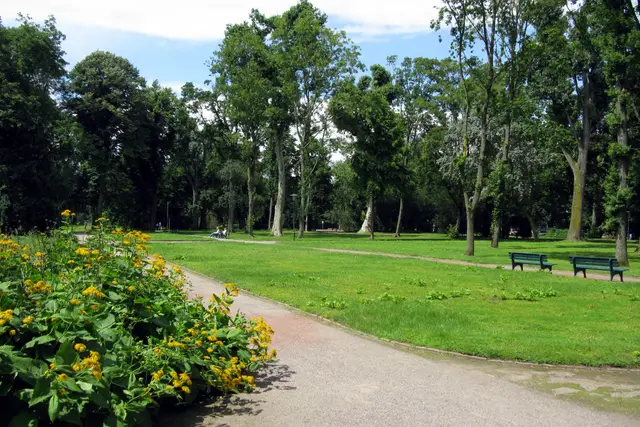
At the northern end the canal widens into a basin with the Tritonenbrunnen, the Triton fountain. Its bronze sea god and attendant figures date from the early 1900s. Beyond it, the water continues into the Hofgarten, Düsseldorf’s oldest public park.
- Time needed: 30 to 60 minutes at an easy pace, longer with a bench break
- Best photo: the Triton fountain looking south down the canal
- Seasons: spring green, deep shade in summer, and a gold canopy in autumn

Sitting by the Graben the Düsseldorf way
Treat the canal as a promenade, not an attraction. That is how the city uses it.
- Use the benches. Office workers on the west bank eat lunch on them on weekdays. Take a seat, then give it up when you are done.
- Mind the cycle lanes. The Kö’s cycle paths are separate from the footpaths. Germans expect pedestrians to stay out of them, and riders will ring at you.
- Don’t feed the birds. Bread is bad for the waterfowl, and feeding them is widely frowned upon in German cities.
- Coffee to go. Pick up a cup from a café on the Kö and drink it at the water. Most places take cards, though a few smaller kiosks still prefer cash.
- Window-shop freely. Nobody expects you to go into the flagship stores. Looking at the displays from the canal side is part of the stroll.
Getting to Stadtgraben
The Wehrhahn-Linie U-Bahn stops right at the Kö. Lines U71, U72, U73 and U83 serve Steinstraße/Königsallee station, which brings you up near the middle of the canal.
For the north end, walk from Heinrich-Heine-Allee station, the main stop for the Altstadt. It is a few minutes to the Triton fountain and the Kö-Bogen. From Düsseldorf Hauptbahnhof, the south end is a straightforward walk of about 15 to 20 minutes northwest, or one short U-Bahn ride.
Driving is not worth it. Parking around the Kö is in garages, and central Düsseldorf is easier on foot and by tram.
When the canal is at its best
The canal never closes. Its character changes with the hour.
Early morning on a weekday is the quietest time. The shops are shut, and the water and trees are mostly yours. Late afternoon puts low light along the length of the canal. After dark, streetlamps and lit shop windows reflect off the water, and the walk is calm and well lit.
Saturdays draw the most shoppers to the east bank. If you want the calm version, keep to the west side or come before the stores open.
Around the north end
Finish at the Triton fountain and you are within a few minutes of several of the city’s main sights.
- Hofgarten: the canal flows into this large landscaped park, with lawns, ponds and long tree-lined paths.
- Kö-Bogen: Daniel Libeskind’s curving office and retail building. Its sliced facades face the park.
- Altstadt: the old town, with its Altbier brewpubs and the Rhine promenade, is a short walk west.
- Carlsplatz: the city’s daily food market, on the southern edge of the Altstadt, is good for lunch after the walk.
- Schadowstraße: the mainstream shopping street runs east from the Kö-Bogen if the boutiques were not your style.
Few visitors think of the Stadtgraben as a sight in its own right. Most rush past it between stores. Slow down here, and the Kö turns into one of the most pleasant walks in Düsseldorf.
Frequently asked questions
How do I get to the Stadtgraben on Königsallee?
Take U-Bahn line U71, U72, U73 or U83 to Steinstraße/Königsallee, which brings you up beside the canal. Heinrich-Heine-Allee station is closest to the north end and the Triton fountain.
How long does it take to walk the Stadtgraben?
The canal runs roughly a kilometre down the Kö. Allow 30 to 60 minutes to walk it end to end and cross a few bridges. Add time if you continue into the Hofgarten.
Is the Stadtgraben open at night?
Yes. It is a public promenade, open 24 hours every day. The canal is lit after dark, and shop windows and streetlamps reflect off the water.
Which side of the canal is quieter?
The west side is quieter. It is lined mostly with banks and offices, while the east side holds the luxury shops and draws the shopping crowds, especially on Saturdays.
What is near the Stadtgraben?
At the north end are the Triton fountain, the Hofgarten park and the Kö-Bogen. The Altstadt, Carlsplatz market and the Rhine promenade are a short walk west.
Plan your trip to Düsseldorf
Some links above are affiliate links — if you book through them, Wander Atlas earns a small commission at no extra cost to you. It's how we keep every guide free.