Basilica of Santa Maria Novella: Florence Travel Guide
When to visit Italy: month-by-month weather, crowds and holidays →
✓ Facts verified via Google Places · Sep 19, 2026
At a glance
Opening hours
- Monday: 9:00 AM – 5:30 PM
- Tuesday: 9:00 AM – 5:30 PM
- Wednesday: 9:00 AM – 5:30 PM
- Thursday: 9:00 AM – 5:30 PM
- Friday: 11:00 AM – 5:30 PM
- Saturday: 9:00 AM – 5:00 PM
- Sunday: 1:00 – 5:00 PM
Live foot-traffic data via BestTime.app
How this guide is made
Produced with AI assistance and reviewed against live data sources. Facts such as hours, ratings, and location come from Google Places; images are licensed or public domain. Details can change — please verify before visiting. Editorial policy
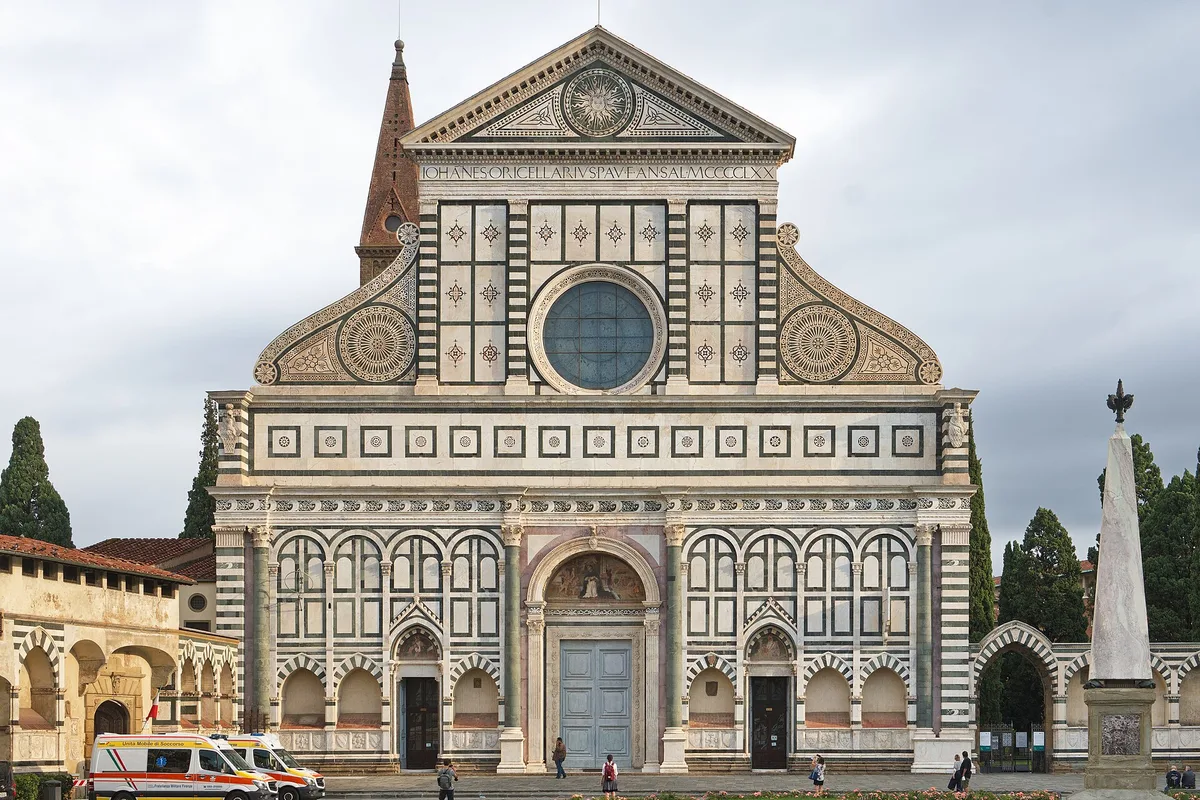
Most visitors arrive at this piazza already tired, dragging suitcases from the train station two minutes away, and almost walk past the church without looking up. That would be a mistake: the marble facade in front of you is one of the clearest lessons in Renaissance geometry in the city, and the paintings inside rival anything in the Uffizi.
The facade as a diagram, not just a decoration
Leon Battista Alberti finished the upper half of the facade in the 1470s, grafting a classical, mathematically ordered front onto a Gothic lower body built a century earlier by the Dominicans. The green-and-white marble panels aren’t random pattern-work; they encode circles, squares and proportional ratios that Alberti considered the visual language of harmony.
Stand back at the far side of the piazza before going in. From there you can see the seam between the older Gothic base, with its pointed arches and striped marble tombs, and Alberti’s newer, cooler classicism above. Few facades in Florence let you read two centuries of architectural thinking in one glance like this.
What’s actually inside
The nave holds one of the most important fresco cycles of the early Renaissance. Behind the main altar, Domenico Ghirlandaio’s cycle on the life of the Virgin and John the Baptist fills the Tornabuoni Chapel, painted in the 1480s with Florentine merchants and their families inserted as bystanders in biblical scenes.
Masaccio’s Trinity, a fresco from around 1425–28, uses one-point perspective so convincingly that it appears to punch a coffered, vaulted niche straight through the wall. Art historians treat it as one of the first fully resolved uses of linear perspective in painting, predating much of what you’ll see elsewhere in the city.
Off the church itself, the Green Cloister (Chiostrino Verde) and the adjoining Spanish Chapel hold further fresco cycles, including work traditionally linked to Paolo Uccello. These rooms get a fraction of the nave’s foot traffic, so it’s worth the extra few minutes.

Getting in and timing it right
A single ticket covers the basilica, the cloisters, the chapterhouse and the small museum, and you buy it at the entrance on the piazza rather than at the church’s side door used for Mass.
- Weekdays (Mon–Thu): open 9am–5:30pm
- Friday: shorter hours, 11am–5:30pm
- Saturday: 9am–5pm
- Sunday: afternoon only, 1pm–5pm, reflecting Mass schedules
The quietest window is 9am to 10am on weekdays, right at opening, before coach groups and school tours fill the nave. Weekends get busy from 11am through to closing, so if you’re only free on a Saturday, come in the first hour or plan around the afternoon crowds.
Reading the Tornabuoni Chapel without a guide
Ghirlandaio’s frescoes reward five extra minutes of looking rather than a quick photo and move on. Each scene nominally depicts a biblical event but is staged like a contemporary Florentine street or interior, full of portraits of the Tornabuoni family who commissioned the work.
Look for the same faces recurring across different scenes: Ghirlandaio reused his patrons as models throughout the cycle. It’s a rare, direct look at how a 15th-century Florentine banking family wanted to be remembered, dressed in their own fashions inside biblical settings.
The piazza outside and how locals actually use it
Piazza Santa Maria Novella has long been a gathering spot rather than a pure tourist forecourt, historically used for the Palio dei Cocchi chariot races in the 16th century, and the two obelisks on marble turtles at either end are surviving turning posts from that history. Today it’s mostly a place people cut through on the way to the station or sit on the church steps between appointments.
Because this is one of the most visited churches in Florence, don’t expect a quiet, empty piazza at midday; treat it as a working part of the city rather than a museum courtyard. If you want the wide facade photo without a crowd of tour groups in frame, early morning before the piazza fills is your best bet.
Practical notes for the visit itself
Dress rules are standard for Florentine churches: shoulders and knees covered for both men and women, and this is checked at the entrance. The interior is unheated and can feel noticeably cooler than the piazza outside, even in summer, so a light layer helps regardless of season.
Photography without flash is generally allowed in the nave, but flash and tripods damage the pigments in frescoes this old and are typically restricted, especially near the Tornabuoni and Masaccio works. Audio guides and information panels in multiple languages are available at the ticket desk if you want context beyond what’s posted in the chapels.
Given the volume of visitors this basilica receives, allow at least 45 minutes for the church and frescoes alone, and closer to 90 minutes if you’re adding the Green Cloister, Spanish Chapel and museum rooms. Confirm the current opening hours and ticket price before you go, since Sunday and holiday schedules shift around Mass times.
Frequently asked questions
How do I get to the Basilica of Santa Maria Novella?
It's on Piazza di Santa Maria Novella, a two-minute walk from Firenze Santa Maria Novella train station, and easily reached on foot from the Duomo or the Uffizi in about 10-15 minutes.
What is the quietest time to visit?
Weekdays between 9am and 10am, right after opening, is the calmest window. Weekends stay busy from 11am until closing, so avoid midday Saturday if you can.
How long should I spend inside?
Plan on 45-60 minutes for the nave and main frescoes, or up to 90 minutes if you also visit the Green Cloister, Spanish Chapel and museum, which are covered by the same ticket.
Are the opening hours the same every day?
No. Monday to Thursday it's open 9am-5:30pm, Friday it opens later at 11am-5:30pm, Saturday runs 9am-5pm, and Sunday it's open afternoon only, 1pm-5pm.
What's nearby if I have extra time?
The Officina Profumo-Farmaceutica di Santa Maria Novella, a historic pharmacy and perfumery, is just around the corner, and the Mercato Centrale food hall is a short walk northeast.
Plan your trip to Florence
Some links above are affiliate links — if you book through them, Wander Atlas earns a small commission at no extra cost to you. It's how we keep every guide free.
Related guides
 attraction
 Cathedral of Santa Maria del Fiore: Florence Travel Guide
 attraction
 Galleria dell Accademia di Firenze: Florence Travel Guide
 attraction
 Palazzo Vecchio: Florence Travel Guide
 attraction