Galleria dell Accademia di Firenze: Florence Travel Guide
When to visit Italy: month-by-month weather, crowds and holidays →
✓ Facts verified via Google Places · Sep 1, 2026
At a glance
Opening hours
- Monday: Closed
- Tuesday: 8:15 AM – 6:50 PM
- Wednesday: 8:15 AM – 6:50 PM
- Thursday: 8:15 AM – 6:50 PM
- Friday: 8:15 AM – 6:50 PM
- Saturday: 8:15 AM – 6:50 PM
- Sunday: 8:15 AM – 6:50 PM
Live foot-traffic data via BestTime.app
How this guide is made
Produced with AI assistance and reviewed against live data sources. Facts such as hours, ratings, and location come from Google Places; images are licensed or public domain. Details can change — please verify before visiting. Editorial policy
Why go
You come to the Galleria dell’Accademia for one reason, and that reason is five metres tall. But the museum’s real trick is how it makes you wait for him. You enter through rooms of gilded Byzantine-style altarpieces and Florentine Gothic panels, and just when you’ve settled into a slower rhythm, the corridor opens and there he is, David, lit from above by a skylight added specifically to show him the way Michelangelo intended, seen in raking Tuscan daylight rather than torchlight. It’s a staged reveal, and it works even when you know it’s coming.
What to see
Walk the Hall of the Prisoners first, even though David pulls your eye down the corridor the whole time. These four unfinished figures, the Prigioni, show Michelangelo’s non-finito technique: bodies straining to emerge from raw marble blocks, chisel marks still visible, torsos twisting free while limbs remain trapped in stone. Art historians still debate whether he left them incomplete on purpose or simply moved on to other commissions; either way, they’re some of the most revealing works in the building because you can watch the artist thinking.
Beyond them stands the original David (the ones outdoors at Piazza della Signoria and Piazzale Michelangelo are copies), carved from a single flawed block of Carrara marble that two earlier sculptors had already rejected. Look at the tension in his right hand, the vein work, the deliberately oversized head and hands, proportions meant to read correctly from below, since the statue was originally commissioned for a cathedral buttress high above street level.
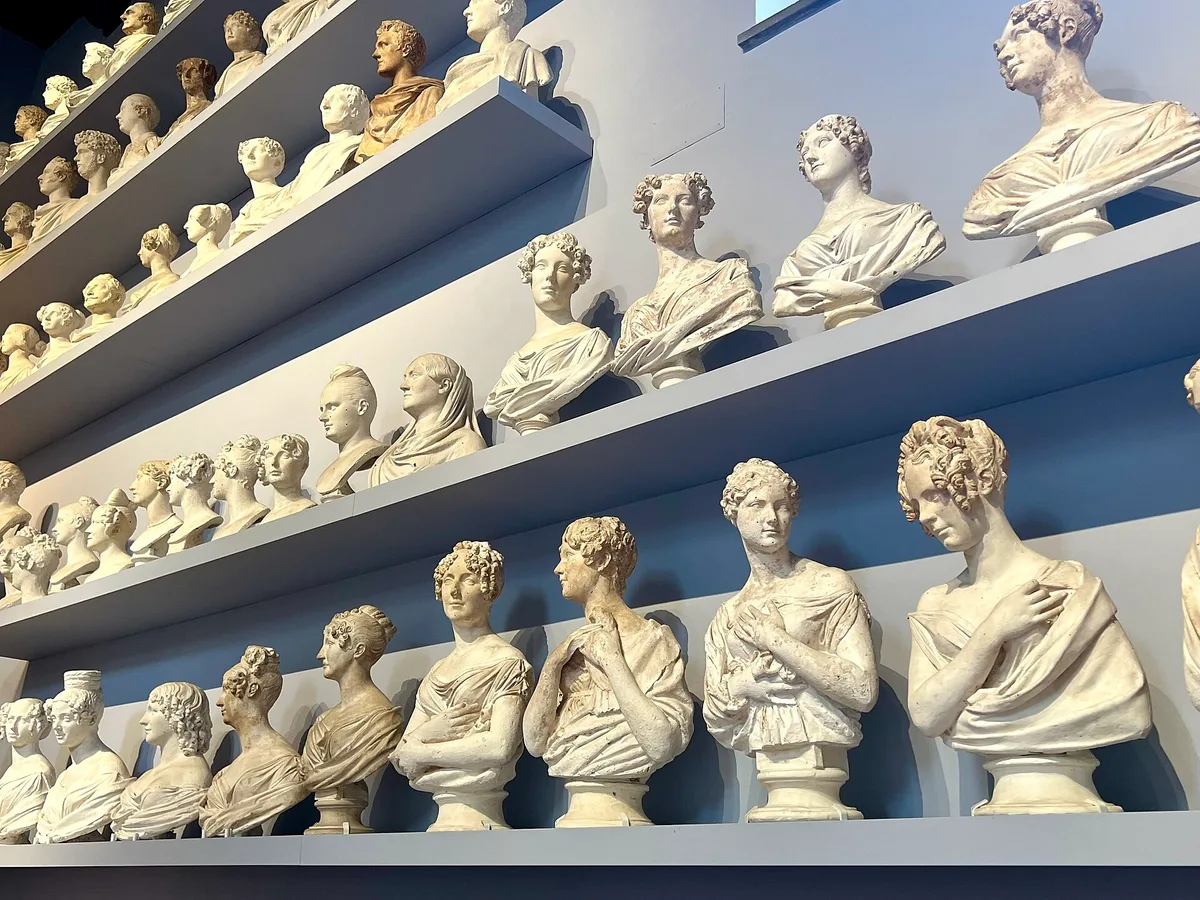
Beyond David, the museum holds a strong collection of Florentine Gothic and early Renaissance panel paintings, a hall of plaster models by Lorenzo Bartolini and other 19th-century sculptors, and a lesser-visited collection of Russian icons upstairs that most tour groups skip entirely, worth ten quiet minutes if you want a break from the crowds around the sculpture halls.
Getting there
The Accademia sits at Via Ricasoli 58/60, in the university quarter a few minutes’ walk north of the Duomo, follow Via Ricasoli straight up from the cathedral and you’ll hit the entrance in about eight minutes on foot. It’s easily combined with Piazza San Marco (with its Fra Angelico frescoes at the Museo di San Marco) and the Duomo complex on the same morning, since all three sit within a compact walking radius.
There’s no dedicated metro in central Florence, so most visitors arrive on foot from wherever they’re staying, or via one of the ATAF city buses that stop near Piazza San Marco.
When to go
This is consistently one of the most-visited museums in Italy, and the queue on Via Ricasoli without a reservation can run well over an hour, especially in spring and summer. The measured crowd pattern backs this up: weekends stay busy from 10am right through to 6pm, so the calm window is early, between 8:15am and 9am at opening. Arriving right when the doors open is the single best move you can make here. You’ll often have the Prisoners hall nearly to yourself before the tour groups arrive. Outside peak season (roughly November through February, excluding holidays), the whole museum breathes easier all day.
How to visit like a local
Book your timed-entry ticket online well ahead (this is standard practice for anyone in Florence who isn’t a first-time tourist, since walk-up tickets mean standing in a line that wraps around the block. Entry is ticketed by time slot, so show up at your slot rather than early; security and bag-check take a few minutes. Payment for tickets is almost entirely online or by card at the counter) cash-only queues are increasingly rare here.
Once inside, resist the urge to plant yourself directly in front of David for ten minutes with your camera; the polite local rhythm is to circle him slowly from multiple angles, then step back to the benches at the edge of the rotunda to sit and look properly, freeing up the sightline for others. The most common visitor mistake is treating this as a ten-minute photo stop and missing the Prisoners and the painting galleries entirely. Budget 60 to 90 minutes minimum. No flash photography is permitted anywhere near the sculptures, and guards enforce it.
Nearby afterward
Once you’re done, Piazza San Marco is two minutes away for a coffee stop, and the leather markets around San Lorenzo are a short walk south if you want to keep exploring on foot rather than doubling back toward the Duomo crowds.
Frequently asked questions
Do I need to book tickets in advance?
Yes — this is one of Florence's busiest museums, and booking a timed-entry slot online ahead of your visit avoids a walk-up queue that can exceed an hour, especially in spring and summer.
How long should I plan to spend there?
Budget 60 to 90 minutes to see David, the Prisoners hall, the painting galleries, and the Russian icon collection without rushing.
When is the quietest time to visit?
On weekends, the calmest window is right at opening, 8:15am to 9am. Crowds build steadily after that and stay heavy from 10am to 6pm.
Is the David at the Accademia the original?
Yes. The statues of David outdoors at Piazza della Signoria and Piazzale Michelangelo are both replicas; the original carved by Michelangelo is housed here.
What else is nearby worth combining with the visit?
Piazza San Marco and the Museo di San Marco (Fra Angelico frescoes) are a few minutes' walk away, and the Duomo is about eight minutes on foot down Via Ricasoli.
Plan your trip to Florence
Some links above are affiliate links — if you book through them, Wander Atlas earns a small commission at no extra cost to you. It's how we keep every guide free.
Related guides
 attraction
 Cathedral of Santa Maria del Fiore: Florence Travel Guide
 attraction
 Basilica of Santa Maria Novella: Florence Travel Guide
 attraction
 Palazzo Vecchio: Florence Travel Guide
 attraction