Shops hanging over the Arno
From the riverbank, the bridge looks overloaded. Small ochre and rust-coloured shopfronts crowd both edges of three stone arches. Their back rooms jut out over the water on wooden brackets, so the whole thing looks like a street that kept going when the land ran out.
Step onto it and it becomes a narrow paved lane. Jewellers’ windows line both sides, full of gold chains, cameos and watches under bright display lights. Halfway across, the shops break for two open terraces facing up and down the river. This is where everyone stops.
Why it’s all gold
It wasn’t always this polished. Butchers, tanners and fishmongers worked here in the Middle Ages and tipped their waste straight into the Arno. In 1593 Grand Duke Ferdinando I de’ Medici threw them out and gave the shops to goldsmiths and jewellers. That trade has stayed on the bridge ever since.
The stone structure you walk on dates from 1345. It replaced an earlier bridge swept away by the flood of 1333, and a crossing stood near this spot back in Roman times. Its wide, shallow segmental arches were an ambitious bit of engineering for the period.
The bridge has survived worse than floods. In August 1944 the retreating German army blew up every other bridge in Florence and spared only this one. To block it, they destroyed the medieval buildings at each end instead. It also came through the great Arno flood of 1966, though its shops were badly damaged.
On the central terrace stands a bronze bust of Benvenuto Cellini, the Renaissance goldsmith and sculptor. It was put up in 1901 in honour of the bridge’s jewellers.
The corridor overhead
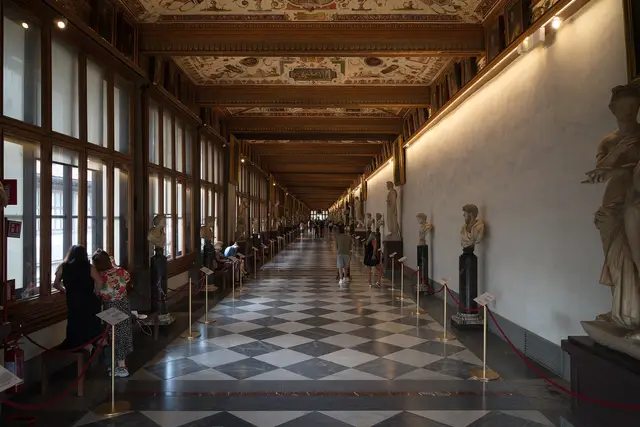
Look up while you’re crossing. On the upstream side, a row of small square windows runs along the top of the shops. That’s the Vasari Corridor, a private elevated passage Giorgio Vasari built in 1565 for Cosimo I de’ Medici. It let the duke walk from Palazzo Vecchio, through the Uffizi and over the river to Palazzo Pitti without mixing with the crowd below.
At the south end, the corridor bends around the medieval Torre dei Mannelli, because the family that owned the tower refused to have it knocked down. The corridor reopened to visitors after a long restoration. Access is by timed ticket through the Uffizi Galleries, so check their official site for availability and prices.

Where to stand for the view
You can’t really see the bridge while you’re standing on it. These spots work better:
- Ponte Santa Trinita, the next bridge west, gives the postcard view of the arches and hanging shops. It’s best in late-afternoon light and at sunset.
- Ponte alle Grazie, to the east, shows the corridor side with the hills of the Oltrarno behind.
- Lungarno degli Archibusieri, the riverside road under the Uffizi, lets you watch the corridor run along the water.
- Piazzale Michelangelo, a steep climb across the river, looks down on the whole bend of the Arno with the bridge in the middle.
Crossing without the crush
This is one of the most crowded few hundred metres in Florence, and nothing about it is secret. Your timing makes a huge difference. Early morning is the calmest stretch. The shops are still shut behind their old wooden shutters, so you see the bridge the way it looked for centuries.
Late morning and early afternoon usually bring the guided groups walking between the Uffizi and Palazzo Pitti. After dark the shops close, street musicians often set up near the terraces, and the lamps reflect on the water. That’s worth doing even if you’ve already crossed in daylight.
Some etiquette the locals will thank you for:
- Step onto a terrace or into a shop doorway to take photos. Don’t stop in the middle of the lane.
- Don’t attach a padlock to the railings around the Cellini bust. It’s banned, it’s fined, and the city cuts them off.
- If you’re buying gold, remember that jewellers here price by weight and purity. Ask for a written certificate and compare a few windows before you commit. Cards are widely accepted.
- Florence’s centre is a restricted traffic zone (ZTL), so walk. It’s about 15 minutes from Santa Maria Novella station, heading down past the Duomo or along the river.
Either end of the bridge
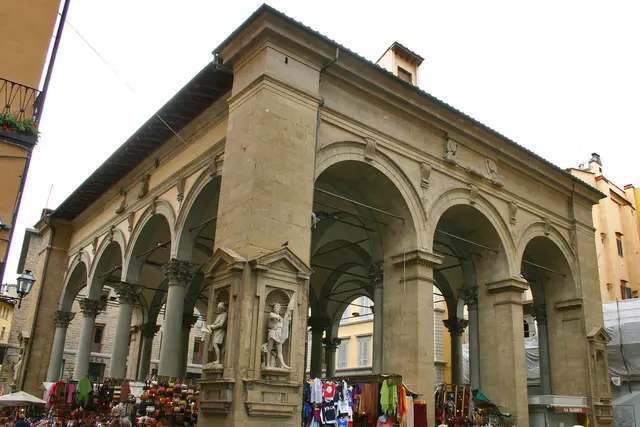
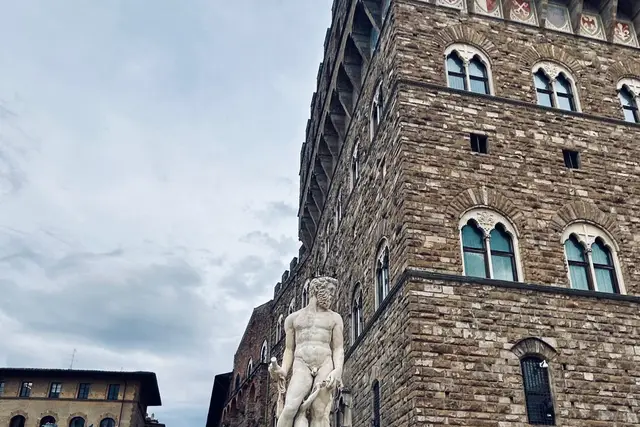
The north end opens onto Via Por Santa Maria. From there it’s a few minutes to Piazza della Signoria, the Uffizi and the Mercato Nuovo loggia. Visitors rub the nose of its bronze boar, Il Porcellino, for luck.
Cross south and you’re in the Oltrarno. Via de’ Guicciardini runs straight to Palazzo Pitti and the Boboli Gardens. The side streets toward Santo Spirito are full of artisan workshops, frame-makers and restorers, and they’re noticeably quieter than the bridge behind you.
Allow about 20 minutes for the crossing and the terrace views. Plan an hour or more if you’ll be browsing the jewellers or walking to the viewpoints on either side.
Frequently asked questions
How do I get to Ponte Vecchio?
Walk. The historic centre is a restricted traffic zone (ZTL), and the bridge is about 15 minutes on foot from Santa Maria Novella station. From Piazza della Signoria and the Uffizi it's a couple of minutes down Via Por Santa Maria.
When is the best time to visit Ponte Vecchio?
Early morning is calmest. The shops are still shuttered and the guided groups haven't arrived yet. After dark is also good, once the shops have closed and the bridge is lit. For photos of the bridge itself, go to Ponte Santa Trinita around sunset.
How long should I spend there?
About 20 minutes covers the crossing and the central terraces. Allow an hour or more if you want to browse the jewellers or walk to the viewpoints at Ponte Santa Trinita and Ponte alle Grazie.
Can I walk through the Vasari Corridor above the bridge?
Yes. The corridor reopened after restoration and is visited by timed ticket through the Uffizi Galleries. Check the Uffizi's official website for availability and current prices.
What's near Ponte Vecchio?
On the north bank you'll find the Uffizi, Piazza della Signoria, Palazzo Vecchio and the Mercato Nuovo with its bronze boar. On the Oltrarno side, Via de' Guicciardini leads to Palazzo Pitti and the Boboli Gardens, and further on is Piazzale Michelangelo's view over the river.
Plan your trip to Florence
Some links above are affiliate links — if you book through them, Wander Atlas earns a small commission at no extra cost to you. It's how we keep every guide free.