Basilica of Santa Croce in Florence: Travel Guide
✓ Facts verified via Google Places · Sep 1, 2026
At a glance
Opening hours
- Monday: 9:30 AM – 5:30 PM
- Tuesday: 9:30 AM – 5:30 PM
- Wednesday: 9:30 AM – 5:30 PM
- Thursday: 9:30 AM – 5:30 PM
- Friday: 9:30 AM – 5:30 PM
- Saturday: 9:30 AM – 5:30 PM
- Sunday: 12:30 – 5:45 PM
Live foot-traffic data via BestTime.app
How this guide is made
Produced with AI assistance and reviewed against live data sources. Facts such as hours, ratings, and location come from Google Places; images are licensed or public domain. Details can change — please verify before visiting. Editorial policy
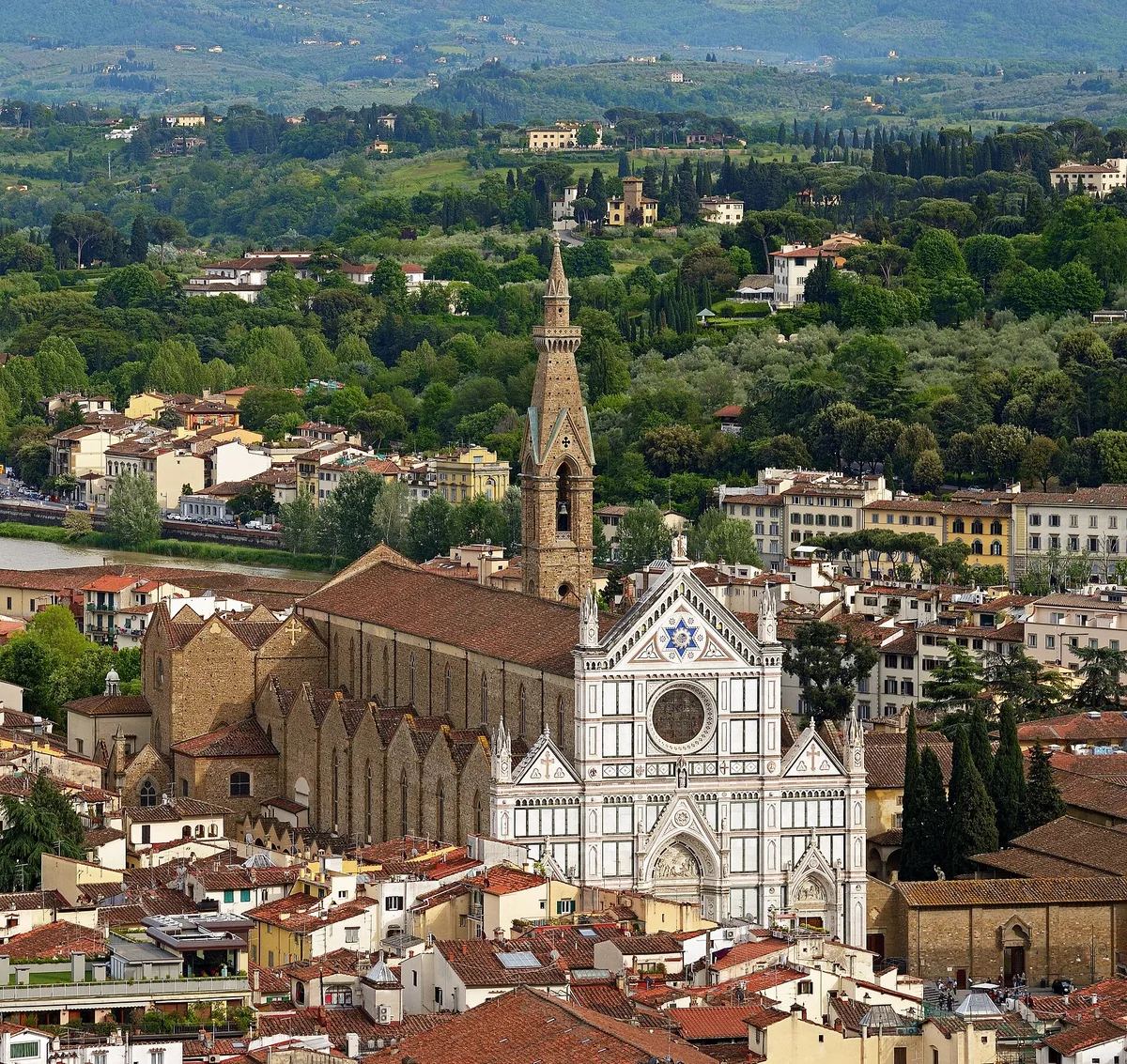
You feel Santa Croce before you see its famous facade. The piazza in front of it is one of Florence’s largest open spaces, a flat expanse of grey stone that in the 16th century hosted calcio storico matches and public executions, and today hosts tourists photographing the church’s green-and-white marble front, a 19th-century neo-Gothic addition, not original to the medieval building behind it.
Step through the doors and the temperature drops, the noise of the piazza falls away, and you’re standing in the largest Franciscan church in the world, its wooden roof trusses stretching overhead like the hull of an upturned ship.
Why go
This isn’t just a church. It’s effectively Italy’s pantheon. Michelangelo is buried here, his tomb designed by Vasari. So is Galileo, whose monument sits opposite, added a century after his death once the Church’s objections had cooled. Machiavelli, Rossini, and the poet Ugo Foscolo are here too, along with a cenotaph for Dante, who never actually made it home from exile to be buried in his native city.
Beyond the tombs, the real draw for art lovers is Giotto’s fresco cycles in the Bardi and Peruzzi chapels near the altar, worn in places, but foundational to Western painting, done decades before his more famous work in Padua and Assisi.
What to see inside
Walk the nave slowly and you’ll pass funerary monuments on both sides before reaching the sanctuary, where the Giotto frescoes depict scenes from the lives of St. Francis and St. John. Off the right transept, the Pazzi Chapel, reached through a tranquil cloister, is Brunelleschi’s small masterpiece of Renaissance proportion: a grey-and-white geometric calm after the ornate nave.
In the museum section, don’t skip Cimabue’s Crucifix, badly damaged in the catastrophic 1966 Arno flood and left partially restored as a deliberate reminder of that disaster, Santa Croce, sitting in a low part of the city, took the worst of the floodwaters. Nearby, Donatello’s gilded Cavalcanti Annunciation and his wooden Crucifix (the one Brunelleschi reportedly mocked as looking like a peasant on the cross) reward a slow look.

Getting there
Santa Croce sits at Piazza di Santa Croce, 16, in the eastern edge of the historic center, about a 10–15 minute walk from the Duomo. Head down Borgo dei Greci or Via de’ Neri and you’ll land right in the square. There’s no metro in central Florence; the nearest train station is Firenze Santa Maria Novella, roughly 20–25 minutes on foot or a short bus/taxi ride. If you’re coming from the Uffizi or Ponte Vecchio, it’s an easy 10-minute stroll along the river side streets.
When to go
The basilica opens in the morning and closes in the late afternoon most days; Sundays it runs shorter hours, geared around morning services. Measured foot-traffic patterns show the calmest window is 9:30am–11am on weekdays and Saturdays. Arrive right at the opening bell and you’ll have long stretches of the nave and the Pazzi Chapel nearly to yourself; Sundays open later, at 12:30pm, so the same logic applies to that first half hour instead.
Weekend afternoons, especially 1pm–5pm, are the peak crush; if a Sunday visit is your only option, go as close to 12:30pm as you can rather than mid-afternoon.
How to visit like a local
Florentines call it simply “Santa Croce,” and locals treat the piazza outside as a real public square, a spot for gelato on the steps, not just a monument forecourt. Because this is one of the most visited sights in Florence, don’t expect a quiet hidden corner; instead, beat the crowds by timing rather than luck, using that 9:30–11am window before tour groups arrive off buses.
Tickets are sold at the door or online in advance, and buying ahead online saves real queuing time in high season (April–October). Inside, the dress code is the standard Italian church rule, shoulders and knees covered, and photography without flash is generally tolerated but keep voices low; this remains an active place of worship, not only a museum.
The tourist mistake to avoid is rushing straight to Michelangelo’s tomb and out again, the leather school at the back of the complex, run by Franciscan friars, and the flood-marked cloisters are easy to miss but take only an extra fifteen minutes.
Frequently asked questions
How long should I spend at Santa Croce?
Plan 60–90 minutes for the church, tombs, and Pazzi Chapel; add 20–30 minutes if you want to see the museum, cloisters, and leather school.
When is the quietest time to visit?
Foot-traffic data shows 9:30am–11am, right after opening, is calmest on weekdays and Saturdays. On Sundays, when the basilica opens later at 12:30pm, arriving right at opening is your best bet. Avoid weekend afternoons between 1pm and 5pm, when it's busiest.
What are the opening hours?
Monday to Saturday it's open 9:30am–5:30pm; Sunday hours are shorter, 12:30–5:45pm, due to morning services. Always check the official schedule before visiting, as hours can shift around holidays.
How do I get to Santa Croce from the train station?
From Firenze Santa Maria Novella it's about a 20–25 minute walk east through the historic center, or a short bus/taxi ride. On foot from the Duomo, it's roughly 10–15 minutes.
Is Santa Croce worth it if I've already seen the Duomo and Uffizi?
Yes — it holds a different draw: the tombs of Michelangelo, Galileo, and Machiavelli, plus Giotto's frescoes and Brunelleschi's Pazzi Chapel, none of which overlap with those other sights.
Plan your trip to Florence
Some links above are affiliate links — if you book through them, Wander Atlas earns a small commission at no extra cost to you. It's how we keep every guide free.
Related guides
 attraction
 Palazzo Vecchio: Florence Travel Guide
 attraction
 Uffizi Galleries: Florence Travel Guide
 attraction
 Cathedral of Santa Maria del Fiore: Florence Travel Guide
 attraction