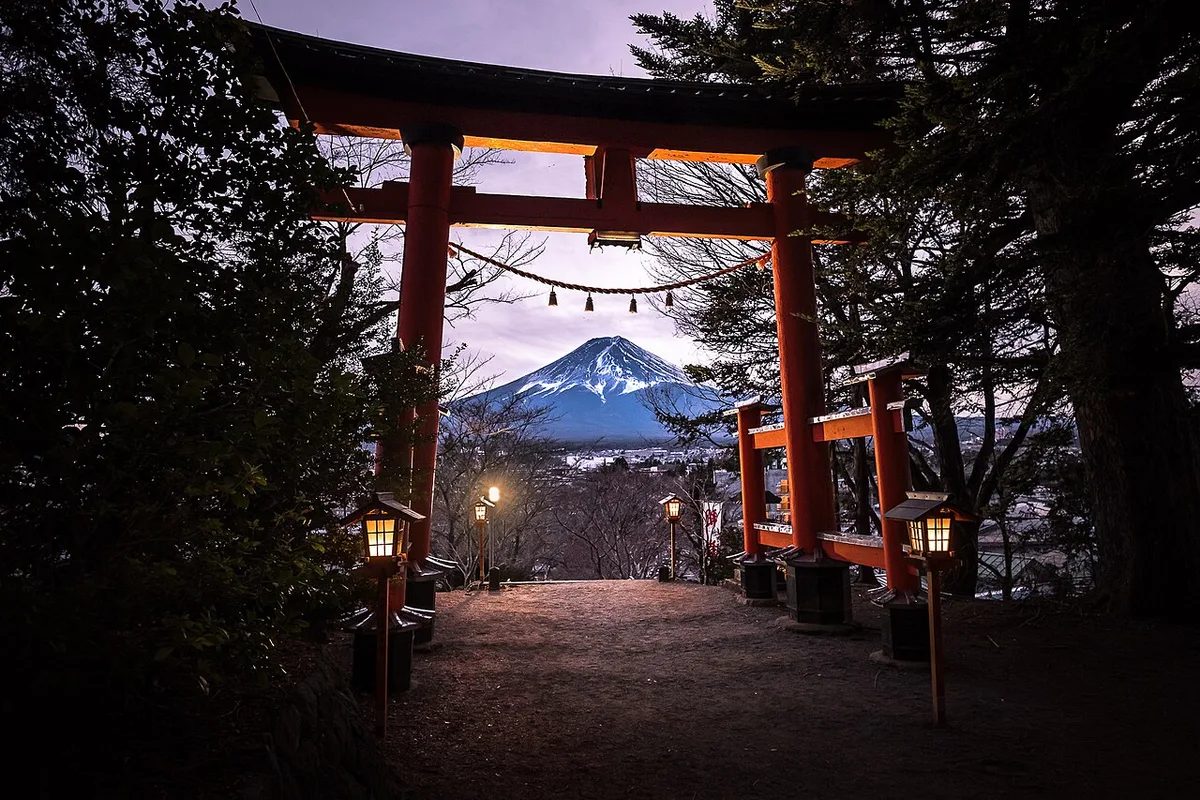
A December Sunday under the mountain
The date is Sunday, December 13, 2026. On that day the Mt. Fuji International Marathon takes place in the lake country at Fuji’s northern foot. Fujiyoshida is the gateway town here. Its streets climb toward the volcano, and on clear days the snow-capped cone fills the end of the road.
This is an annual race, and in mid-December the setting does a lot of the work. Winter is when the air around Fuji tends to be driest and the summit is most often visible. The trade-off is cold. Mornings in this area at an altitude of around 800 metres regularly sit near or below freezing.
The organiser publishes the start location, course map, cut-off times and race-day schedule on its official site. This guide covers the place around the race: how people get there, where they sleep, and what the town offers once the medal is round your neck.
Getting to Fujiyoshida from Tokyo
You have two routes, and both start in Shinjuku.
- Train: The JR Chuo Line runs to Otsuki, where you change to the Fujikyu Railway. That line climbs to Fujisan Station in central Fujiyoshida and ends at Kawaguchiko Station. The limited express Fuji Excursion runs directly from Shinjuku onto the Fujikyu line, so you skip the change.
- Highway bus: Buses leave Busta Shinjuku, the terminal above Shinjuku Station’s south side, for Fujisan Station, Fuji-Q Highland and Kawaguchiko Station. The ride usually takes around two hours, depending on traffic on the Chuo Expressway.
Either way, plan on about two to two and a half hours from central Tokyo. On a race weekend, runners usually treat the day before as a travel day. Very few try to arrive from Tokyo on the morning itself.
Where runners usually stay
Accommodation falls into two clusters. Fujiyoshida has business hotels and guesthouses near Fujisan Station and Shimoyoshida Station. Many of these are cheaper and less touristy than places on the lake. Fujikawaguchiko, one stop on at the end of the line, has the ryokan, lakeside hotels and onsen resorts.
Visitors usually stay within walking distance of a Fujikyu station. Taxis are limited across the Fuji Five Lakes area, and buses thin out in the evening. Being close to the line keeps race morning simple. It also means a short shuffle home on tired legs afterwards.
Cold-weather racing at altitude
A December marathon in this area is a different event from a city race at sea level. Runners commonly line up in throwaway layers, gloves and a hat, then shed them as the sun climbs. The sun is strong at this elevation even in winter. Shade along the lakes stays cold, though, so many people keep their gloves on for the whole race.
The altitude matters less than the chill, but it is real. The race runs at a height where breathing feels slightly harder on climbs for people who live at sea level. Experienced runners usually hold back on pace for the first few kilometres. A warm layer, dry socks and something hot to drink are standard in the post-race bag.
Refuelling the Fujiyoshida way: Yoshida udon
The town’s signature dish suits a cold race day. Yoshida udon (吉田のうどん) is famous across Japan for being the firmest, chewiest udon you will meet. The thick noodles take real jaw work. They come in a soy and miso broth, usually topped with boiled cabbage, and horse meat is the traditional topping.
Each table has suridane, a fiery paste of chilli, sesame and spices, for you to add to the bowl. Many of the town’s udon shops are small and casual, and some operate out of the front rooms of homes. Plenty open only around lunch, so a post-race bowl is easiest on the day before or the day after the race.
Small courtesies on and off the course
Japanese running events follow a quiet set of norms, and visitors fit in easily once they know them.
- Rubbish: Public bins are rare in Japan. Runners carry gel wrappers to the bins at aid stations or take them home.
- Aid stations: Volunteers hand out drinks, and a nod or a quick arigatō is the usual thanks. Tipping is not done.
- Onsen after the race: You wash fully at the seated showers before getting into the bath. Towels stay out of the water. Rules on tattoos vary by facility, and many post them at the entrance.
- Paying: IC cards and credit cards work in stations and chain shops. Small udon counters and family-run places in Fujiyoshida often take cash only.
- Language: The race is called Fujisan Marason in Japanese, and local signs mostly use 富士山 (Fujisan) for the mountain.
The day after: Fujiyoshida on stiff legs
Most of the town’s classic views involve stairs, so time them according to how your quads feel.
- Chureito Pagoda (Arakurayama Sengen Park): The five-storey red pagoda with Fuji behind it is one of the most photographed views in Japan. Getting there means several hundred steps from Shimoyoshida Station, which is a test the day after 42 kilometres.
- Kitaguchi Hongu Fuji Sengen Jinja: This is a forested shrine with a long cedar-lined approach. Historically it was the starting point for pilgrims climbing Fuji from the north. The walk is flat and gentle.
- Honcho-dori: Fujiyoshida’s main shopping street runs straight toward the mountain. On a clear day the street scene with the volcano at the end draws a steady line of photographers.
- Lake Kawaguchi: It is one stop away by Fujikyu Railway. The northern shore gives broad views of Fuji across the water.
Fuji-Q Highland, the roller-coaster park next to Fujikyu’s Fuji-Q Highland Station, is also nearby for anyone with legs to spare. Mid-December light fades by late afternoon. Visitors usually save mornings for mountain views, when Fuji is most often clear of cloud.
Frequently asked questions
When is the Mt. Fuji International Marathon in 2026?
It takes place on Sunday, December 13, 2026. The organiser publishes the start time, course map and race-day schedule on its official site.
How do I get to Fujiyoshida for the race?
From Shinjuku you can take the JR Chuo Line to Otsuki and change to the Fujikyu Railway, or take the direct limited express Fuji Excursion. You can also take a highway bus from Busta Shinjuku to Fujisan Station or Kawaguchiko Station. Both routes usually take around two to two and a half hours.
How cold is it in December?
Mornings in the Fuji Five Lakes area at around 800 metres regularly sit near or below freezing. The sun is strong at midday. Runners typically start in throwaway layers, gloves and a hat.
Where do marathon runners usually stay?
They usually stay near a Fujikyu Railway station, either in Fujiyoshida around Fujisan or Shimoyoshida stations, or in Fujikawaguchiko by the lake, where most of the ryokan and onsen hotels are. Most travel up the day before.
What is there to do nearby after the race?
You can visit Chureito Pagoda in Arakurayama Sengen Park, which involves a lot of steps. You can also walk the cedar approach of Kitaguchi Hongu Fuji Sengen Jinja, see Fuji from Honcho-dori, or take a lakeside walk at Lake Kawaguchi. For food, try a bowl of the famously firm local Yoshida udon.
Plan your trip to Fujiyoshida
Japan eSIM & staying connected →
Some links above are affiliate links — if you book through them, Wander Atlas earns a small commission at no extra cost to you. It's how we keep every guide free.