Four storeys of rust-red stone
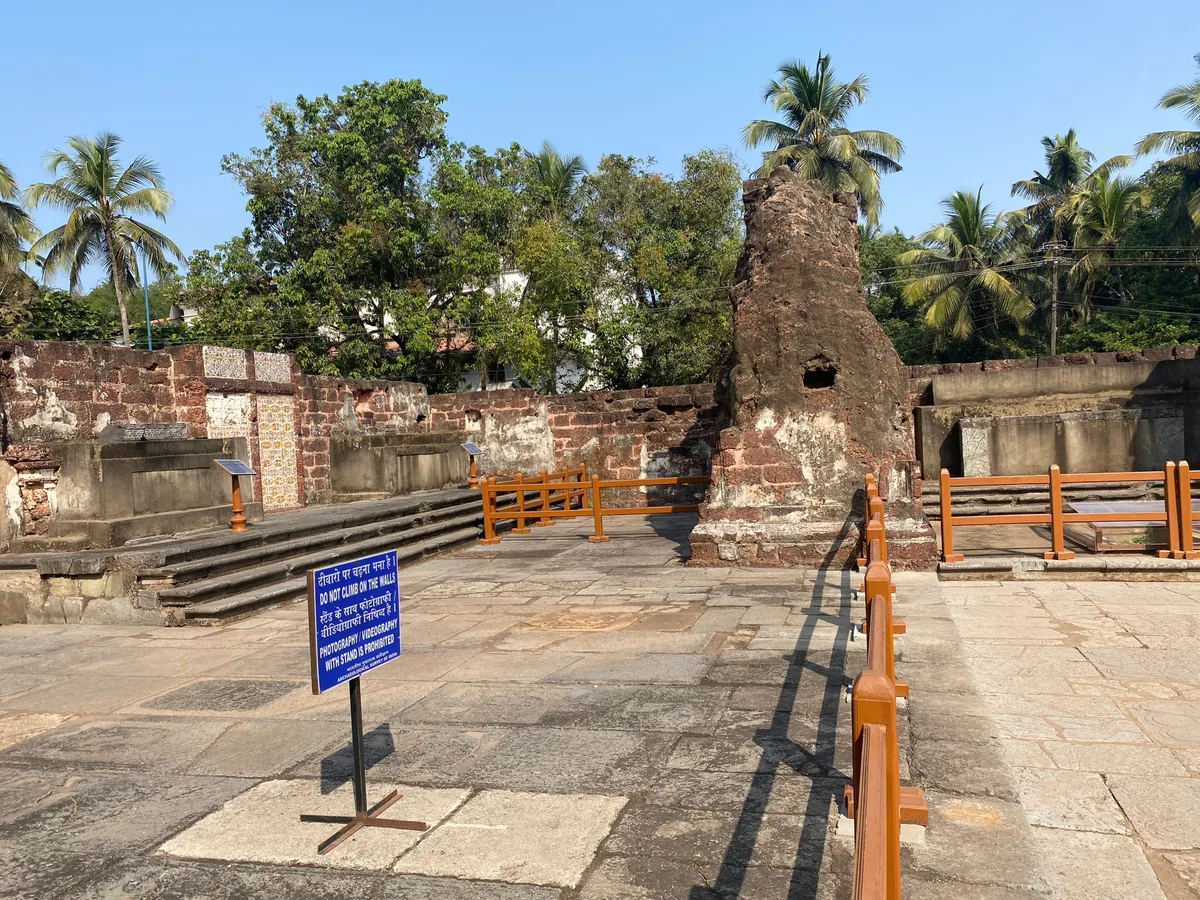
One wall of a tower stands against the sky. It rises in four tiers of laterite, the porous red-brown stone that went into almost everything the Portuguese built in Old Goa. At 46 metres it is still the tallest thing on Holy Hill, and it is all that is left above head height of the Church of St. Augustine.
Around its base, the church’s footprint spreads out in low walls, broken pillar bases and grassy chapels with no roofs. You walk across what used to be the nave. The tower’s arched openings look out over open air.
How a great church came down
The Augustinian friars finished the complex in 1602. It was one of the largest churches in Portuguese Goa. It did not survive the order: religious orders were suppressed in 1835, the friars left, and nobody kept the building up.
The vault fell in 1842. The facade and much of the tower came down in the 1930s, leaving the single tier-stacked shell you see now. The great bell went to the Church of Our Lady of the Immaculate Conception in Panaji, where it still hangs above the whitewashed steps.
The ruins are part of the UNESCO World Heritage listing for the Churches and Convents of Goa. Archaeologists excavating here also identified remains linked to St. Ketevan, a Georgian queen martyred in Persia. That is why some visitors come from Georgia specifically.
Getting up Holy Hill
Old Goa is roughly 10km east of Panaji along the Mandovi river. Local buses run from Panaji’s Kadamba bus stand to Old Goa. Taxis and rented scooters are the other usual options. Karmali, on the Konkan Railway, is the nearest train station.
Once you’re in Old Goa, the tower sits up the lane behind the main church cluster. From the Basilica of Bom Jesus it’s a short uphill walk. Along the way you pass the Convent of Santa Monica and the Chapel of Our Lady of the Rosary, which are also on the hill.

Walking the ruins without the crowds
This is a well-known stop on the Old Goa circuit, and the tour coaches find it. The quietest windows are usually 9am–11am on weekdays and 9am–10am on weekends. Try not to arrive on a weekend between 11am and 5pm. That’s when groups pile in after the Basilica.
A few practical habits help:
- Go early for the light as well as the space. In the morning the sun falls on the laterite at a low angle. By midday there is almost no shade on the hilltop.
- Treat it as a ruin, not a playground. You can’t climb the tower. Stay off the crumbling wall tops, however photogenic they look.
- Dress for the church next door. The ruin itself isn’t a place of worship, but most people pair it with the Basilica and Sé Cathedral, which still hold services. Covered shoulders and knees keep the day simple.
- Check details at the gate. The site is run as a protected monument. Entry rules and any ticketing are posted at the entrance, and the official Archaeological Survey of India listings carry current information.
The listing currently shows 9am–5pm. Heritage sites shift their hours through the year and around holidays, though, so confirm before you make a special trip.
Pairing it with the rest of Old Goa
Most visitors spend 30–45 minutes at the ruins. That’s long enough to walk the footprint, read the information boards and photograph the tower from below. It works best as one stop on a half-day loop on foot.
- Basilica of Bom Jesus: holds the tomb of St. Francis Xavier, at the foot of the hill.
- Sé Cathedral: the vast whitewashed cathedral across the main road.
- Church of St. Francis of Assisi: next to the Sé, with the Archaeological Museum in the former convent.
- Convent of Santa Monica: on the way up to the tower.
- Chapel of Our Lady of the Rosary: on the hill’s edge, looking out over the Mandovi.
When to plan your visit
November to February brings the driest, most comfortable weather for walking exposed hilltop ruins. The monsoon, roughly June to September, turns the grass green and the laterite dark with rain. It also makes the paths slick, so wear shoes with grip if you visit then.
Whatever the month, carry water. There’s little on the hill itself. Leave the afternoon for the riverside or for Panaji’s old Fontainhas quarter, and give the tower the morning.
Frequently asked questions
When is the quietest time to visit St. Augustine Tower?
Typically 9am–11am on weekdays and 9am–10am on weekends. Avoid weekends between 11am and 5pm, when it is usually busiest.
How do I get to St. Augustine Tower from Panaji?
Old Goa is about 10km east of Panaji. Local buses run from the Kadamba bus stand, and taxis and scooters are common. The tower is a short uphill walk from the Basilica of Bom Jesus on Holy Hill.
Can you climb the tower?
No. The tower is a fragile ruin, the last standing part of a church that collapsed in stages from 1842 onwards. You see it from the ground and walk the excavated church footprint around it.
How long should I spend there?
About 30–45 minutes for the ruins alone. Allow half a day if you add the Basilica of Bom Jesus, Sé Cathedral, the Church of St. Francis of Assisi and the Archaeological Museum.
What are the opening hours?
The current listing shows 9am–5pm. Heritage sites can change hours by season and on holidays, so check the posted information or the official listing before you go.
Plan your trip to Goa
India eSIM & staying connected →
Some links above are affiliate links — if you book through them, Wander Atlas earns a small commission at no extra cost to you. It's how we keep every guide free.