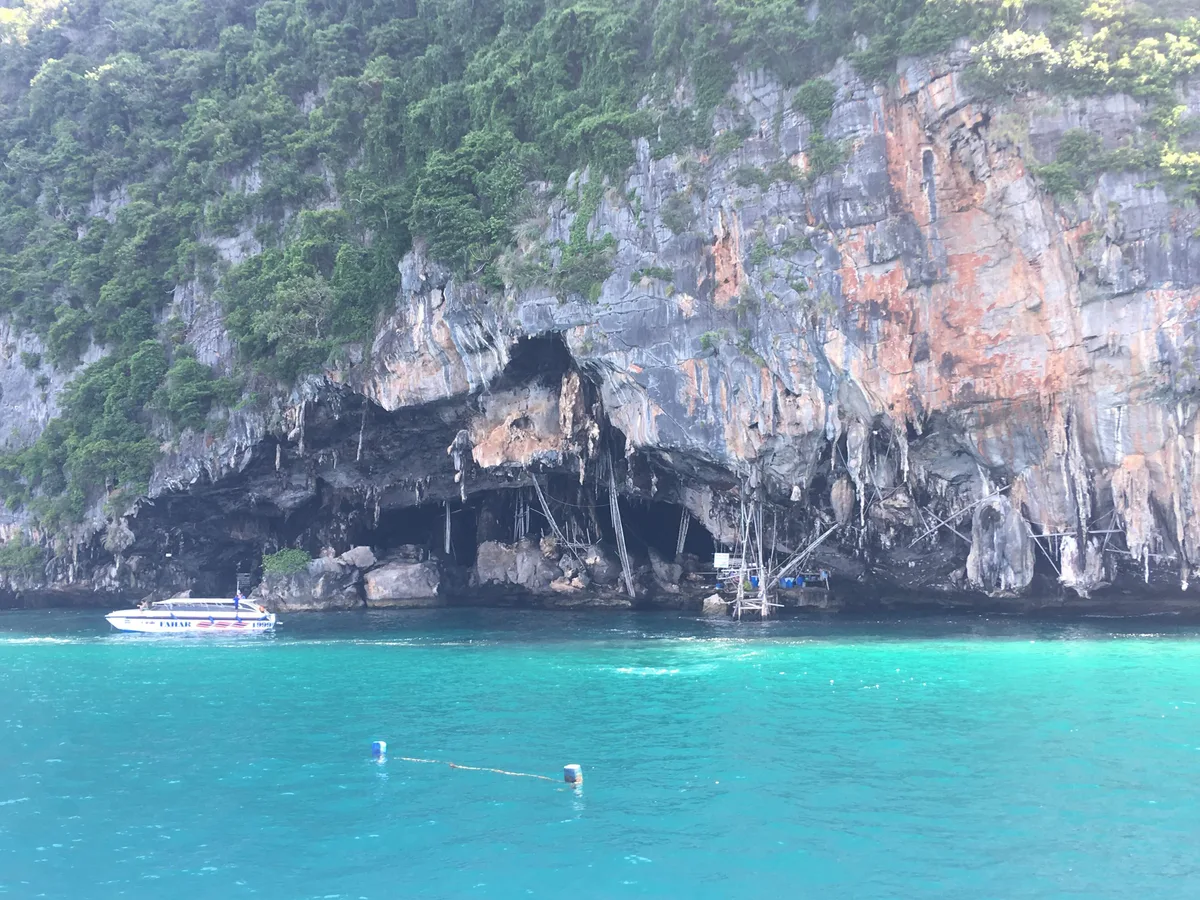
A cliff with scaffolding on it
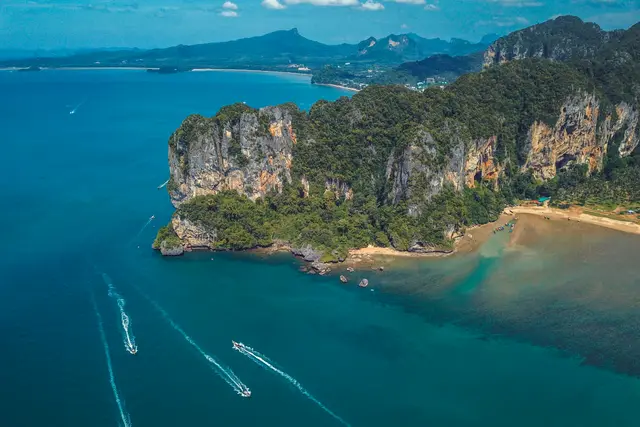
Your boat slows and drifts under a sheer wall of grey and rust-streaked limestone on the east side of Phi Phi Leh. At its base, a dark mouth opens just above the waterline. Above it, bamboo poles and ladders are lashed against the rock, climbing toward the roof of the cave.
That scaffolding is the point. Viking Cave is a working site for harvesting swiftlet nests, the saliva-built cups that go into bird’s nest soup, a traditional Chinese delicacy. The rock is the same honeycombed limestone that makes Phi Phi look the way it does. The cave’s name comes from what’s inside.
Why it’s called Viking Cave
The cave walls carry old paintings of boats. Early visitors thought the vessels looked like Viking longships, and the name stuck. That’s a poetic reading, not history. The drawings are more often linked to Asian and Arab trading ships that sheltered in these waters long before tourism arrived.
The Thai name is Tham Phaya Nak, the Cave of the Serpent King. Either name gets you understood at the pier. Mostly you’ll hear “Viking Cave” on the tour boards in Tonsai.
You won’t see the paintings yourself. Tourists aren’t allowed to land, so the cave is a view from the boat: the entrance, the bamboo rigging and sometimes the collectors’ shelters at the base. Go with that expectation and the stop makes sense.
Getting out to Phi Phi Leh
Every trip starts on the water. Most people leave from Tonsai Pier on Phi Phi Don, the main inhabited island, which ferries reach from Phuket and Krabi. Day-trip speedboats from Phuket and Ao Nang also include Viking Cave on Phi Phi loops.
Here’s the usual Phi Phi Leh circuit, so you know what the stop sits alongside:
- Viking Cave, a slow pass along the northeast cliffs
- Pileh Lagoon, an enclosed turquoise bay ringed by cliffs, popular for swimming
- Loh Samah Bay, a common snorkelling stop
- Maya Bay, the beach from The Beach, now run under strict visitor rules
- Monkey Beach, back on Phi Phi Don, on many half-day routes
The cave is often the first or last stop because it’s close to the Phi Phi Don side. Google lists the site as open 24 hours since it’s simply a cliff face. In practice you’ll only see it on daylight boat trips.
Picking your season and your seat
Weather decides this trip. The Andaman coast is calmest roughly November to April, when the water is flatter and the cliffs are easier to photograph from a rocking boat. From about May to October the southwest monsoon can make crossings choppy, and some boat trips get cut short or cancelled.
Morning light hits the east-facing cliff, which helps if you want the scaffolding in focus. Sit on the side of the boat nearest the rock as you approach from the north. On a speedboat, ask the crew which side to take. On a longtail, the driver will usually turn the bow in so everyone gets a look.
Booking a boat at Tonsai Pier
How you book shapes what you see. Group speedboat tours keep a tight schedule, so Viking Cave can be a two-minute slowdown. A private longtail hired along the Tonsai seafront gives you more say over how long you stay.
- Agree the route and the price before you board. Longtail drivers quote per boat, not per person, and the stops you want should be named out loud.
- Ask to linger. Drivers are used to holding position under the cliff for photos if the sea allows it.
- Don’t ask to land. Access is restricted to protect the nest harvest, and guards watch the site.
- Expect national park fees. Phi Phi Leh is inside a marine national park. Fees are collected separately from your boat fare, and the current rates are posted by the park, so check them on the day.
- Pay the longtail in cash, in Thai baht. Many tour desks in Tonsai take cards, but the boats themselves rarely do.
Is it worth the stop?
Treat Viking Cave as a footnote on a Phi Phi Leh day, not the main reason to go. It’s well known and on nearly every island-loop itinerary, so you’ll share the water with other boats. Seeing it comes free with the route.
What makes it worth a look is the contrast. Ten minutes from a lagoon full of swimmers, men climb bamboo poles inside a cliff to collect nests, as people have done here for generations. Look up at the rigging as you drift past.
Frequently asked questions
Can you go inside Viking Cave?
No. Tourists aren't allowed to land because the cave is a working swiftlet-nest harvesting site, and it's guarded. You see the entrance and bamboo scaffolding from your boat.
How do I get to Viking Cave from Koh Phi Phi?
Take a longtail or speedboat tour of Phi Phi Leh from Tonsai Pier on Phi Phi Don. Day trips from Phuket and Ao Nang in Krabi also include it on Phi Phi loops.
How long does the Viking Cave stop take?
Usually just a few minutes of slow cruising under the cliff. On a private longtail you can ask the driver to hold position longer for photos if the sea is calm.
When is the best time to visit Viking Cave?
Roughly November to April, when Andaman seas are calmer. Morning light falls on the east-facing cliff. From about May to October, monsoon swells can make crossings rough or cancel trips.
What else is near Viking Cave?
It sits on Phi Phi Leh alongside Pileh Lagoon, Loh Samah Bay and Maya Bay, and most tours combine them. Monkey Beach on Phi Phi Don is often added to half-day routes.
Plan your trip to Koh Phi Phi
Thailand eSIM & staying connected →
Some links above are affiliate links — if you book through them, Wander Atlas earns a small commission at no extra cost to you. It's how we keep every guide free.
Related guides
 hidden gem
Phi Phi Lee Island: Koh Phi Phi Travel Guide
 attraction
Monkey Bay: Koh Phi Phi Travel Guide (4.2★)
 attraction
Phi Phi Islands: Koh Phi Phi Travel Guide
 attraction