Seven Hundred Years of Turning
The night is called Şeb-i Arus. That means “wedding night”, and it is how the Mevlevi order describes 17 December 1273, the night Jalal al-Din Rumi died in Konya. To his followers, death was a reunion with God, not an ending.
The Mevlana Festival runs December 7–17, 2026, building toward that anniversary. Each evening the semazen, the whirling dervishes, perform the sema. This is a structured ritual of music, prayer and turning, and Konya has hosted the commemoration for generations.
Inside the Sema
The performance starts with music, and the dervishes stand still at first. The ney, a reed flute, opens it, with drums and singing in Turkish and Persian around it. The dervishes walk in wearing black cloaks and tall honey-coloured felt hats called sikke. The hat stands for a tombstone and the cloak for the grave.
When the cloaks drop, white skirts appear underneath. One by one the dervishes begin to turn, right palm up to receive from heaven and left palm down to pass it to the earth. The sema has four sections called selam. A sheikh in a darker cloak moves slowly among the turning figures.
Expect the ceremony to last about an hour. It is closer to a liturgy than a stage show, and the pace builds slowly.
Venue and Tickets
The main ceremonies are traditionally staged at the Mevlana Cultural Center (Mevlana Kültür Merkezi). This large modern hall has a circular floor designed for the sema, with tiered seating around it. It is a short walk east of the Mevlana Museum.
Seats for the final nights, especially 17 December, are the hardest to get. Confirm timing, venue and tickets on the official site, and buy through that site or the venue’s official box office, not resellers. No ticket price is given here. The official listing shows the current one.
Watching Without Breaking the Spell
The audience is part of the ritual’s mood. Many Turkish visitors come as pilgrims, not spectators. Follow what they do:
- Hold your applause. Announcers usually ask the hall not to clap, because the sema is a prayer. Stay silent at the end too, unless the room clearly does otherwise.
- No flash. Turn your phone to silent and dim, and follow any photography rules announced before the start.
- Arrive early. Doors and security checks take time on the big nights, and latecomers are not always seated mid-ceremony.
- Dress modestly. Shoulders and knees covered is a sensible default. Bring a headscarf if you plan to visit the museum and mosques by day.
Konya is one of Turkey’s more conservative cities, so expect alcohol to be scarce in the old centre. Cards work in most restaurants and shops. Keep some lira for tea and small bakeries.
By Day: Rumi’s Konya
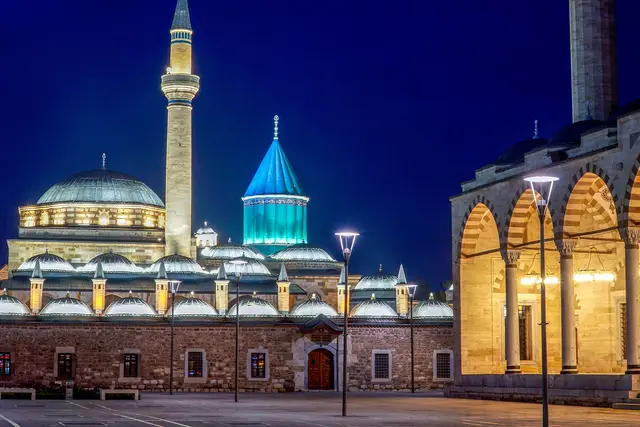
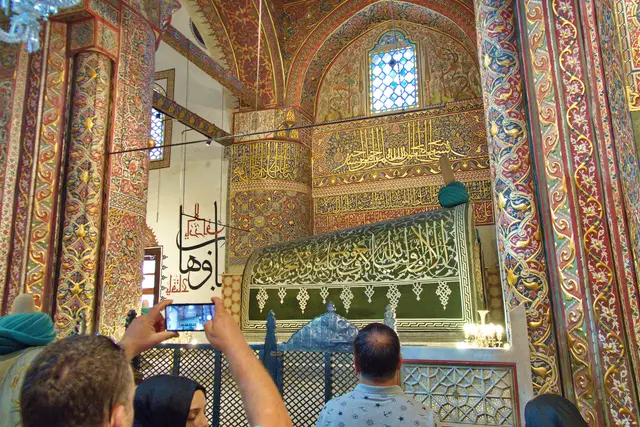
Rumi’s tomb lies under the turquoise-tiled dome of the Mevlana Museum, once the order’s dervish lodge. During the festival, queues of pilgrims file past his sarcophagus. Getting there right at opening usually beats the tour groups. Next door stands the Ottoman Selimiye Mosque.
Nearby stops worth fitting in:
- Tomb of Şems-i Tebrizi. This honours the wandering mystic whose friendship changed Rumi. It is a few minutes’ walk north-west.
- Alaeddin Hill. The old Seljuk citadel mound and its mosque, at the western end of Mevlana Avenue.
- Karatay Madrasa. A 13th-century Seljuk school, now a tile museum, below Alaeddin Hill.
For food, order etli ekmek, Konya’s long, thin flatbread topped with minced meat. Fırın kebabı, slow-roasted lamb, is the other local classic. Finish with sweet tea.
Reaching Konya in December
Most visitors come by high-speed train (YHT). Direct services run from Ankara in under two hours, and there are connections from Istanbul. Konya Airport has domestic flights, mostly from Istanbul. Mevlana Avenue links the old centre’s sights, and the city tram serves the centre.
Konya sits on the Anatolian plateau, about 1,000 metres up. December nights are cold and snow is possible, so pack a warm coat for the walk back from the cultural center. Hotels near the museum fill up for the final nights, so book early if 17 December is your target.
Frequently asked questions
When is the Mevlana Festival in 2026?
It runs December 7–17, 2026. The final night, 17 December, is Şeb-i Arus, the anniversary of Rumi's death in 1273, and it is the most sought-after ceremony. Confirm exact dates on the official site.
Where are the whirling dervish ceremonies held?
They are traditionally held at the Mevlana Cultural Center (Mevlana Kültür Merkezi) in Konya, a short walk east of the Mevlana Museum. Check the official site for the venue of each performance.
How long does a sema ceremony last?
Allow about an hour for the ceremony itself, plus time for security checks and finding your seat. Arriving early is wise on the final nights.
Can I clap or take photos during the ceremony?
The sema is a religious ritual, and audiences are usually asked not to applaud. Flash photography is not appropriate. Follow the announcements made before it starts.
How do I get to Konya?
The easiest route is the high-speed YHT train from Ankara, which takes under two hours, with connections from Istanbul. Konya Airport also has domestic flights, mainly from Istanbul.
Plan your trip to Konya
Some links above are affiliate links — if you book through them, Wander Atlas earns a small commission at no extra cost to you. It's how we keep every guide free.