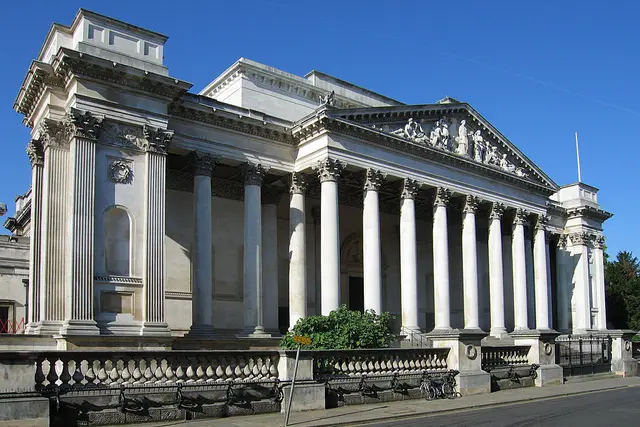
Forty-odd Ionic columns line the front of a pale stone building on Great Russell Street, and a queue for the bag check shuffles through the forecourt below them. Robert Smirke designed this Greek Revival facade in the nineteenth century. The museum itself goes back further: it was founded in 1753, and it has been collecting the world ever since.
Under the glass roof
Go through the doors and the space opens out. The Great Court is a covered square with a roof of steel and triangulated glass panes, designed by Norman Foster’s practice and opened in 2000. The round, drum-shaped Reading Room stands in the middle.
This is where you get your bearings. Maps and information desks sit here, and every wing opens off it. Most people drift left toward the Egyptian and Greek galleries on the ground floor, so that side fills first.
The rooms people come for
The editorial shorthand fits: this is a huge showcase for global antiquities, and Egyptian mummies and ancient Greek sculpture top most lists. You could walk for days. For a first visit, these are the anchors:
- Rosetta Stone, Room 4: expect a crowd three deep around the glass case
- Parthenon sculptures, Room 18: a long, top-lit hall of marble frieze and pediment figures
- Egyptian mummies, Rooms 62–63, upstairs: painted coffins and wrapped bodies in long cases
- Sutton Hoo treasure, Room 41: the Anglo-Saxon ship burial and its helmet
- Lewis Chessmen, Room 40: walrus-ivory pieces with glum, oversized faces
Two to three hours covers these at a sensible pace. A full day barely scratches the rest.

Timing your visit around the crowds
Opening hours shift across the week, so check the day before you plan. It opens at 10am daily. Most days it closes at 5pm, but Wednesday closes early at 3:30pm and Friday stays open until 8:30pm.
Our measured foot-traffic says weekdays are quiet right across the 10am–6pm window. In practice that means any weekday hour the doors are open. Weekends work differently. The calm stretch is 10am–11am, and the busiest period runs from 12pm to 4pm.
Arrive after noon on a Saturday and you will be queueing at the Rosetta Stone for a clear look. A Friday evening, after the school groups leave, is a good weekday alternative.
Getting through the doors smoothly
The museum is well known and gets plenty of visitors, so the goal is simply to avoid the worst of the crush. A few habits help:
- Book a timed slot. General admission to the permanent collection is free, and the museum often recommends booking an entry time on its official website. Check there before you go.
- Use the back entrance. Montague Place, on the north side, usually has a shorter bag-check line than the main Great Russell Street gate.
- Pack light. Every bag is searched on the way in, and large luggage is not accepted.
- Donate if you can. Donation boxes stand near the entrances, and that is the local custom in free UK museums.
- Pay for exhibitions separately. Special exhibitions need their own ticket, with prices on the official site.
Talk quietly in the galleries. Photos without flash are generally fine in the permanent collection, but watch for signs in exhibition spaces.
Getting there and what’s nearby
Several Underground stations are within a ten-minute walk:
- Tottenham Court Road: Central, Northern and Elizabeth lines
- Holborn: Central and Piccadilly lines
- Russell Square: Piccadilly line
- Goodge Street: Northern line
The full address is Great Russell St, London WC1B 3DG. Around it, Bloomsbury is a district of garden squares and Georgian terraces. Russell Square and Bedford Square are close by for a sit on a bench. Covent Garden is about fifteen minutes’ walk south, and Sir John Soane’s Museum in Lincoln’s Inn Fields makes a much smaller, stranger second stop.
Frequently asked questions
When is the quietest time to visit the British Museum?
Weekdays are quiet right across the measured 10am–6pm window, so any weekday hour it is open works. At weekends the calm stretch is 10am–11am. Avoid 12pm–4pm on Saturdays and Sundays, when it is busiest.
What are the British Museum's opening hours?
It opens at 10am every day. It closes at 5pm on Monday, Tuesday, Thursday, Saturday and Sunday, at 3:30pm on Wednesday and at 8:30pm on Friday.
How long do I need at the British Museum?
Allow two to three hours for the highlights: the Rosetta Stone (Room 4), the Parthenon sculptures (Room 18), the Egyptian mummies (Rooms 62–63) and Sutton Hoo (Room 41). A full day still only covers a fraction of the collection.
What is the nearest Tube station to the British Museum?
Tottenham Court Road (Central, Northern and Elizabeth lines) and Holborn (Central and Piccadilly lines) are both under ten minutes' walk away. Russell Square and Goodge Street are also close.
Do I need to book tickets for the British Museum?
The permanent collection is free, but the museum often recommends booking a timed entry slot on its official website. Special exhibitions are ticketed separately, and prices are listed on the official site.
Plan your trip to London
Some links above are affiliate links — if you book through them, Wander Atlas earns a small commission at no extra cost to you. It's how we keep every guide free.