A stone house built for one very rich man
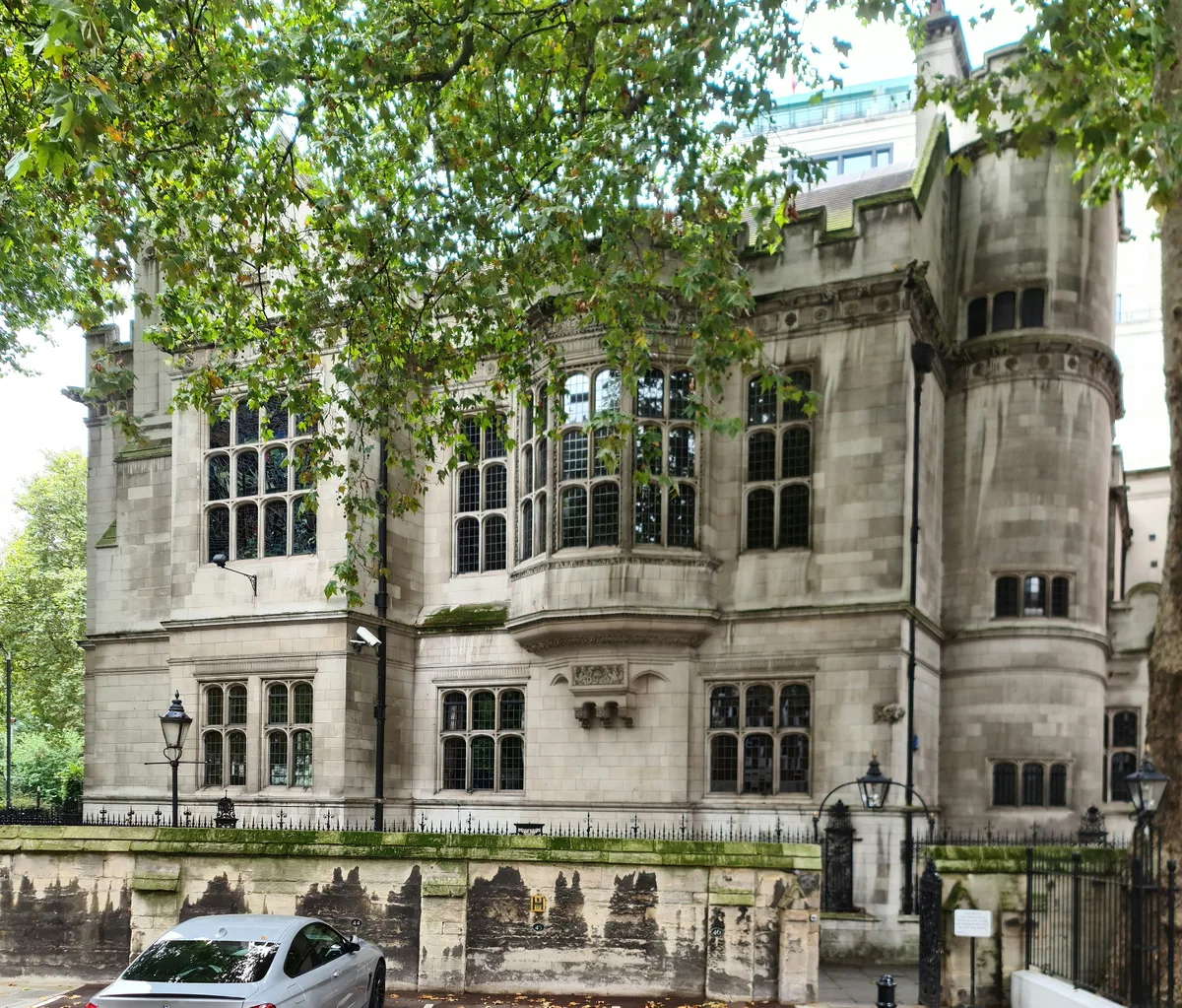
From the Embankment it looks like a small Gothic fortress. Two Temple Place was built in the 1890s as the estate office of William Waldorf Astor, then one of the richest men in the world. His architect was John Loughborough Pearson, better known for churches, and it shows.
The outside is pale Portland stone with steep roofs and mullioned windows. Look up at the roofline for the gilded weathervane. It is a model of the Santa Maria, the ship Columbus sailed to the Americas, a nod to Astor’s own transatlantic roots.
Today the building belongs to a charity, which opens it for free-to-browse exhibitions of art lent by museums and collections across Britain. It sits on Temple Place, a quiet side street, and plenty of Londoners walk past without knowing what’s inside.
Inside: oak, carving and a staircase full of musketeers
Through the front door, almost everything is carved wood. The main staircase is the showpiece. Its newel posts carry figures from Alexandre Dumas’s The Three Musketeers, a favourite book of Astor’s.
Upstairs, the Great Hall runs the length of the building under a hammerbeam roof. A gallery runs along the walls, lined with carved figures from history and literature. Coloured light comes in through the stained glass.
The house is rich enough to pull your eyes away from the paintings. Plan to look at both:
- The staircase newels and the small carved figures on the balustrade
- The Great Hall ceiling and the gallery carvings
- The library and smaller panelled rooms, where much of the art usually hangs
- The exterior carving and the weathervane, best seen from across the street
What the exhibitions are like
The art is the reason the doors open. Each season brings one themed show built from publicly owned British collections. Much of it comes from regional museums and archives that London visitors rarely get to see.
The rooms are domestic in scale, so the shows are tight and curated rather than sprawling. Labels are short and the room count is small. An hour covers it comfortably, longer if you read everything and linger in the Great Hall. Recent themes are listed on the official website, along with the current season’s dates.

Getting to Temple Place
The easiest route is the Underground. Temple station, on the District and Circle lines, comes out onto Temple Place, and the house is a few steps east along the same street.
On foot, the house sits between the Strand and the Thames. From Covent Garden, walk down through Somerset House to the river and turn east along the Embankment. From Blackfriars, follow the Embankment west.
Riverside buses run along the Embankment and dozens more use the Strand. No parking is attached to the house, and central London streets are a poor bet for drivers anyway.
Timing a visit to a house that’s usually shut
This is the part visitors get wrong. Two Temple Place does not keep year-round public hours. It opens for its exhibition season, traditionally in the first months of the year, and is otherwise used for events and private hire. Turning up on a whim in summer often means a locked door.
- Check the season first. The official website posts the exhibition dates and opening days each year.
- See if booking is needed. Booking arrangements change from season to season, and the website says which applies.
- Go early in the run. Shows here are small and get busier by word of mouth toward their final weeks.
- Watch for talks and late openings. These are listed with each exhibition and are a good way to see the Great Hall used as a room.
- Bags and photography. Rules vary with each exhibition’s lenders, so ask staff at the door rather than assuming.
Staff are used to people stopping on the staircase to stare. Do it, but step to the side, because the stairs are the main route between floors.
Making an afternoon of it
The house sits in one of London’s densest few blocks for architecture. Pair it with:
- Victoria Embankment Gardens, a strip of lawn and bandstand just west along the river
- Somerset House, a few minutes west, with its courtyard and the Courtauld Gallery
- Temple Church and the Inns of Court, through the lanes to the east, where the round church dates from the 12th century
- The Royal Courts of Justice on the Strand, another Victorian Gothic building
- Waterloo Bridge, for one of the best free river views in the city
A slow loop from Temple station to the house, through the Temple lanes, up to the Strand and back along the river takes a comfortable half day.
Frequently asked questions
How do I get to Two Temple Place?
Take the District or Circle line to Temple station. It comes out onto Temple Place, and the house is a few steps east along the same street, by the Victoria Embankment.
Is Two Temple Place open all year?
No. It opens to the public mainly for its annual exhibition season, traditionally early in the year, and is used for events and private hire the rest of the time. Check the official website for this year's dates and opening days before you go.
How long should I spend there?
About an hour covers the exhibition plus the carved staircase and the Great Hall. Allow longer if you're going to a talk or want to study the woodwork closely.
What is there to see besides the art?
The building itself: a neo-Gothic mansion built in the 1890s for William Waldorf Astor. Look for the oak panelling, the staircase carved with Three Musketeers figures, the hammerbeam roof in the Great Hall and the gilded Santa Maria weathervane on the roof.
What else is nearby?
Victoria Embankment Gardens, Somerset House and the Courtauld Gallery are a few minutes west. Temple Church and the Inns of Court are just east, and the Royal Courts of Justice face the Strand.
Plan your trip to London
Some links above are affiliate links — if you book through them, Wander Atlas earns a small commission at no extra cost to you. It's how we keep every guide free.