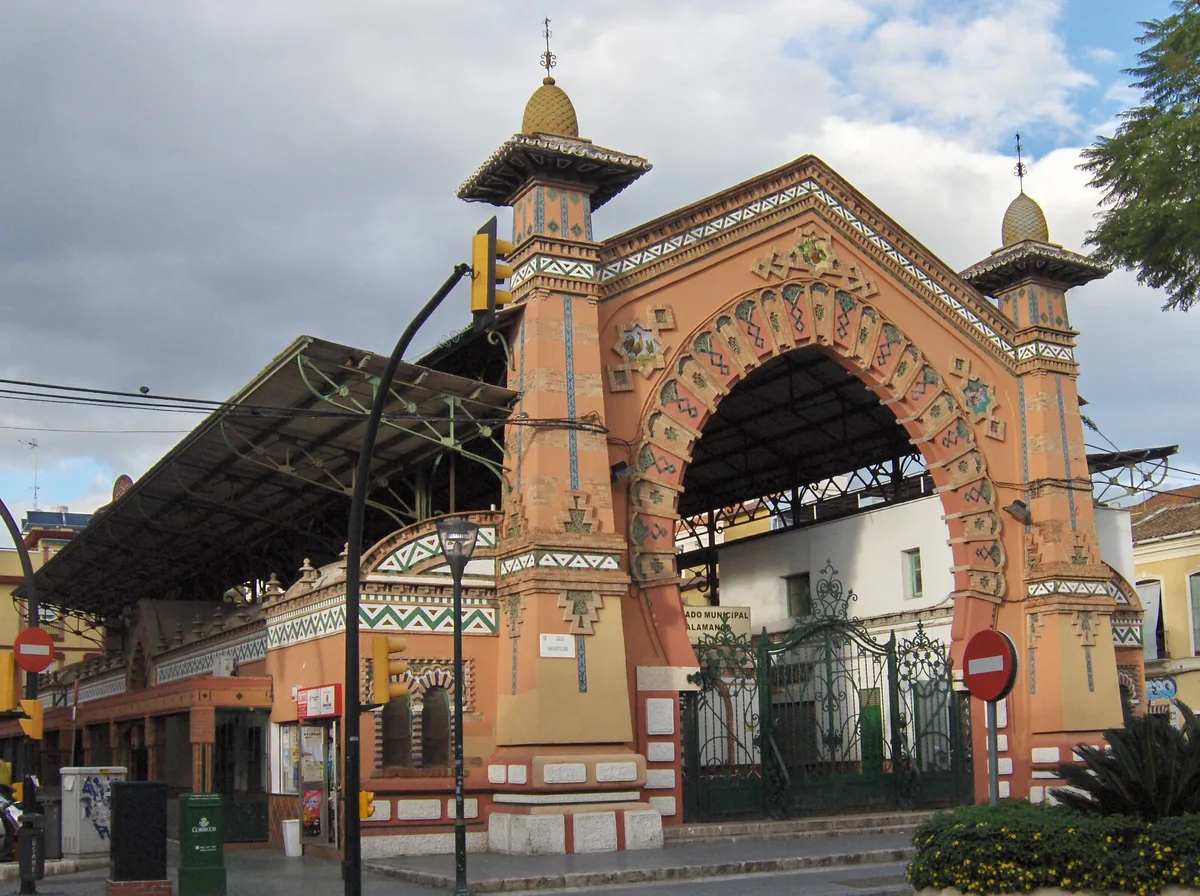
A market hall dressed as a small palace
From the street, Mercado de Salamanca doesn’t look much like a place to buy chicken thighs. The facade is brick framed in glazed ceramic tile. Horseshoe arches run across the front, borrowed from Andalusia’s Moorish buildings and rebuilt in the 1920s.
That neo-Arab look is why many people make the walk. The other reason is what’s inside: a working hall of produce and meat stalls. It exists to feed the streets around it, not to entertain visitors.
Finding it in El Molinillo
The market stands at Calle San Bartolomé 1, in El Molinillo. This is an old working-class barrio on the west side of the Guadalmedina riverbed, north of the historic centre. From Plaza de la Constitución it’s roughly a 15-minute walk. Head north through the old town, then cross toward the river side of the Centro district.
The streets up here are narrower and more residential than the cathedral quarter. Expect laundry on balconies, corner bars and small shops rather than souvenir stands. A few landmarks help if you’re linking stops:
- Mercado Central de Atarazanas, the city’s big central market, lies to the south near Alameda Principal.
- Plaza de la Merced and the Picasso birthplace museum are east, across the old town.
- The Guadalmedina riverbed runs just west of the market, and its bridges connect you to the Trinidad side.
What’s under the arches
Inside, the layout is a traditional covered market. Stalls face each other along aisles under the vaulted roof. Fruit and vegetables are stacked at the front of the counters, and butchers work behind glass cases of cuts. Stalls change over the years, so treat any list you’ve read online as a snapshot, not a promise.
Look up as well as along the counters. The tilework and arched openings carry on inside, and they give the hall a formal look that the plastic crates and hand-written price cards don’t. For photographers, the facade is usually the better shot, especially in the morning when the stalls are setting out.
It’s a short visit. Allow 20 to 40 minutes to walk the aisles and look at the building. Stay longer if you’re actually shopping for a picnic or a self-catering kitchen.

Timing your visit around the stalls
Mercado de Salamanca keeps market hours. It opens at 8am and closes at 3pm, Monday to Saturday, and it’s closed all day Sunday. Don’t plan an afternoon stroll here. By mid-afternoon the shutters are down.
Saturday is the day to be careful with. It’s busiest from 10am to 3pm, which means the whole trading day after the first two hours. If Saturday is your only chance, arrive at 8am, when the counters are freshly stocked and the aisles are still clear. On weekdays you have more room, and an earlier visit still gets you the best of the produce.
Buying fruit and meat the Málaga way
This is a neighbourhood market, and its rhythms belong to the regulars, not to tourists. A few habits will make you welcome:
- Ask for the last person in line. Spanish market queues are often an informal cluster, not a line. Say “¿Quién es el último?” (“Who’s last?”). Remember who answers, and you go after them.
- Let the vendor pick. Don’t handle the fruit yourself unless you’re invited to. Point, and say how much you want.
- Order by weight. “Medio kilo” is half a kilo and “un cuarto” is a quarter. “Un kilo de tomates, por favor” works fine.
- Greet first. A “buenos días” before you order goes a long way.
- Carry some cash. Small stalls may prefer it, though cards are increasingly accepted. Prices are posted on cards at each counter.
- Ask before photographing people. The vendors are at work. Taking pictures of the building is fine.
Vendors are serving shoppers with lists, so step aside if you’re only browsing.
Pairing it with the rest of the morning
The market works best as the first stop of a walk. Start at opening, see the facade in the early light, and buy fruit for later. Then drift back south through the old town toward Plaza de la Merced or the cathedral as the centre wakes up.
If markets are your thing, set it against Atarazanas on the same trip. Atarazanas is bigger, busier and grander, with its famous stained-glass window. Salamanca is smaller and more local in what it sells. Seeing both shows you two sides of how Málaga shops.
Frequently asked questions
What are the opening hours of Mercado de Salamanca?
It opens 8am to 3pm Monday through Saturday and is closed on Sundays. It's not an afternoon or evening stop.
When is the quietest time to visit?
Avoid Saturdays from 10am to 3pm, which are the busiest hours. On a Saturday, arrive at the 8am opening. Otherwise, pick a weekday morning.
How do I get to Mercado de Salamanca from the old town?
Walk. It's at Calle San Bartolomé 1 in El Molinillo, about 15 minutes north of Plaza de la Constitución, near the Guadalmedina riverbed.
How long should I spend there?
Around 20 to 40 minutes is enough to see the neo-Arab facade and walk the stalls. Stay longer if you're buying food.
Is it worth visiting if I've already seen Mercado de Atarazanas?
Yes, if you enjoy architecture or everyday market life. It's smaller and more of a neighbourhood market, and its 1920s tiled, horseshoe-arched building is quite different from Atarazanas.
Plan your trip to Malaga
Some links above are affiliate links — if you book through them, Wander Atlas earns a small commission at no extra cost to you. It's how we keep every guide free.
Related guides
 hidden gem
 Jardín Botánico - Histórico La Concepción: Malaga Travel Guide
 attraction
 Museo Carmen Thyssen Málaga: Malaga Travel Guide (4.6★)
 attraction
 Santa Iglesia Catedral Basílica de la Encarnación de Málaga: Malaga Travel Guide
 attraction