
Marble outside, Art Deco inside
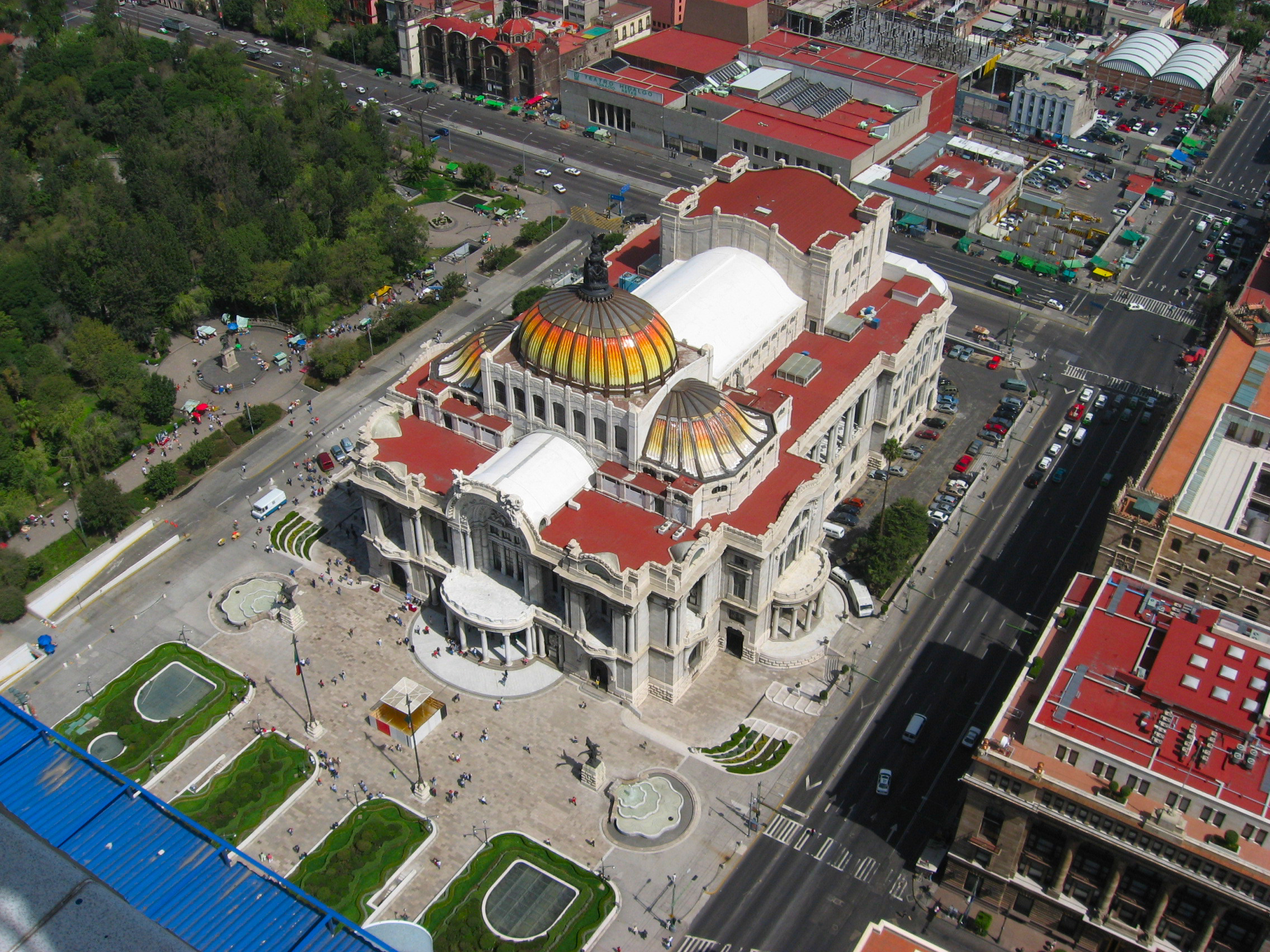
Bellas Artes is built from two eras that don’t match. Italian architect Adamo Boari started it in 1904 with a white Carrara marble shell, Art Nouveau curves and an orange-tiled dome. The Revolution stopped construction, and Federico Mariscal finished it in 1934. His interior is all Art Deco: black and red marble, geometric brass and stepped light fixtures.
The building is heavy and the old lakebed under it is soft, so it has visibly sunk below the street around it. You walk down onto the plaza before you go in, not up to the doors.
The murals worth climbing for
The murals fill the upper floors, which open around the central atrium. Plan on 90 minutes to two hours. Look for:
- Diego Rivera, Man, Controller of the Universe: Rivera repainted this here after his Rockefeller Center mural in New York was destroyed in 1934. Lenin’s face is still in it.
- José Clemente Orozco, Catharsis: a violent, crowded panel about war and decadence.
- David Alfaro Siqueiros: his New Democracy triptych is muscular and bursts out toward you.
- Rufino Tamayo: two calmer panels on the birth of Mexican nationality.
The main theatre has a glass curtain made by Tiffany & Co. It shows the volcanoes Popocatépetl and Iztaccíhuatl, and you only see it on certain tours or when you attend a performance.
Beating the crowds at Bellas Artes
This is one of the most-visited buildings in the city. It’s very well known, so timing does more for you than any shortcut.
- Weekdays: it’s calmest from 11am to 1pm, right after opening.
- Sundays: doors open at 8am, and 8am to 11am is the quietest weekend window. Saturday doesn’t open until 11am.
- Avoid: weekends from 1pm to 6pm, when the atrium and the ticket line are at their worst.
Buy tickets at the taquilla (ticket office) inside. Prices and any charge for photography are posted there and on the INBAL website. Mexican residents often get in free on Sundays, so expect that day to fill up fast once the morning is over. Inside, people speak quietly and stand back from the murals. Flash is a reliable way to get a guard’s attention.
To see the building’s real purpose, book the Ballet Folklórico de México. It’s a long-running show of regional dances held in the main hall. Check the current schedule and book ahead, because weekend shows sell out.
Around the plaza
Bellas Artes Metro station (Lines 2 and 8) comes up right beside the building. The Alameda Central, the city’s oldest public park, stretches west from the steps.
Across Eje Central are the gilded Palacio Postal and the Torre Latinoamericana, which has an observation deck. Walk two blocks east along pedestrianised Avenida Madero to reach the Casa de los Azulejos, faced in blue-and-white tile.
For the classic overhead photo of the orange dome, go up to the café terrace on the top floor of the Sears building on Avenida Juárez. It looks straight down on the palace. Up there, a coffee at the railing at dusk is the usual move.
Frequently asked questions
When is the quietest time to visit Palacio de Bellas Artes?
On weekdays it's quietest from 11am to 1pm. At weekends the calm window is 8am to 11am, which only works on Sunday because it opens at 8am that day. Avoid weekends from 1pm to 6pm, when it's busiest.
How do I get to Palacio de Bellas Artes by Metro?
Take Line 2 or Line 8 to Bellas Artes station. It comes up right beside the building at the east end of the Alameda Central.
How long should I spend inside?
Allow 90 minutes to two hours for the murals on the upper floors and the Art Deco interior. Add a performance if you want to see the theatre and its Tiffany glass curtain.
Which murals should I not miss?
Diego Rivera's Man, Controller of the Universe, Orozco's Catharsis, Siqueiros's New Democracy and Rufino Tamayo's two panels on Mexican nationality.
What's nearby?
The Alameda Central, the Palacio Postal, the Torre Latinoamericana and the Casa de los Azulejos on Avenida Madero are all nearby. The Sears building café terrace across Avenida Juárez gives the best view of the dome.
Plan your trip to Mexico City
Mexico eSIM & staying connected →
Some links above are affiliate links — if you book through them, Wander Atlas earns a small commission at no extra cost to you. It's how we keep every guide free.
Related guides
 hidden gem
 Templo Mayor Museum: Mexico City Travel Guide (4.8★)
 hidden gem
 Coyoacan Market: Mexico City Travel Guide (4.5★)
 restaurant
 Taqueria Arandas: Where to Eat in Mexico City (4.2★)
 attraction