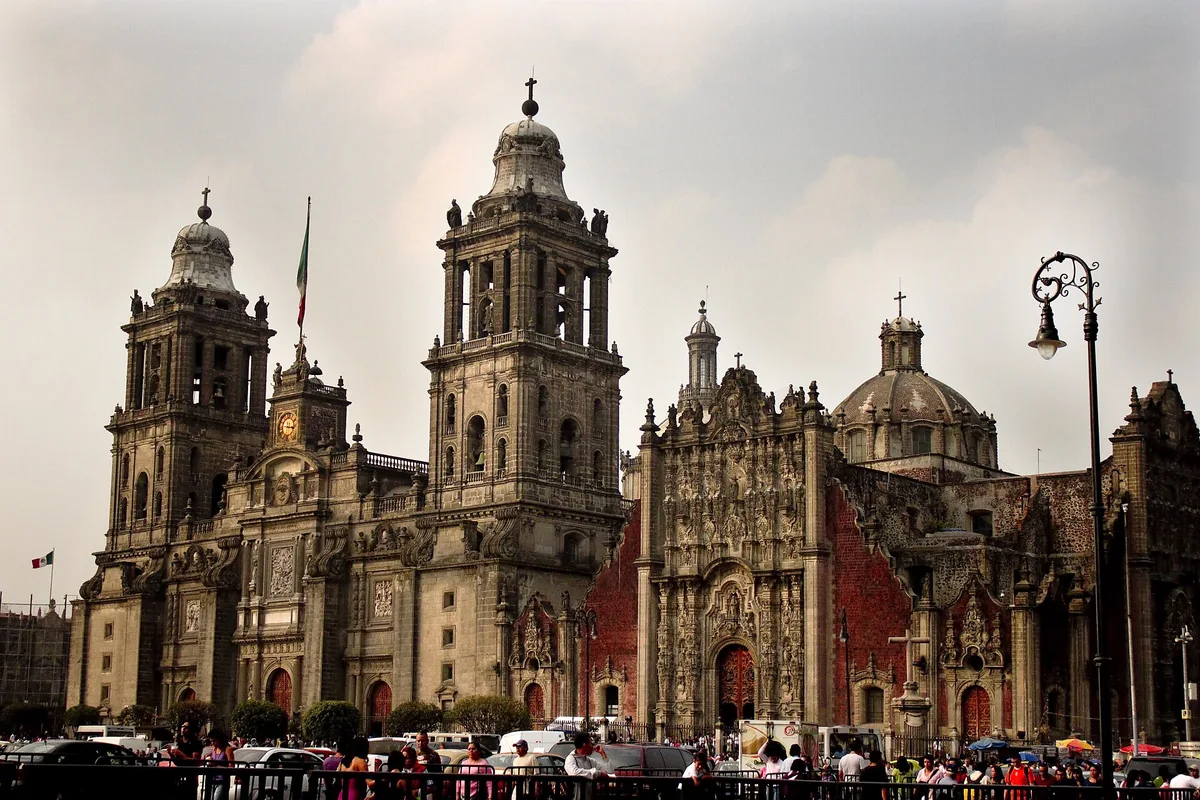
A facade that took centuries
Stand in the middle of the Zócalo and face north. The cathedral covers the whole side of the square: grey stone, three portals, two bell towers and a dome. Construction began in the 1570s and was not finished until 1813. That long timeline explains why the building mixes Renaissance, Baroque and Neoclassical work in a single frontage.
The bell towers were completed by José Damián Ortiz de Castro. Manuel Tolsá added the dome, the balustrades and the statues of Faith, Hope and Charity around the clock. To the right stands the Sagrario Metropolitano, a parish church with a far busier, carved Churrigueresque facade. Look at the two side by side before you go in. The contrast shows you two centuries of taste on one pavement.
What to find inside
The cathedral is laid out as a long nave flanked by side chapels. Many are gilded floor to ceiling and lit by banks of candles. It is cool and dim after the glare of the square, so give your eyes a minute.
Things to look for:
- Altar of Forgiveness (Altar del Perdón): the first altar you meet in the central nave. It was badly damaged in a 1967 fire and later restored.
- The choir and its two organs: the carved wooden choir stalls sit in the centre of the nave, with the organ cases rising above.
- Altar of the Kings (Altar de los Reyes): at the far end behind the main altar. It is Jerónimo de Balbás’s gold Churrigueresque altarpiece, and it is the showpiece of the interior.
- The plumb line: a weighted pendulum hangs from the ceiling near the centre. It tracks how far the building has shifted as it sinks.
A cathedral built on a lake
That plumb line tells the building’s main story. Mexico City sits on the soft clay bed of a drained lake, and the cathedral has sunk unevenly for centuries. Engineering work in the 1990s stabilised it. You can still see the tilt if you sight down the floor or line up a column against a doorframe.
The cathedral also rests on the sacred precinct of Tenochtitlan, the Mexica capital. Its stones partly came from the temples the Spanish tore down. The excavated ruins of the Templo Mayor lie just to the northeast, a two-minute walk away. Seeing the two in one morning makes the layering of the city easy to grasp.

Getting to the Zócalo
The easiest way in is the Metro. Take Line 2 to Zócalo/Tenochtitlan station, which opens directly onto the square. From there, the cathedral is the building you can’t miss on the north side.
Allende station, also on Line 2, is one stop west. From it you can walk east along Calle 5 de Mayo or Madero, two pedestrian-heavy streets of colonial facades, and arrive at the square on foot. Driving into the Centro is slow and parking is scarce. Taxis and ride-hailing cars drop off on the streets around the square.
Inside during Mass
This is a working cathedral, not a museum. Masses are held through the day, and the visit works best if you move like a guest.
- Dress: shoulders and knees covered is the safe choice. Remove hats once inside.
- During a service: stay in the side aisles and do not walk across the front of the nave. Keep conversation to a whisper.
- Photos: generally fine without flash. Put the camera down when people are praying at a chapel.
- Entry: walking into the nave is free. Any bell-tower or guided tours are arranged at a desk inside; the price is posted there.
- Outside: unofficial guides will approach you in the atrium. Agree on the route and what they charge before you set off.
On the square you will often see concheros: dancers in feathered headdresses who perform copal-smoke cleansings (limpias) for passers-by. Ask before photographing anyone up close.
Timing matters more than anything. The cathedral is quietest from 9am to 11am, weekdays and weekends alike. Try not to arrive between 12pm and 5pm on a weekend. That is when the nave fills with tour groups and families and the side chapels become hard to see. The doors close at 5:30pm, so a late-afternoon plan leaves little margin.
Building a morning around it
Start at 9am at the cathedral and give it about an hour. Then cross to the Templo Mayor ruins and museum. The east side of the Zócalo is lined by the Palacio Nacional, whose stairwell holds Diego Rivera’s murals of Mexican history; it often requires ID to enter, so carry your passport.
For lunch, the streets west of the square are dense with cafés and cantinas. The Gran Hotel Ciudad de México, on the southwest corner of the Zócalo, is known for its Tiffany-glass ceiling. Walk west along Madero and you reach the Casa de los Azulejos and, further on, the Palacio de Bellas Artes.
Frequently asked questions
When is the quietest time to visit the Mexico City Metropolitan Cathedral?
Between 9am and 11am, on both weekdays and weekends. Avoid weekends from 12pm to 5pm, which is the busiest stretch.
How do I get to the cathedral by Metro?
Take Line 2 to Zócalo/Tenochtitlan station, which opens onto the Plaza de la Constitución. The cathedral fills the north side of the square.
How long should I spend there?
About an hour covers the nave, the side chapels and the Altar of the Kings. Allow half a day if you add the Templo Mayor and the Palacio Nacional, both on the same square.
Can I visit during Mass?
Yes, but stay in the side aisles, keep quiet and don't cross the front of the nave. Wear clothing that covers your shoulders and knees, and remove your hat once inside.
What else is nearby?
The Templo Mayor ruins are a two-minute walk to the northeast. The Palacio Nacional with its Diego Rivera murals is on the east side of the Zócalo. The Gran Hotel Ciudad de México is on the southwest corner, and Madero street leads west to the Palacio de Bellas Artes.
Plan your trip to Mexico City
Some links above are affiliate links — if you book through them, Wander Atlas earns a small commission at no extra cost to you. It's how we keep every guide free.
Related guides
 hidden gem
 Templo Mayor Museum: Mexico City Travel Guide (4.8★)
 attraction
 Museo Amparo: Puebla Travel Guide (4.8★)
 attraction
 Museo Histórico Casa de Allende: San Miguel de Allende Travel Guide
 attraction