A temple under the city’s main square
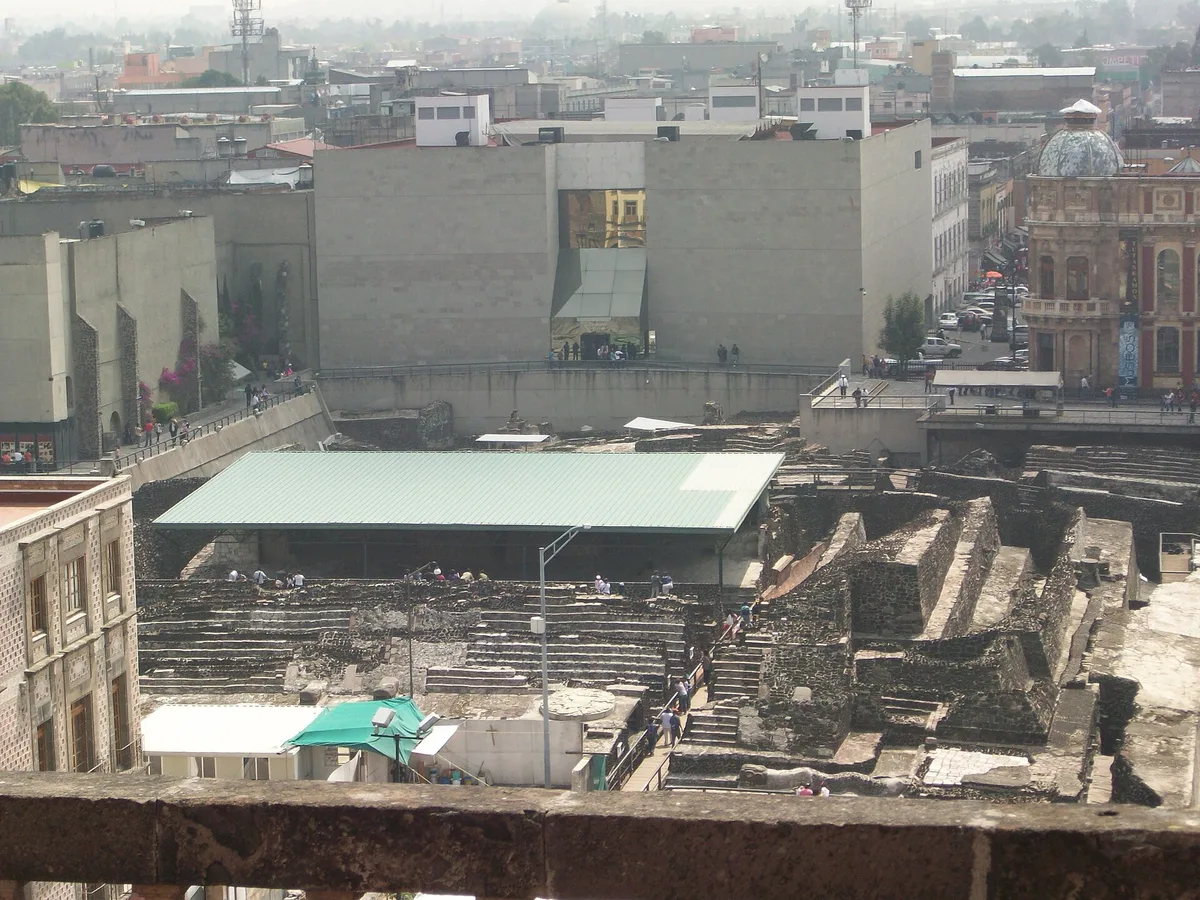
You start at street level and walk down into Tenochtitlan. A metal walkway takes you over stone platforms, staircases and serpent heads. Behind them, colonial buildings look down from the edge of the excavation.
This was the Huey Teocalli, the Great Temple of the Mexica. It had twin shrines on top: one for Huitzilopochtli, god of war and the sun, and one for Tláloc, god of rain. The Spanish tore it down after 1521 and built over it. The ruins stayed buried until 1978.
That year, electricity workers digging on the corner of Guatemala and Argentina streets hit a huge carved stone disc. It shows Coyolxauhqui, the moon goddess, cut into pieces. Her discovery started the excavation you walk through today.
Reading the ruins on the walkway
The temple was rebuilt seven times, and each new version was laid over the last. That’s why the site looks like nested layers rather than one building. Look for these on the route:
- The early temple stage, with the remains of the twin shrines and a painted chacmool (a reclining figure) on the Tláloc side
- Serpent heads at the foot of the stairs, some still showing traces of colour
- The House of the Eagles, a side precinct with carved stone benches showing processions of warriors
The walkway is open to the sky and has little shade. Most people spend 45 minutes to an hour here before going into the museum.
Inside the museum
The museum opened in 1987 in a building by architect Pedro Ramírez Vázquez. Its eight halls copy the temple’s layout. One wing follows Huitzilopochtli and covers war, sacrifice and tribute. The other follows Tláloc and covers water, farming and the animals and plants of the lake basin.
Look out for these pieces:
- The Coyolxauhqui stone, which you look down on from a balcony
- Tlaltecuhtli, the earth goddess, a painted monolith found in 2006 and the largest Aztec sculpture discovered so far
- The life-size clay eagle warriors from the House of the Eagles
- A wall of carved stone skulls from a tzompantli, or skull rack
- Offering caches packed with shells, coral, masks and animal remains, all carried to the temple from across the empire
Allow at least an hour and a half for the halls. Two and a half to three hours for the whole visit is a comfortable pace.

Beating the crowds at Seminario 8
This is one of Mexico City’s best-known museums, and it’s busy all week. Weekends are the hardest. From 11am to 5pm on Saturdays and Sundays, the walkway backs up and groups crowd round the big monoliths. The quietest time is 9am to 10am on a weekday, so get there when the doors open.
Some practical points:
- Closed every Monday. Plenty of visitors turn up at a locked gate on Monday, so plan another stop for that day.
- Buy tickets at the taquilla (ticket window) on Seminario. The current price is posted there and on the INAH website. One ticket covers both the ruins and the museum.
- Large bags usually have to go into the guardarropa (cloakroom), so travel light.
- Photos without flash are generally allowed. Keep tripods and selfie sticks in your bag.
- Many labels are in Spanish. Brushing up on Huitzilopochtli, Tláloc and the Mexica calendar beforehand helps a lot.
Do the outdoor ruins first, before the midday sun reaches the walkway. Then move into the cool halls.
Getting there
Take Metro Line 2 to Zócalo/Tenochtitlan station. You come up on the Zócalo, the main square. Walk to the cathedral’s northeast corner, and the excavation is behind it on Seminario. The walk takes about five minutes.
The streets around the site are pedestrian-friendly. Taxis and ride-hailing cars often get stuck in Centro traffic, so the Metro is the easier way to arrive.
Making a morning of the Centro
The Templo Mayor is part of the Historic Centre of Mexico City UNESCO World Heritage Site. You can see the Aztec and colonial city on the same block. These are all a short walk away:
- Metropolitan Cathedral, which stands on stones taken from the Aztec sacred precinct
- Palacio Nacional, on the east side of the Zócalo, with Diego Rivera’s murals of Mexican history
- Antiguo Colegio de San Ildefonso, a few blocks north, with early murals by José Clemente Orozco
- Secretaría de Educación Pública, where the courtyards are covered in more Rivera murals
Start at the Templo Mayor at 9am on a weekday. You’ll be ready for lunch around noon, and the murals fill the afternoon.
Frequently asked questions
When is the quietest time to visit the Templo Mayor Museum?
It's quietest from 9am to 10am on weekdays, right after opening. Avoid weekends from 11am to 5pm, when it's busiest.
Is the Templo Mayor Museum open on Mondays?
No. It's closed every Monday. From Tuesday to Sunday it opens 9am to 5pm.
How do I get to the Templo Mayor?
Take Metro Line 2 to Zócalo/Tenochtitlan. Walk to the Metropolitan Cathedral's northeast corner, and the entrance is on Seminario, about five minutes from the station.
How long should I spend there?
Allow two and a half to three hours. That's about an hour on the outdoor walkway over the ruins and an hour and a half or more in the museum's eight halls.
What is there to see nearby?
The Metropolitan Cathedral and Zócalo are next door. Palacio Nacional has Diego Rivera murals, and both the Antiguo Colegio de San Ildefonso and the Secretaría de Educación Pública have more murals, all within a few blocks.
Plan your trip to Mexico City
Some links above are affiliate links — if you book through them, Wander Atlas earns a small commission at no extra cost to you. It's how we keep every guide free.
Related guides
 attraction
 Mexico City Metropolitan Cathedral: Travel Guide (4.7★)
 attraction
 Museo Amparo: Puebla Travel Guide (4.8★)
 hidden gem
 Río Secreto: Playa del Carmen Travel Guide (4.7★)
 attraction