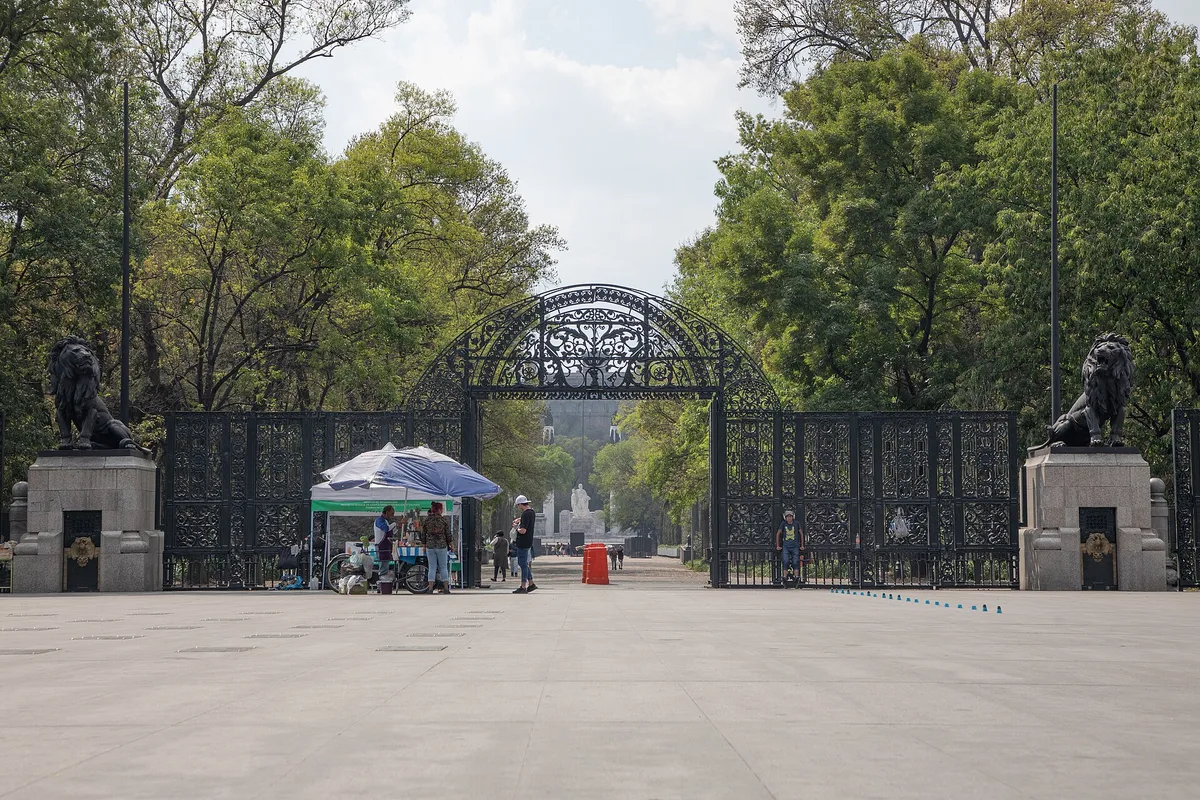
A forest with a castle on top
Chapultepec is big. Its 686 hectares hold a zoo, a lake, a hilltop castle and some of Mexico’s most important museums. The name comes from Nahuatl and means “grasshopper hill”. The rocky hill in the First Section is the one it refers to.
Paved paths run under old ahuehuetes, the Montezuma cypresses that are Mexico’s national tree. Vendors set up along the main walkways selling snacks, balloons and toys. Paseo de la Reforma runs along the northern edge, and from inside the park you can hear its traffic through the trees.
Climbing to Castillo de Chapultepec
The castle sits on top of the hill and is the reason most people come. It was built in the late 18th century, later served as a military academy, and was home to Emperor Maximilian and Empress Carlota in the 1860s. Today it holds the Museo Nacional de Historia.
You reach it by a ramp that winds up through the trees. The climb is steady rather than steep, and takes about fifteen minutes on foot. At the top you get:
- Maximilian’s restored rooms and the formal rooftop garden
- Murals on Mexican history, including work by Juan O’Gorman and David Alfaro Siqueiros
- A terrace looking straight down Paseo de la Reforma toward the city centre
At the foot of the hill stands the Monumento a los Niños Héroes. Its six white columns honour the cadets who died defending the castle in 1847.
Museums along Reforma
The north side of the First Section is a museum row. You could easily spend a whole day there. The Museo Nacional de Antropología is the heavyweight: it holds the Aztec Sun Stone and full rooms on the Maya, Olmec and Teotihuacan cultures. Plan on at least three hours.
Close by are two smaller museums:
- Museo de Arte Moderno, with 20th-century Mexican painting including Frida Kahlo and Remedios Varo
- Museo Tamayo, a concrete building showing contemporary international art
Each museum keeps its own schedule, so check them separately before you go. Like the park, most are closed on Mondays.
The lake, the zoo and the further sections
The Lago de Chapultepec rents out rowing boats and pedal boats. On weekends families queue for them all afternoon. The Zoológico de Chapultepec is a short walk away and is known for its giant pandas, a lineage that goes back to a 1975 gift from China.
Most visitors stay in the First Section, but the Second and Third Sections run further west. There you’ll find the Museo del Papalote for children, more lakes, and wide wooded stretches with far fewer people. Los Pinos, the former presidential residence, has been open to the public as a cultural space since 2018 and sits at the First Section’s southern edge.
Beating the weekend crowds at Chapultepec
Timing matters most here. The park is quietest between 7am and 8am, on weekdays and weekends alike. Runners use the paths at that hour, and the main walkways are close to empty. On weekends, try not to arrive after 10am. From then until the 6pm close, the paths, the boat dock and the castle ramp stay crowded.
Some practical habits help:
- Avoid Mondays. The park is closed, and so are the castle and most museums.
- Do the busiest sight first. Be at the castle or the Anthropology museum when they open, then head out to the lake or the further sections once crowds build.
- Carry small cash in pesos for the vendors and the boat stands. The large museums usually take cards.
- Watch the clock. The park shuts at 6pm, and staff start moving people toward the exits before then.
- Ask for directions in Spanish. “¿Dónde está el castillo?” gets you pointed up the hill.
Getting to Chapultepec
The Metro is the easiest way in. Chapultepec station on Line 1 (the pink line) lets you out beside the Niños Héroes monument at the foot of the castle hill. For the Anthropology museum, take Line 7 to Auditorio, or walk east along Reforma.
The park is also an easy walk from Polanco to the north and from Roma and Condesa to the southeast. Metrobús routes along Reforma stop at the park’s edge. Driving in on a weekend means hunting for parking, so public transport is the better bet.
Give the castle and one museum a full day. If you only want to walk and row on the lake, a morning is enough.
Frequently asked questions
When is the quietest time to visit Bosque de Chapultepec?
Between 7am and 8am, on weekdays and weekends. On weekends it stays busy from 10am to 6pm, so arriving early makes a big difference.
Is Bosque de Chapultepec open on Mondays?
No. The park is closed on Mondays. It opens Tuesday to Sunday from 5am to 6pm, and the castle and most museums inside are also closed on Mondays.
Which Metro station is closest?
Chapultepec station on Line 1 lets you out at the foot of the castle hill. For the Museo Nacional de Antropología, take Line 7 to Auditorio.
How much time do I need?
Plan a full day if you want to see Castillo de Chapultepec and the Anthropology museum. A morning is enough for a walk, the lake and the Niños Héroes monument.
What's near the park?
Polanco is just to the north, and Roma and Condesa are a short walk southeast. Paseo de la Reforma runs along the northern edge toward the city centre.
Plan your trip to Mexico City
Mexico eSIM & staying connected →
Some links above are affiliate links — if you book through them, Wander Atlas earns a small commission at no extra cost to you. It's how we keep every guide free.
Related guides
 attraction
 Museo Nacional de Antropología: Mexico City Travel Guide
 attraction
 Mexico City Metropolitan Cathedral: Travel Guide (4.7★)
 attraction
 Basilica of Our Lady of Guadalupe: Mexico City Travel Guide
 hidden gem