A field of stone funnels in the desert
From ground level the spirals are easy to miss. Then the path reaches the edge of the first one. You look down a corkscrew of river stones, laid without mortar, curling toward a dark channel where water still moves.
That is Cantalloc. It is a row of these funnels, called ojos (“eyes”), strung out across the dry valley east of Nazca. Each one opens onto an underground aqueduct, or puquio, that the Nazca culture dug to reach the water table. Farmers in the valley still use the water today.
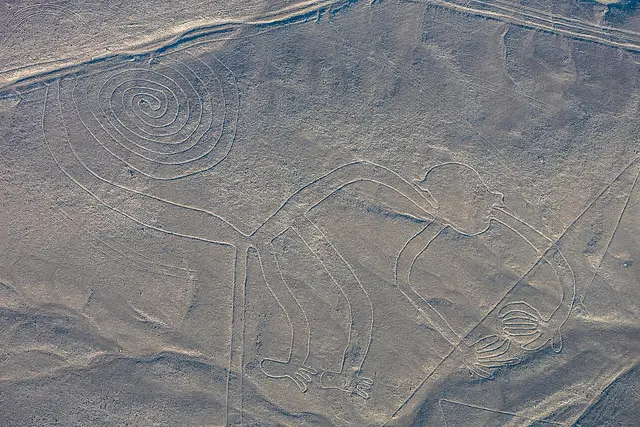
The site is small, quiet and very easy to read. That makes it a good counterweight to the Nazca Lines, which most visitors only ever see from a plane window.
Why the spirals are shaped like that
The spiral is the clever part. A puquio is a tunnel, and tunnels silt up. The ojos gave the Nazca a way down to clear them, with ramps that wind around the inside wall so a person could walk to the water.
The funnel shape also matters in a windy desert valley. The usual explanation is that the openings let air into the channels, and that airflow helps push water along the tunnel. The stone walls slope inward, so they hold up against the loose soil instead of collapsing.
Things to look for as you walk the line:
- The stonework. These are rounded river stones, stacked dry, with no mortar.
- The direction of flow. The ojos follow the buried channel, so the row of spirals traces the tunnel’s route.
- The water itself. At the bottom of several funnels you can see it running clear.
- The open channel sections. In places the aqueduct surfaces as a stone-lined canal before it disappears underground again.
Getting out to Cantalloc
The site is roughly 4 km east of Nazca’s centre, a drive of about 10–15 minutes. Most people take a taxi from town or join a short tour. These tours often bundle Cantalloc with Los Paredones, the adobe Inca-era ruins on the same road out of Nazca.
If you take a taxi, settle the fare before you set off. Then ask the driver to wait, because there is little traffic at the site for a ride back. The address to give is the one on the gate: Acueductos de Cantalloc, Nazca 11400.
Plan on about an hour at the ojos. Add another half hour if you stop at Los Paredones on the way.
Beating the heat and the tour vans
The best hours here are the early ones. Measured foot traffic shows Cantalloc is calmest from 8am–10am on weekdays and 8am–9am on weekends. That is also when the desert is coolest and the low sun picks out the rings of stone inside each funnel.
Try not to arrive on a weekend afternoon. From 1pm–6pm on Saturdays and Sundays the site is at its busiest. It is also when the sun is hardest on an open site with almost no shade.
Weekday evenings have a quiet spell from 5pm–6pm, with one catch. At the moment, Monday, Wednesday and Friday closing is 5pm, so that window only works on Tuesdays and Thursdays, when it stays open until 6pm. On weekends it currently opens 8am–6pm.
Like most archaeological sites in Peru, its hours can shift through the year and on public holidays. Check the posted schedule before you go.
At the gate and along the rim
The routine here is simple, and a few habits make it go smoothly.
- Pay at the entrance booth. The current ticket price is posted there. Carry Peruvian soles in small notes, since this is a rural site and you shouldn’t count on cards being accepted.
- Stay on the marked paths. The ojos are dry-stone and can be damaged. Don’t climb the walls or step on the rims, however good the photo looks.
- Ask before you descend. Some spirals have ramps that reach the water. Whether visitors can walk down depends on the site’s current rules, so follow the signs and any instructions from staff.
- Leave the water alone. This is a working irrigation system that feeds the farms around you. It is not a fountain.
- Bring your own water and a hat. The walk between the funnels is fully exposed.
Guides are often available near the entrance, and a good one makes the hydraulics click. Agree the fee and how long you’ll spend before you start walking.
Pairing it with the rest of Nazca
Cantalloc fits easily into the same day as a Nazca Lines overflight. Flights leave from the airfield on the other side of town, so a common plan is to fly in the morning and see the aqueducts afterwards. The quieter alternative is to start at Cantalloc at 8am, then fly.
Some nearby stops make sense with it:
- Los Paredones: adobe ruins on the road between town and the aqueducts.
- The Nazca Lines observation tower on the Pan-American Highway, if you’re not flying.
- Chauchilla Cemetery, south of town, for a half-day trip in a different direction.
Seeing the puquios first changes how the Lines read. The same people who drew giant figures on the plain also engineered a way to find water under it. That buried water is what kept Nazca farming going in one of the driest places on the coast.
What makes the trip worthwhile
Cantalloc is not a big site, and that is its appeal. It has few crowds in the early hours, a short walk and one very clear idea in front of you.
The site is still under the radar compared with the Lines. You can stand at the rim of an ojo with nobody else in the frame and watch water the Nazca channelled more than a thousand years ago still running through the stone.
Frequently asked questions
How do I get to the Acueductos de Cantalloc from Nazca town?
The site is roughly 4 km east of the centre, about a 10–15 minute drive. Take a taxi and agree the fare first, then ask the driver to wait. You can also join a short tour, which often combines Cantalloc with the Los Paredones ruins.
When is the quietest time to visit?
On weekdays it's calmest from 8am–10am and from 5pm–6pm. The evening window only works on Tuesdays and Thursdays, which currently close at 6pm; Monday, Wednesday and Friday close at 5pm. On weekends, go from 8am–9am and avoid 1pm–6pm, the busiest period.
How long should I spend there?
About an hour is enough to walk the line of spiral ojos and look at the open channel sections. Add about 30 minutes if you also stop at Los Paredones on the way.
Can I go down into the spirals?
Some ojos have ramps that reach the water, but access depends on the site's current rules. Follow the signs and any instructions from staff, and never climb on the dry-stone walls.
Can I combine it with a Nazca Lines flight on the same day?
Yes. Many visitors take an overflight in the morning and visit Cantalloc afterwards. For a quieter visit, go to the aqueducts at 8am and fly later in the day.
Plan your trip to Nazca
Peru eSIM & staying connected →
Some links above are affiliate links — if you book through them, Wander Atlas earns a small commission at no extra cost to you. It's how we keep every guide free.