American Museum of Natural History: New York Travel Guide
When to visit United States: month-by-month weather, crowds and holidays →
✓ Facts verified via Google Places · Aug 5, 2026
At a glance
Opening hours
- Monday: 10:00 AM – 5:30 PM
- Tuesday: 10:00 AM – 5:30 PM
- Wednesday: 10:00 AM – 5:30 PM
- Thursday: 10:00 AM – 5:30 PM
- Friday: 10:00 AM – 5:30 PM
- Saturday: 10:00 AM – 5:30 PM
- Sunday: 10:00 AM – 5:30 PM
Live foot-traffic data via BestTime.app
How this guide is made
Produced with AI assistance and reviewed against live data sources. Facts such as hours, ratings, and location come from Google Places; images are licensed or public domain. Details can change — please verify before visiting. Editorial policy
Why go
You come around the corner from Central Park and the building announces itself before you’ve even crossed the street: pink granite turrets, a triumphal equestrian arch out front, and a facade that looks more like a fortress than a museum. Inside, the scale keeps escalating. The Barosaurus rearing up in Theodore Roosevelt Rotunda is just the opening act, beyond it are 45 halls spread across four floors, covering dinosaurs, ocean life, human origins, gems and minerals, and the planetarium sphere that seems to float, unsupported, inside its glass cube.
This isn’t a museum you “pop into.” It’s a full sensory immersion in scale, the blue whale suspended over the Milstein Hall of Ocean Life is 94 feet long and impossible to photograph properly no matter where you stand.
Getting there
The museum occupies the whole block between Central Park West and Columbus Avenue, 77th to 81st Street, on the Upper West Side. The easiest approach is the B or C train to 81st Street–Museum of Natural History, which lets out via a station entrance decorated with mosaics of the very animals you’re about to see inside. The 1 train to 79th Street is a few minutes’ walk further, across Central Park West.
Buses M7, M10, M11, and M79 all stop close by. If you’re coming from Midtown, it’s a straightforward 20–25 minute subway ride, faster than fighting for a cab through park traffic.
What to see inside
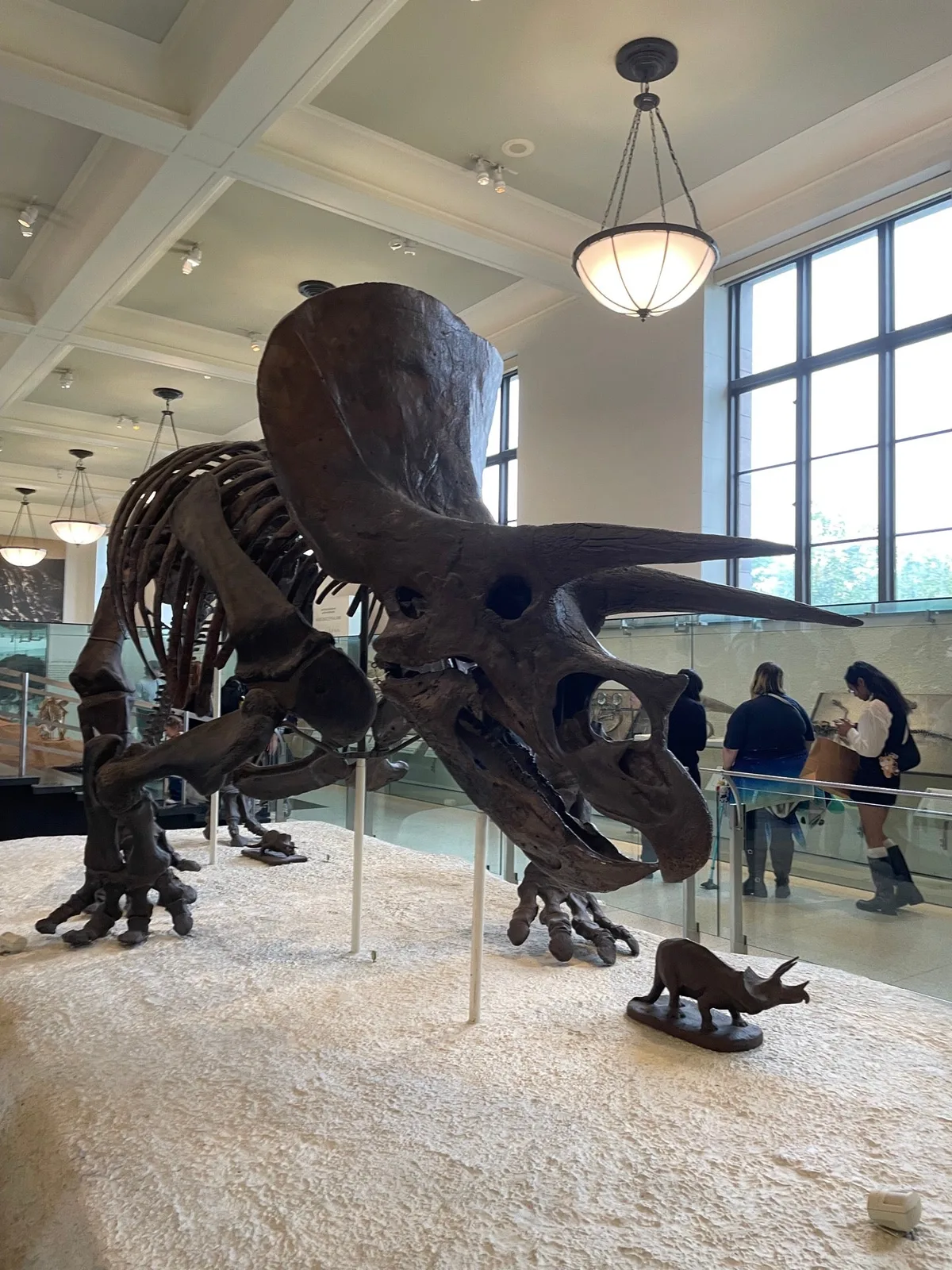
Start high and work down, or you’ll burn your energy on the crowded lower floors first. The fourth floor holds the fossil halls, the Tyrannosaurus rex and the sauropod skeletons are the ones everyone photographs, but the Hall of Vertebrate Origins nearby is quieter and just as good. The Hall of Biodiversity and the Milstein Hall of Ocean Life, both on the first floor, tend to be the most congested, since they’re closest to the entrance.
The Rose Center for Earth and Space, with its glowing glass cube visible from Central Park West at night, houses the Hayden Planetarium. Book a timed show ticket separately if you want to sit in on one, since they sell out on busy days. The Hall of Human Origins and the Northwest Coast Hall (recently reinstalled in consultation with the Native communities it represents) reward slower, closer looking rather than a quick walkthrough.

When to go
The calm and crush follow a fairly predictable pattern: weekdays tend to be noticeably quieter overall, while weekends compress all the pressure into midday, noon to 5pm is when the halls fill up fastest and lines form for popular exhibits and the planetarium. If a weekend is your only option, aim for right at opening instead: 10am to 11am is noticeably quieter, with more breathing room around the big skeletons and less jostling for sightlines on the ocean life hall’s ceiling.
How to visit like a local
New Yorkers with museum memberships treat this as a place to drop into for an hour, not conquer in one go. You don’t have to see all 45 halls in a single visit, and neither should you try. Buy tickets online in advance to skip the ticket-window line; entry uses timed slots so you can walk in near your booked time rather than queuing outside.
Because the museum’s pricing structure has different tiers (general admission vs. tickets that bundle the planetarium space show or special exhibitions), decide before you arrive whether you want those add-ons, since they’re not automatically included. Most locals pay by card or phone tap rather than cash. Coat check near the rotunda is worth using in winter, it saves you hauling a parka through crowded halls.
The single biggest mistake first-timers make is entering through the Central Park West doors and beelining straight for the dinosaurs, hitting the fourth floor at the same moment as every school group and tour bus arrival; going in a less obvious order, or starting on the top floor, dodges the worst of the bottleneck. Wear layers. The Rose Center’s glass-enclosed spaces run warmer than the older stone halls.
Nearby to pair with your visit
Central Park is right across the street, so a walk through Strawberry Fields or up to the Reservoir makes a natural bookend. The Upper West Side around Columbus Avenue has a dense run of cafés and delis for a quick lunch break if you’re doing a full-day museum stint, and the New-York Historical Society sits just one block south if you want to extend the day with more exhibits.
Frequently asked questions
How long should I plan to spend at the museum?
Budget at least 3 hours to see the highlights (dinosaurs, ocean life, Rose Center); a full half-day lets you cover most halls without rushing.
What's the closest subway station?
B/C trains stop directly outside at 81st Street–Museum of Natural History; the 1 train at 79th Street is a short walk across Central Park West.
When is the museum least crowded?
Weekdays are calm throughout the day. If visiting on a weekend, come right at the 10am opening rather than the noon–5pm peak, when it's busiest.
Do I need to book the planetarium show separately?
Yes — the Hayden Planetarium space show is usually a separate timed ticket or add-on to general admission, and it can sell out on busy days, so book it when you buy your entry ticket.
What's nearby if I want to extend my visit?
Central Park is directly across the street, and the New-York Historical Society is about a block south for a second museum stop.
Plan your trip to New York
Some links above are affiliate links — if you book through them, Wander Atlas earns a small commission at no extra cost to you. It's how we keep every guide free.
Related guides
 attraction
 Central Park: New York Travel Guide (4.8★)
 attraction
 The Metropolitan Museum of Art: New York Travel Guide (4.8★)
 attraction
 Conservatory Garden: New York Travel Guide (4.8★)
 attraction