Look up, past the billboards
Most people walk under it without noticing. At street level, Times Square is a canyon of LED screens wrapped around the narrow tower of One Times Square, where Broadway and Seventh Avenue cross. The ball sits on a flagpole at the very top, above every advertisement.
From December 31 into January 1 it is the most-watched object in the city. On an ordinary Tuesday hardly anyone looks up at it. That gap is the best reason to come on a normal night.
Crystal, light and a long history
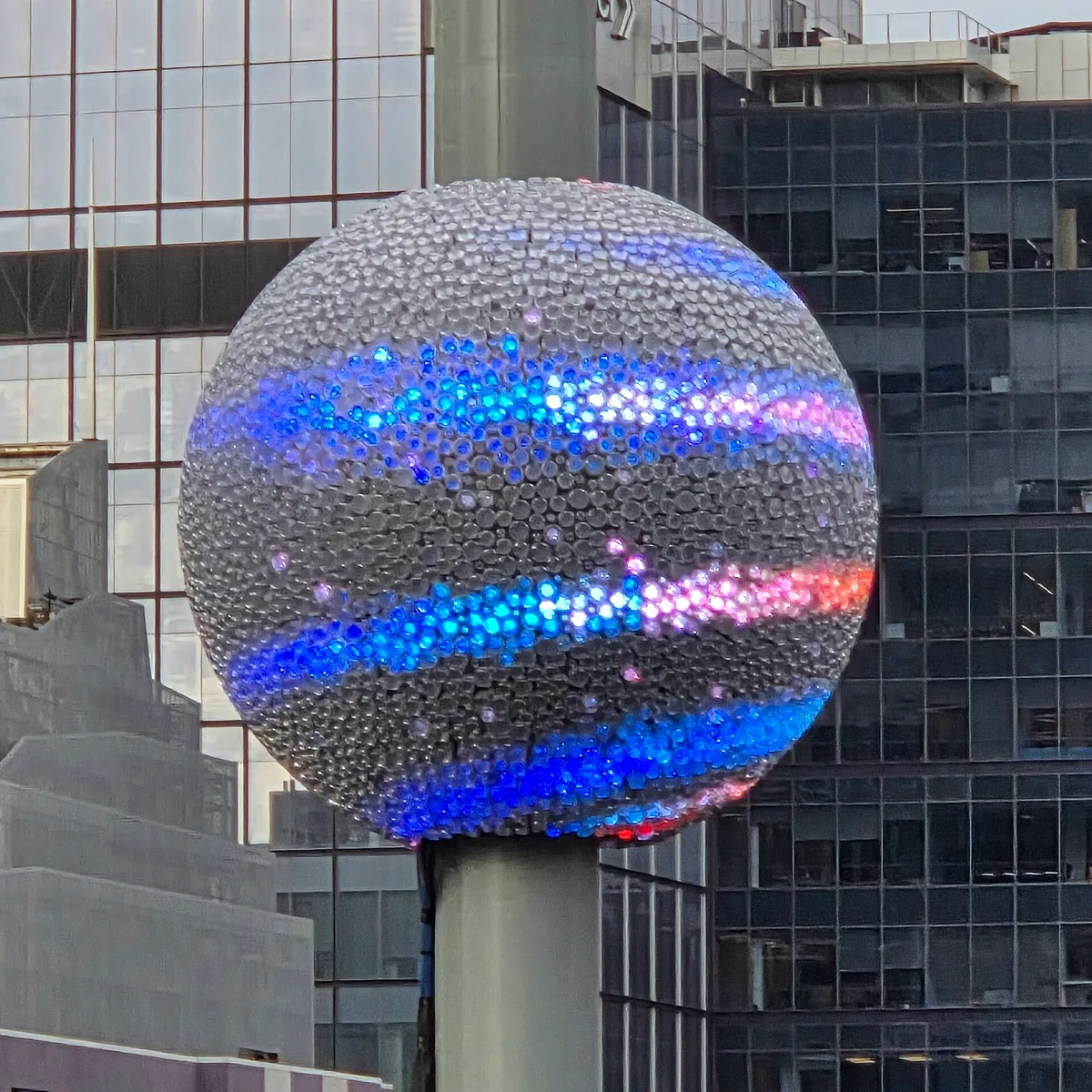
The current ball is a geodesic sphere 12 feet across. Its surface is 2,688 Waterford crystal triangles, lit by 32,256 LEDs that can produce millions of colour combinations. It weighs close to six tons.
The tradition goes back to New Year’s Eve 1907, when the first ball, made of iron and wood, came down the pole. That came three years after The New York Times began celebrating New Year on the square. The drop was paused in 1942 and 1943 because of wartime dimouts. Crowds still gathered for a minute of silence and chimes from a sound truck.
Since 2009 the ball has stayed at the top of the tower all year. It glows over the square every night, not just one.
How midnight plays out
The drop takes place at midnight on December 31. The ball rises up the pole at 6pm, and at 11:59pm it begins its 60-second descent. The crowd counts down the last ten seconds out loud. When the ball reaches the bottom, the numerals of the new year light up above it.
Then the confetti comes down. Tonnes of it drift off the surrounding rooftops, followed by “Auld Lang Syne” and Sinatra’s “New York, New York”. The Times Square Alliance and Countdown Entertainment run the event. Their official site lists the programme and the performers.

Surviving the pens on New Year’s Eve
The night works by its own rules, and knowing them changes the experience.
- Entry is free. Nobody sells tickets to the street, so anyone offering one is running a scam. Some restaurants and hotels sell their own packages for indoor parties.
- The NYPD runs the crowd. Spectators are screened at checkpoints and then directed into barricaded viewing pens along Broadway and Seventh Avenue, filling them from the north end down.
- There’s no coming back. Leave your pen for food or a toilet and you lose your spot. There are no public restrooms in the pens.
- Bags are banned. That includes large bags, backpacks, umbrellas and alcohol, all turned away at screening.
People who want a view of the ball usually reach the square in the early afternoon and settle in for many hours of standing. Regulars come in layers, with thermal socks and hand warmers, because December wind cuts straight down the avenues. Most eat a big meal before they go through screening.
Getting to 42nd Street and Broadway
Times Sq–42 St is one of the city’s biggest subway hubs. The 1, 2, 3, 7, N, Q, R, W and S (shuttle) trains all stop there, and the Port Authority Bus Terminal on Eighth Avenue connects to it underground. On a normal day, come out on Broadway and look south: the tower is the slim building at the bottom of the bowtie.
On December 31, police close streets and some station exits around the square. Many attendees walk in from Sixth or Eighth Avenue instead. After midnight, the walk to a train usually goes faster than waiting in line at the nearest entrance.
Seeing the ball on any other night
For most visitors, this is the better trip. The site is open around the clock, and after dark the lit sphere is easy to pick out against the sky.
The red glass steps over the TKTS booth in Duffy Square, between 46th and 47th Streets, are the classic place to stand. From the top you look straight down the square to One Times Square. Fifteen minutes is enough for photos.
From there it’s a short walk to Bryant Park and the New York Public Library on 42nd Street, or west into the Broadway theatre blocks. If you want a closer look at a ball, retired versions have been shown around Times Square and in the Alliance’s displays over the years. The current ball stays at the top of its pole.
Frequently asked questions
Can you see the Times Square Ball when it isn't New Year's Eve?
Yes. Since 2009 the ball has stayed on top of One Times Square all year, and it's lit at night. You can see it from the street at any hour. The TKTS red steps in Duffy Square give a clear view straight down the square.
Which subway station is closest?
Times Sq–42 St, served by the 1, 2, 3, 7, N, Q, R, W and S trains. On December 31, police close some exits and streets around the square, so many people walk in from Sixth or Eighth Avenue.
When does the ball actually drop?
It rises up the pole at 6pm on December 31 and starts its 60-second descent at 11:59pm. It reaches the bottom at midnight, when the new year's numerals light up and the confetti falls.
Do you need a ticket to watch the ball drop in person?
No. Watching from the public street is free. You go through NYPD screening and then into barricaded viewing pens. Large bags, backpacks, umbrellas and alcohol aren't allowed. If you leave your pen, you can't get back in.
How long do people wait on New Year's Eve?
People who want a view of the ball usually arrive in the early afternoon and stand for many hours. There are no public restrooms in the pens, so most eat beforehand and dress in warm layers.
Plan your trip to New York
United States eSIM & staying connected →
Some links above are affiliate links — if you book through them, Wander Atlas earns a small commission at no extra cost to you. It's how we keep every guide free.
Related guides
 attraction
Times Square: New York Travel Guide (4.7★)
 attraction
The Channel Gardens: New York Travel Guide (4.7★)
 attraction
American Museum of Natural History: New York Travel Guide
 attraction
The Metropolitan Museum of Art: New York Travel Guide (4.8★)
This spot is Day 2 of our New York 3-day itinerary