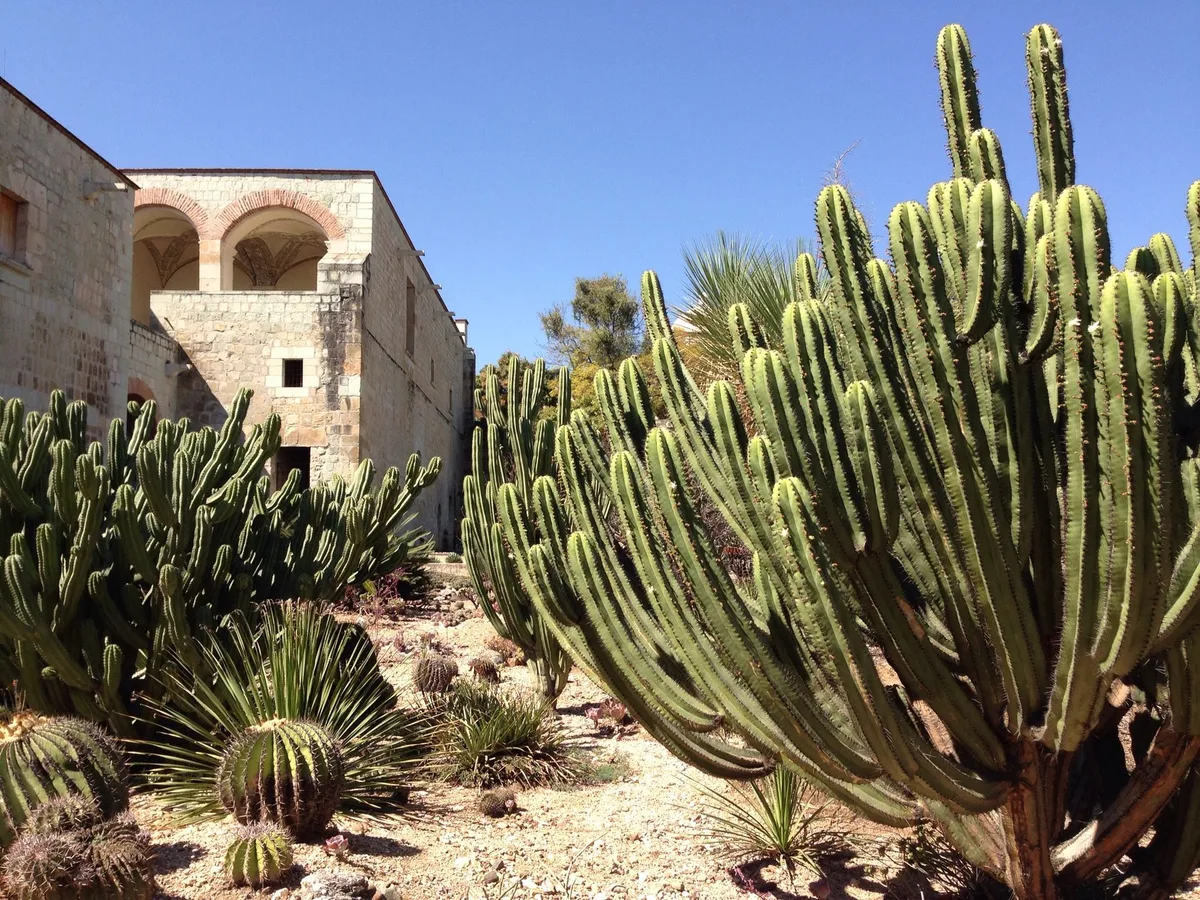
Behind the church
The golden-green stone of Santo Domingo is the landmark. Look past the domes, toward the long back wall of the old convent. Behind it lies a garden built on land that once belonged to the Dominican friars. The garden itself is younger, and the whole collection comes from one state: Oaxaca.
That narrow focus makes it worth the time. Oaxaca is one of the most biologically diverse states in Mexico. The garden places its plants next to the uses people found for them: food, fibre, medicine, dye and drink.
How the garden came to be
It started as a fight over land. In the 1990s the former convent grounds were in line to become a hotel and car park. The artist Francisco Toledo backed a campaign to keep them for public use, and the space opened as a garden at the end of the decade.
Toledo worked on the design with ethnobotanist Alejandro de Ávila, who became the founding director. You can see an artist’s hand in it. The planting reads as composition, with walkways laid out between beds, stone channels and pools.
The walk also passes remains of the convent’s working life, including old water channels and masonry. Your guide will explain what each structure was for.
The organ cactus wall and the agave beds
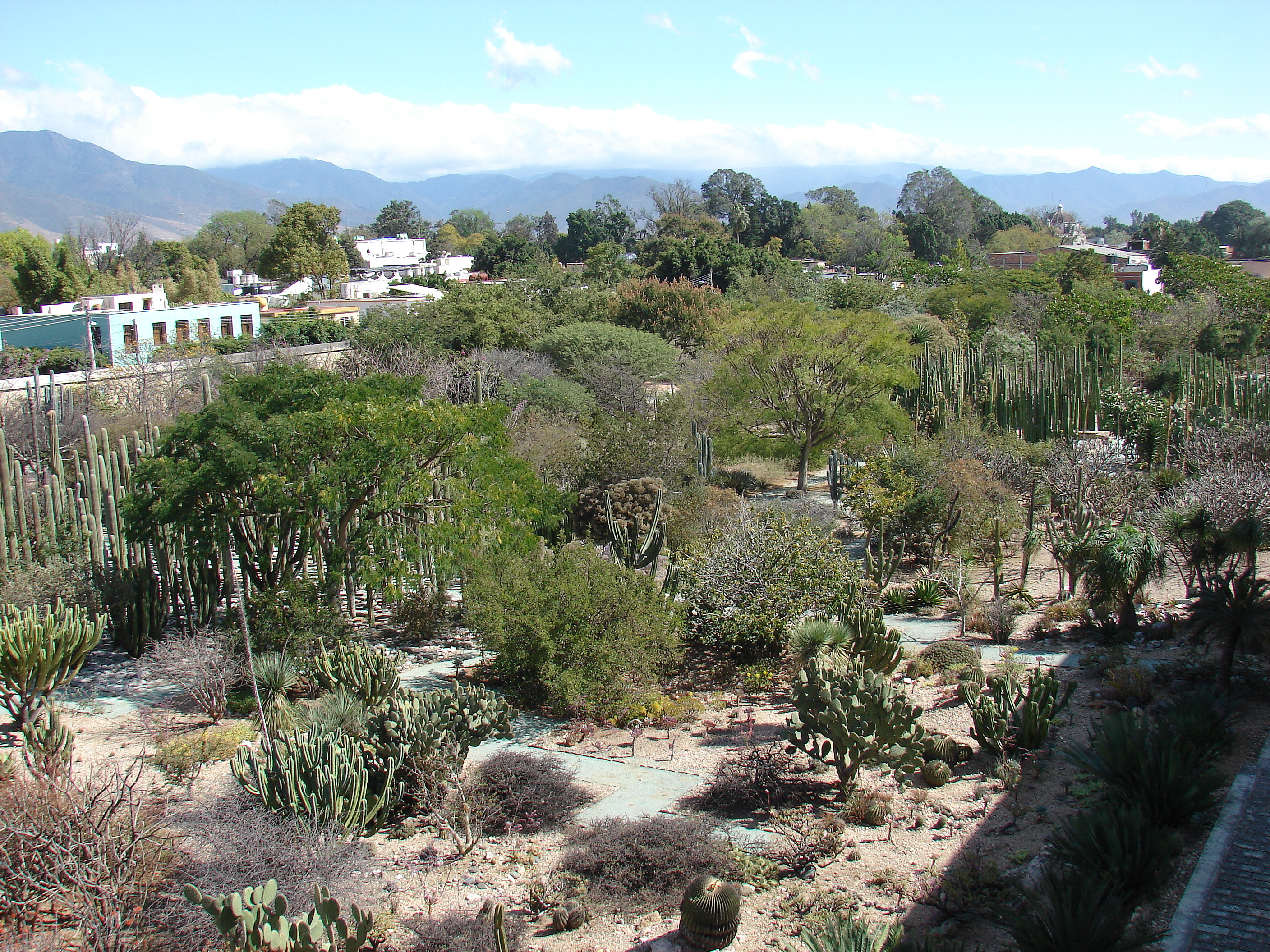
This part of the garden is the one people photograph. A tall line of columnar cactus runs along a pool. The ribbed green stems stand side by side like organ pipes and are mirrored in the still water. In Oaxacan villages, people grow these cacti close together as living fences. The garden borrows that idea and makes it look formal.
Around it you’ll find the plants that hold up Oaxacan life:
- Agaves, from small rosettes to huge blue-grey ones. These are the plants behind mezcal, and your guide will point out the species distilled in the valleys.
- Nopal, the prickly pear. It’s tied to cochineal, the insect dye that made Oaxaca rich in colonial times.
- Dry-forest and highland trees, showing how different the state’s mountain, coast and valley landscapes are.
- Food and medicinal plants that turn up in the city’s markets, so a walk through Mercado 20 de Noviembre afterwards will look different.
Getting in on a tour
You don’t wander the garden alone. Visits are guided, and the group follows its guide along the paths. The rule protects the beds, and it means the plant names come with a story attached.
Some practical points:
- The entrance is on Reforma Sur, on the side of the Santo Domingo complex, not on the church plaza. Walk around the block from Macedonio Alcalá.
- Spanish tours run more often than English ones. Ask at the entrance desk which languages run on the day you plan to visit, and sign up early if you need English.
- The garden opens Monday to Friday, 10am to 5pm. It is closed on Saturday and Sunday. Many visitors arrive on a weekend and find the gate shut.
- Ticket prices are posted at the entrance. Check there for the current rate before your tour.
If you have an afternoon free on a weekday, a tour that starts earlier in the day gives you time to stay for questions afterwards.
Sun, shade and what to carry
The paths are mostly open to the sky, and Oaxaca’s highland sun is strong even when the air feels mild. The cacti and agaves give you no shade. Pack these:
- A hat and sunscreen
- Water for a walk of about an hour or more, depending on the tour
- Shoes with grip, since the paths are gravel and stone in places
The season changes how the garden looks. From roughly November to May it’s dry. The cacti and agaves stand out sharply, and many trees drop their leaves. The rains usually come between June and September. Then the beds fill in green and the pools hold more water. Neither season is wrong; they show you two different landscapes.
Next door in Santo Domingo
The garden is one part of a cluster, so plan a half day around it. The Museo de las Culturas de Oaxaca fills the former convent. Its upper cloister windows look down over the garden beds. You’ll get a second view of the cactus lines from above, after walking among them.
Also close by:
- The Templo de Santo Domingo de Guzmán, with its gilded interior and the carved family tree on the ceiling under the choir.
- The Instituto de Artes Gráficas de Oaxaca (IAGO), across Macedonio Alcalá. Toledo founded it as well.
- The Museo Textil de Oaxaca, a short walk south. It picks up the dye and fibre plants you’ve just seen growing.
Andador Macedonio Alcalá is the pedestrian street that runs downhill to the Zócalo. It links all of this to the centre in about ten minutes on foot.
Being a good guest on the paths
The guided format comes with a few manners. Stay with your group and keep to the paths. The beds are a working collection, and some plants took years to collect from remote parts of the state.
Don’t touch the cacti or agaves. Agave leaf tips are sharp and the spines on nopal stick in skin. Ask the guide before you photograph people. Photos of the plants are normally fine, but check at the desk whether larger camera gear needs permission.
This is a well-known stop, and tour groups from the city’s agencies come here too. Guides in Oaxaca usually accept a tip at the end of the walk. If yours answered your questions about mezcal agaves or cochineal, handing over a little cash as you leave is a normal way to say thanks.
Frequently asked questions
Is the Jardín Etnobotánico de Oaxaca open on weekends?
No. It opens Monday to Friday, 10am to 5pm, and is closed on Saturday and Sunday. Plan a weekday visit.
Can I walk around the garden on my own?
No. Visits are by guided tour. Ask at the entrance on Reforma Sur for that day's tour times and languages. Spanish tours run more often than English ones.
How long does a visit take?
Allow an hour or more for the tour itself. Add time for the Museo de las Culturas de Oaxaca in the former convent next door, which overlooks the garden.
How do I get there from the Zócalo?
Walk north along the pedestrian Andador Macedonio Alcalá to the Templo de Santo Domingo. It takes about ten minutes. Then go around the convent complex to the garden entrance on Reforma Sur.
What is the best season to visit?
Both seasons work. In the dry months, roughly November to May, the cacti and agaves stand out sharply. During the rains, usually June to September, the beds and pools are greener and fuller. Bring sun protection all year.
Plan your trip to Oaxaca
Some links above are affiliate links — if you book through them, Wander Atlas earns a small commission at no extra cost to you. It's how we keep every guide free.
Related guides
 attraction
 Museo Amparo: Puebla Travel Guide (4.8★)
 attraction
 Mexico City Metropolitan Cathedral: Travel Guide (4.7★)
 attraction
 Museo Histórico Casa de Allende: San Miguel de Allende Travel Guide
 attraction