Water that turned to stone
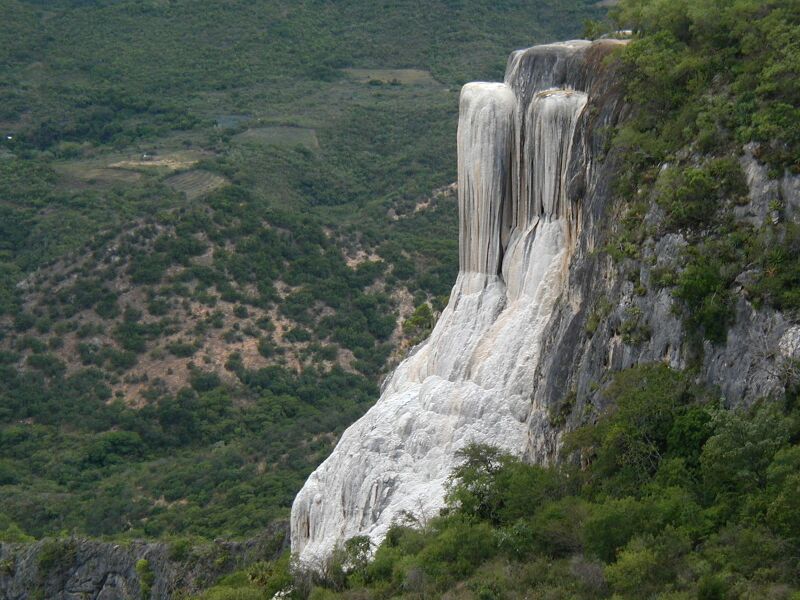
Two white cliffs hang over a valley of scrubby hills. What looks like a frozen waterfall is rock. Mineral springs have run over the cliff edge for thousands of years and left calcium carbonate behind, layer on layer, until the drips formed curtains of travertine.
The two formations are known as the cascada chica and the cascada grande. The name means “the water boils”, but the springs only bubble; they are not hot. At the top, shallow pools sit right at the cliff edge with the valley falling away behind them. That view is the one in every photo.
The pools, the trail and the old canals
Once through the gate, the site splits into a few parts:
- The upper pools. Shallow, cool mineral water on the cliff top. The rim is slick travertine, so walk carefully.
- The trail down. A steep path drops below the cascada chica and loops around for side views of both formations. Give it about an hour, and wear shoes with grip, because the rock is often wet.
- The Zapotec terraces. Look for the narrow channels cut into the slope. They are ancient Zapotec irrigation works, more than two thousand years old, that carried spring water to farm terraces.
Plan on two to three hours on site. Swimsuits are normal, but bring a towel and a hat, because there is little shade at the top.

Getting up from Oaxaca city
The drive takes around 1.5 to 2 hours. You head east on Highway 190 toward Mitla, then follow a winding mountain road up into the municipality of San Lorenzo Albarradas. Without a car, take a bus or colectivo to Mitla. From there, shared pickup trucks and taxis cover the last stretch.
Most visitors come on a day tour from Oaxaca city. A typical tour also stops at the Árbol del Tule in Santa María del Tule, the weaving village of Teotitlán del Valle, the ruins at Mitla and a mezcal distillery near Santiago Matatlán. That fills the day, but it also means less time at the springs.
Paying the ejido and beating the vans
Local communities run the site and charge at checkpoints on the access road, and sometimes again at the entrance. Pay in cash pesos and keep small notes ready. The amount is set by the community and posted at the booths, not online. Disputes between communities have closed the site before, so check its current status with your hotel or tour office before you go.
Tour vans usually leave Oaxaca city mid-morning, so they arrive around midday. With your own transport, aim to be there soon after the 7:00 AM opening. You get the pools before the groups and the light before it turns harsh. The gates close at 6:00 PM every day, and the mountain road is better done in daylight.
The travertine formed over millennia and breaks easily. Stay on the marked paths, don’t climb the formations, and take your rubbish back down the mountain. Comedores near the entrance serve simple food like tlayudas and quesadillas, which is handy after the climb back up.
Frequently asked questions
How far is Hierve el Agua from Oaxaca city?
It is about 70 km east, a drive of roughly 1.5 to 2 hours via Highway 190 toward Mitla and then a winding mountain road. Without a car, get a bus or colectivo to Mitla and take a shared pickup truck or taxi from there.
What are the opening hours?
It opens every day from 7:00 AM to 6:00 PM. Arriving soon after opening puts you ahead of the day tours from Oaxaca city, which usually reach the site around midday.
Can you swim at Hierve el Agua?
Yes, in the shallow mineral pools at the top of the cliff. Despite the name, the water is cool, not hot. The rim is slippery travertine, so move carefully and don't climb the formations.
How long should I spend there?
Allow two to three hours. That covers a swim in the upper pools plus about an hour for the steep loop trail below the petrified waterfalls.
What can I combine it with on a day trip?
It's usually paired with the Mitla ruins, the Árbol del Tule, the rug-weaving village of Teotitlán del Valle and the mezcal distilleries around Santiago Matatlán, all on or near Highway 190.
Plan your trip to Oaxaca
Some links above are affiliate links — if you book through them, Wander Atlas earns a small commission at no extra cost to you. It's how we keep every guide free.
Related guides
 attraction
 Jardín Etnobotánico de Oaxaca: Travel Guide (4.4★)
 hidden gem
 Templo Mayor Museum: Mexico City Travel Guide (4.8★)
 hidden gem
 Charco del Ingenio: San Miguel de Allende Travel Guide
 hidden gem