Stones along the Willamette
Rough basalt boulders rise from a curving path at the river’s edge. Carved into them are short poems written by Japanese Americans. They trace a history: immigrants arriving, families building Portland’s old Japantown, then the forced removal of 1942 under Executive Order 9066.
Landscape architect Robert Murase designed the plaza, and it was dedicated in 1990. Some of the stones are split or broken, a deliberate image of lives cut apart. Others list the names of the incarceration camps where Oregon’s Japanese American families were sent. The poems are brief, so read every one. Seeing the whole memorial takes 20 to 30 minutes.
Finding the plaza
It sits in Tom McCall Waterfront Park, on the stretch between the Burnside and Steel bridges along Naito Parkway.
- MAX light rail: The Blue and Red lines stop at Skidmore Fountain, a short walk south.
- On foot: Old Town Chinatown, where Nihonmachi (Japantown) stood before the war, is just a few blocks west.
- By bike: The riverside path through the park runs right past the stones.
- Hours: The plaza is open 5am to midnight every day of the week.
Under the cherry trees
A row of cherry trees lines the path, and they are the plaza’s calendar. Bloom usually peaks in late March or early April. Pink petals then collect in the carved letters and the grass around the boulders. During those weeks, expect the space to fill with people photographing the blossoms.
Outside bloom season, locals mostly pass the plaza on runs or bike commutes, so it feels like a quieter find. The crowd pattern is plain. It is calmest between 7am and 11pm on both weekdays and weekends. The one window to avoid is weekends from 11am to 8pm, when the waterfront gets busy.
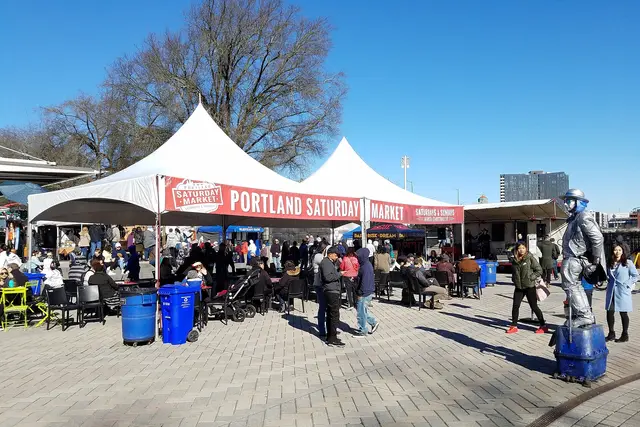
Weekend crowds come partly from Portland Saturday Market, held under the Burnside Bridge a few minutes south. If you want the poems to yourself, visit on a weekday morning. Then walk to the market afterwards if it’s running.
Reading the plaza with care
This is a memorial, and a few habits keep it that way:
- Don’t climb or sit on the inscribed stones, even when the blossom photos tempt you. Use the benches and the lawn.
- Walk the path in order and read each poem. The carvings build a story from arrival to incarceration to return.
- Keep music off and voices low. People sometimes leave flowers or folded paper cranes here, so leave them where they are.
- Come on February 19 if you can. The Day of Remembrance marks the date the executive order was signed in 1942, and Portland’s Japanese American community holds observances around it.
For more context, walk into Old Town to the Japanese American Museum of Oregon. Its exhibits cover the Portland Assembly Center, the temporary detention site at today’s Expo Center. Check the museum’s website for current hours before you go, since they aren’t posted at the plaza. The Steel Bridge’s lower deck walkway is a short walk away too, and from it the stones look small against the river.
Frequently asked questions
Where exactly is the Japanese American Historical Plaza?
It's at the north end of Tom McCall Waterfront Park on the Willamette River, between the Burnside and Steel bridges along Naito Parkway. The nearest MAX stop is Skidmore Fountain on the Blue and Red lines.
When is the quietest time to visit?
The quietest window is 7am to 11pm on both weekdays and weekends. Avoid weekends from 11am to 8pm, which is the busiest period.
When do the cherry trees bloom?
Usually in late March or early April. The exact timing shifts with the weather each year, and the plaza gets busier during peak bloom.
How long should I spend there?
Give it 20 to 30 minutes to read every poem stone. Add an hour or more if you continue to Old Town Chinatown and the Japanese American Museum of Oregon.
What are the plaza's hours?
The plaza is open from 5am to midnight every day.
Plan your trip to Portland
Some links above are affiliate links — if you book through them, Wander Atlas earns a small commission at no extra cost to you. It's how we keep every guide free.