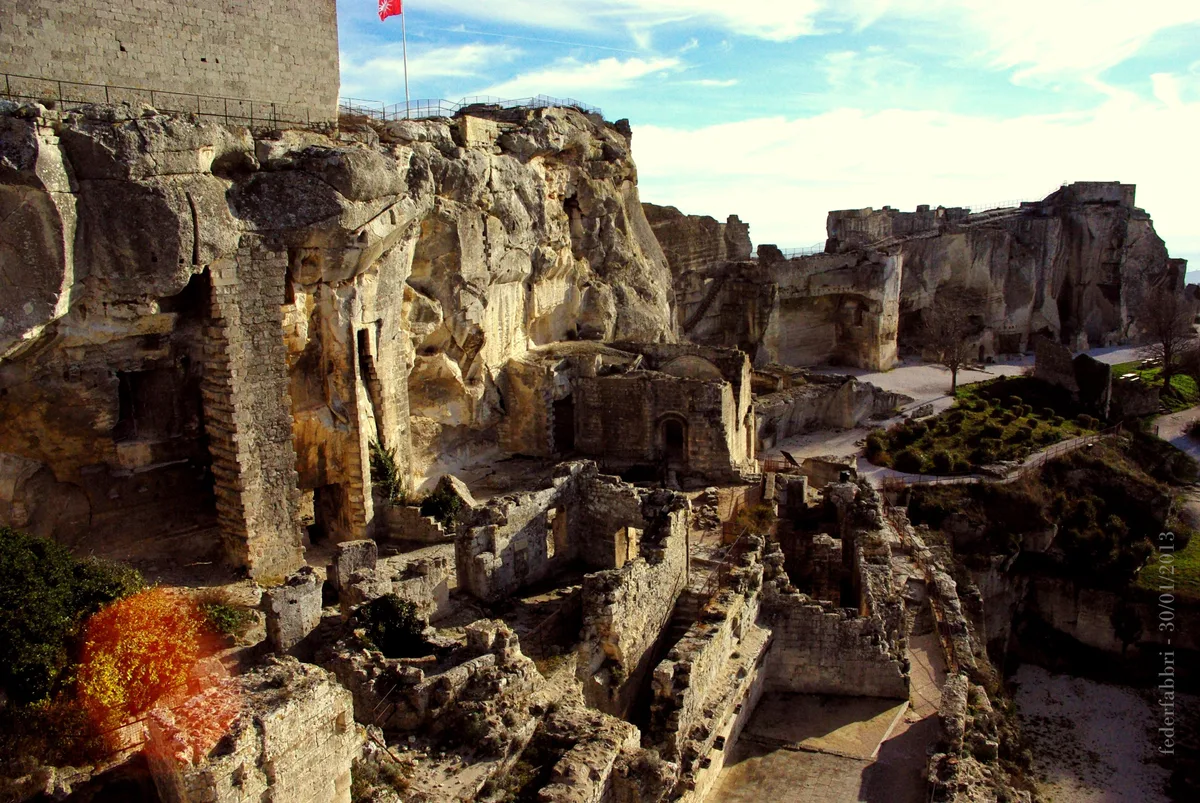
A fortress cut from the rock
Walls, stairs and rock here are all the same pale limestone. The Château des Baux-de-Provence grows straight out of the outcrop it stands on. Some of its rooms were carved into the rock rather than built against it, and in places you can’t tell where the cliff stops and the masonry starts.
At the top you are standing on a bare plateau high above the Alpilles. On a clear day you can see olive groves and vineyards stretching toward Arles and the flat Camargue. The drop on the far side falls into the Val d’Enfer, a valley of eroded rock. The plateau has no shelter from the mistral, so bring a layer even when the village below feels warm.
What is left, and why
The lords of Baux ran this site in the Middle Ages and were a powerful family in Provence. Their emblem was a sixteen-pointed star, a nod to their claimed descent from Balthazar, one of the Three Kings. The castle did not fall to time. In the 1630s Louis XIII had it dismantled, with Richelieu’s backing, after the town rebelled against the crown.
What survives is plenty to explore:
- The keep, reached by steep, narrow steps, with the widest views on the site
- The Saracen and Paravelle towers at the edges of the plateau
- The Saint-Blaise chapel, plain and small
- Rock-cut rooms and cisterns where you can still see the outlines of halls and storerooms
The siege engines
Most visitors remember the siege engines best. Full-size replicas stand on the open ground of the plateau: a trebuchet, a battering ram and smaller catapults, all timber and rope. They are the size of a house, and next to them the ruined walls start to make sense as defences.
In summer the castle puts on costumed events and live demonstrations. The trebuchet is fired and the old machines are explained. If you have children with you, check the official programme and plan your visit around a demonstration slot.

Timing your climb
At the moment the castle opens 10am–5pm daily. These hours change through the year, so check the official site before you go. The hour after opening is your best chance of an uncrowded keep: it’s typically quietest from 10am to 11am, on weekdays and weekends alike.
Try not to arrive after midday on a weekend. From 12pm to 5pm the narrow lanes up to the entrance fill, and the stairs on the keep become a queue. Allow 1.5–2 hours inside, longer if you stay for a demonstration.
Getting up the hill without the hassle
Les Baux has no cars inside, so everyone walks the last stretch. The address is Rue du Trencat, at the very top of the old village. You get there by climbing cobbled lanes lined with shops and old stone houses. Wear shoes that grip, because the limestone underfoot is worn smooth and can be slippery.
How it works on the ground:
- Park below the village. Drivers use the paid car parks at the foot of the rock. Arrive early and you can get a space close to the gate; the current rates are posted at the parking machines.
- Buy at the entrance. Tickets are sold at the castle gate at the top, and current prices are listed there and online. Booking online in high season saves time at the window.
- Pick up the audio commentary if it’s offered when you buy your ticket. Without it, the ruins are hard to read.
- Carry water. You are on an exposed rock with little shade, and in July and August the heat builds up fast.
- Keep to the railings. The plateau has real drops, and the wind is strongest near the edges.
The nearest base towns are Saint-Rémy-de-Provence and Arles. Public transport into the Alpilles is limited, so most people come by car or on a tour.
Around the rock
Just below the village is the Carrières des Lumières, a former limestone quarry. It now shows immersive art projections on its tall cut walls. Pairing it with the castle makes a natural half-day, and the cool quarry is a good escape from midday sun.
Back in the village, the Place Saint-Vincent and its church sit on the way down. They are a quiet place to stop before the climb back to the car. From there, Saint-Rémy, with its Roman ruins at Glanum, is a short drive across the Alpilles.
Frequently asked questions
When is the quietest time to visit the Château des Baux-de-Provence?
It is typically quietest from 10am to 11am, on both weekdays and weekends. Try not to arrive between 12pm and 5pm on weekends, which is the busiest stretch.
How long should I spend at the castle?
Allow about 1.5–2 hours to see the keep, towers, chapel and siege engines. Add time if you want to watch a summer demonstration or visit the nearby Carrières des Lumières.
How do I get to Les Baux-de-Provence?
Most visitors drive from Saint-Rémy-de-Provence or Arles and park in the paid car parks below the village. No cars are allowed in the village, so you walk up the cobbled lanes to the entrance on Rue du Trencat. Public transport into the Alpilles is limited.
Are the siege engines demonstrated every day?
The replica trebuchet and other engines are on display on the plateau. The live demonstrations and costumed events take place in summer, so check the official programme for dates and times.
What are the opening hours?
At the moment the castle opens 10am–5pm daily. Hours change through the year, so check the official site for the current month before you go.
Plan your trip to Provence
France eSIM & staying connected →
Some links above are affiliate links — if you book through them, Wander Atlas earns a small commission at no extra cost to you. It's how we keep every guide free.