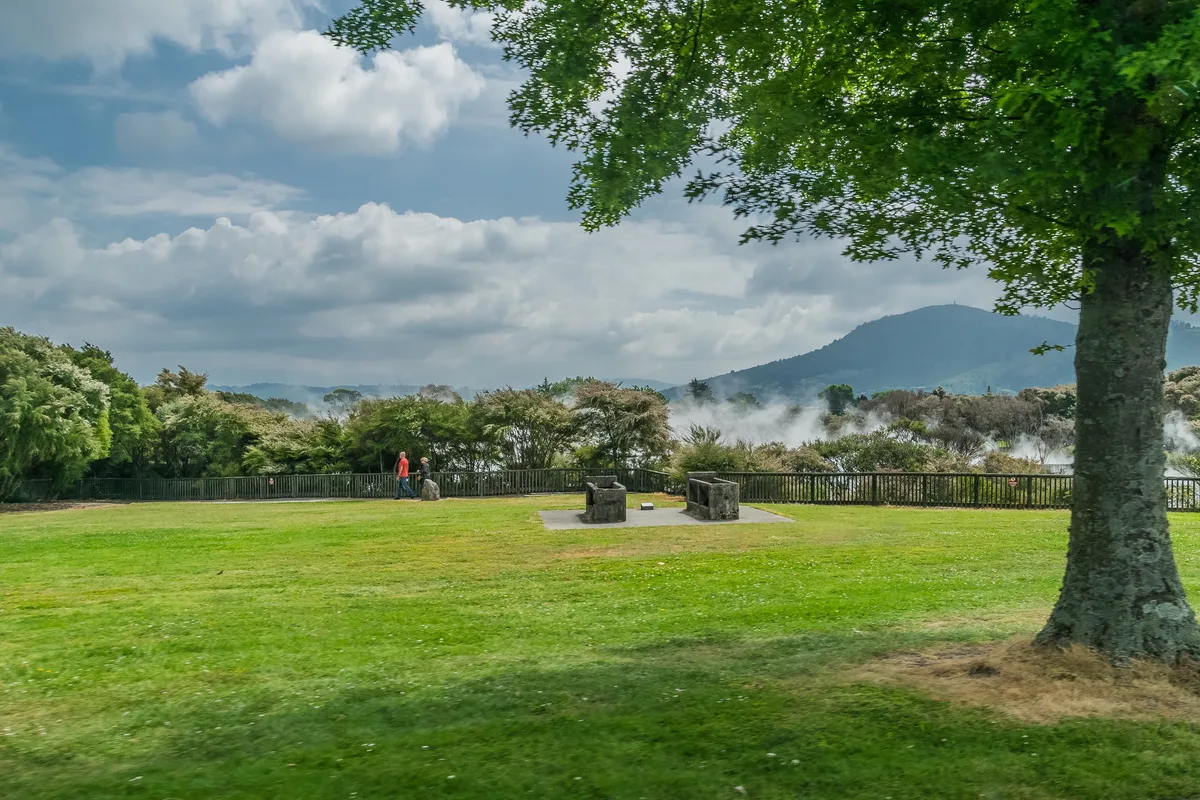
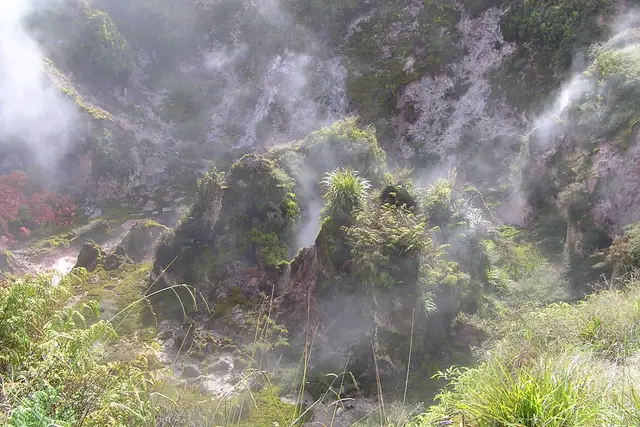
Steam comes up through the grass here. It rises from crater pools beside the footpaths and drifts off a lake the colour of milky tea, and it does this in a city park with a playground and picnic tables. Kuirau Park sits between Ranolf Street and Pukuatua Street on the western side of Rotorua’s centre, and it has no gate and no ticket booth.
What the ground is doing
Kuirau is active geothermal land, not a landscaped display. The paths take you past mud pools that plop and spit behind wooden fences. You also pass pools of clear, scalding water ringed with orange and white mineral crust. The smell of hydrogen sulphide, the rotten-egg note Rotorua is known for, is always strongest here.
The centrepiece is Lake Kuirau. On cool mornings the steam can hide the far bank completely. In Māori tradition the lake is named for Kuirau, a woman taken by a taniwha, a water creature, while she bathed. The gods made the water boil to destroy it, and it has steamed ever since.
That activity is unpredictable. In 2001 a hydrothermal eruption threw mud and rocks over the surrounding trees. New vents open from time to time, and the council fences off the ground around them. A fenced patch of lawn usually means that ground has become unstable.
The foot pools
The foot pools are why most people slow down. They are shallow, concrete-edged pools fed by geothermal water. Bench seating runs around the edge, so you sit, roll up your trousers and lower your feet in. The water is hot, but you can stand it once you ease in.
What to bring:
- A small towel. There is nowhere to dry off.
- Shorts, or trousers that roll well above the knee
- Sandals, which are quicker to slip on and off than laced shoes
Fifteen or twenty minutes is plenty. After a day of walking around the Redwoods or Te Puia, your legs will feel it.

Steaming ground, sensible feet
Kuirau looks gentle, and that is the risk. A few habits keep a visit uneventful.
- Stay on the paths and behind the fences. The crust beside a vent can be thin, and the water under it is near boiling.
- Keep children’s hands in. The playground is close to active ground, so supervise anyone who might climb or lean over a barrier.
- Feet only in the foot pools. As at any New Zealand geothermal water, keep your head above the surface. Never splash water onto your face.
- Dogs on a lead. A dog running loose off the path can end up in a hot pool.
- Read the signs as you go. The council updates closures when the ground shifts, and a path that was open last year may be roped off now.
Nobody collects money and there is no booking. People treat the foot pools as shared seating. Shuffle along to make room and don’t hog the edge when a family arrives.
Saturday in the park
Kuirau changes character on Saturday mornings. The Rotorua Saturday market sets up in the car park area on the Ranolf Street side. You’ll find produce stalls, food vendors and craft tables. Locals come for their weekly vegetables and coffee, and visitors come to wander between the stalls with the steam drifting past.
To combine both, walk the market first while it is fully set up. Then cross into the park for the foot pools. Check the market’s current trading times before you plan around it, because they can vary through the year.
Getting there and timing
From the Rotorua i-SITE on Fenton Street you can walk west along Pukuatua Street in about ten minutes. Eat Streat, the covered dining strip on Tutanekai Street by the lakefront, is a similar walk in the other direction. That makes the park an easy stop before or after a meal. There is roadside parking on the streets around the edges.
Google currently lists the park as open 24 hours, and there is no gate to close. Even so, it is best seen in daylight. Paths beside boiling pools are not where you want to misjudge a step in the dark. Early morning, especially in the cooler months, gives you the thickest steam over the lake.
Pairing it with the rest of Rotorua
Kuirau is the free, low-effort introduction to Rotorua’s geothermal landscape. It isn’t the grand version. To see the geysers, carry on to Te Puia at Whakarewarewa, south of the centre. For gardens and the city’s Tudor-style bathhouse building, Government Gardens is on the lakefront east of Fenton Street. Polynesian Spa, also by the lake, has full-body soaking if the foot pools leave you wanting more.
As a first stop on arrival day, an hour at Kuirau tells you what kind of ground this city is built on.
Frequently asked questions
Do I have to pay to enter Kuirau Park?
No. Kuirau Park is a public council park with no gate or ticket booth, and the foot pools have no charge.
How long should I spend at Kuirau Park?
About an hour covers the lake, the mud pools and a soak in the foot pools. Allow longer on a Saturday morning if you also want to browse the market.
Can I swim in the hot pools at Kuirau Park?
No. Only the foot pools are for public use, and only for your feet. The other pools are near boiling and fenced off. For full-body bathing, go to Polynesian Spa on the lakefront.
How do I get to Kuirau Park from central Rotorua?
Walk west from the i-SITE on Fenton Street along Pukuatua Street. It takes roughly ten minutes. The park runs between Ranolf Street and Pukuatua Street, and there is street parking around it.
What is there to see near Kuirau Park?
Eat Streat on Tutanekai Street and the Lake Rotorua waterfront are a short walk away. So are Government Gardens and Polynesian Spa. For geysers, Te Puia at Whakarewarewa is a short drive south.
Plan your trip to Rotorua
New Zealand eSIM & staying connected →
Some links above are affiliate links — if you book through them, Wander Atlas earns a small commission at no extra cost to you. It's how we keep every guide free.
Related guides
 attraction
Pohutu Geyser: Rotorua Travel Guide (4.6★)
 attraction
Hobbiton Movie Set: Matamata Travel Guide (4.7★)
 attraction
Hobbiton Movie Set Tours: Matamata Travel Guide (4.8★)
 attraction