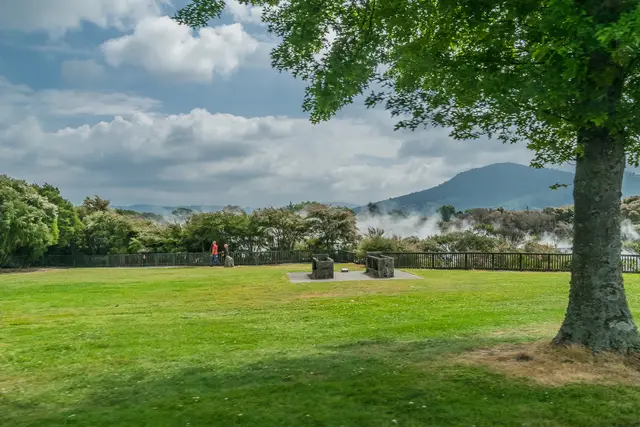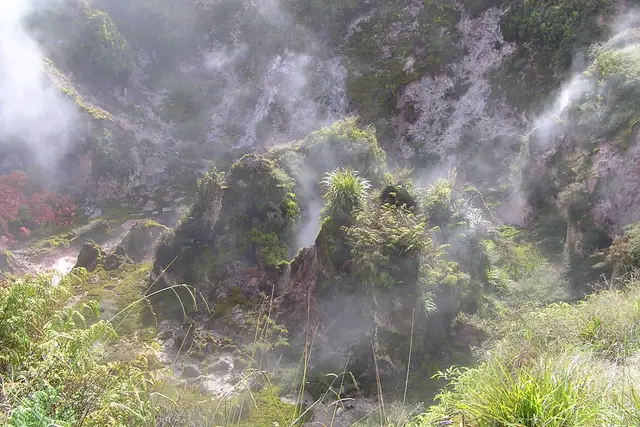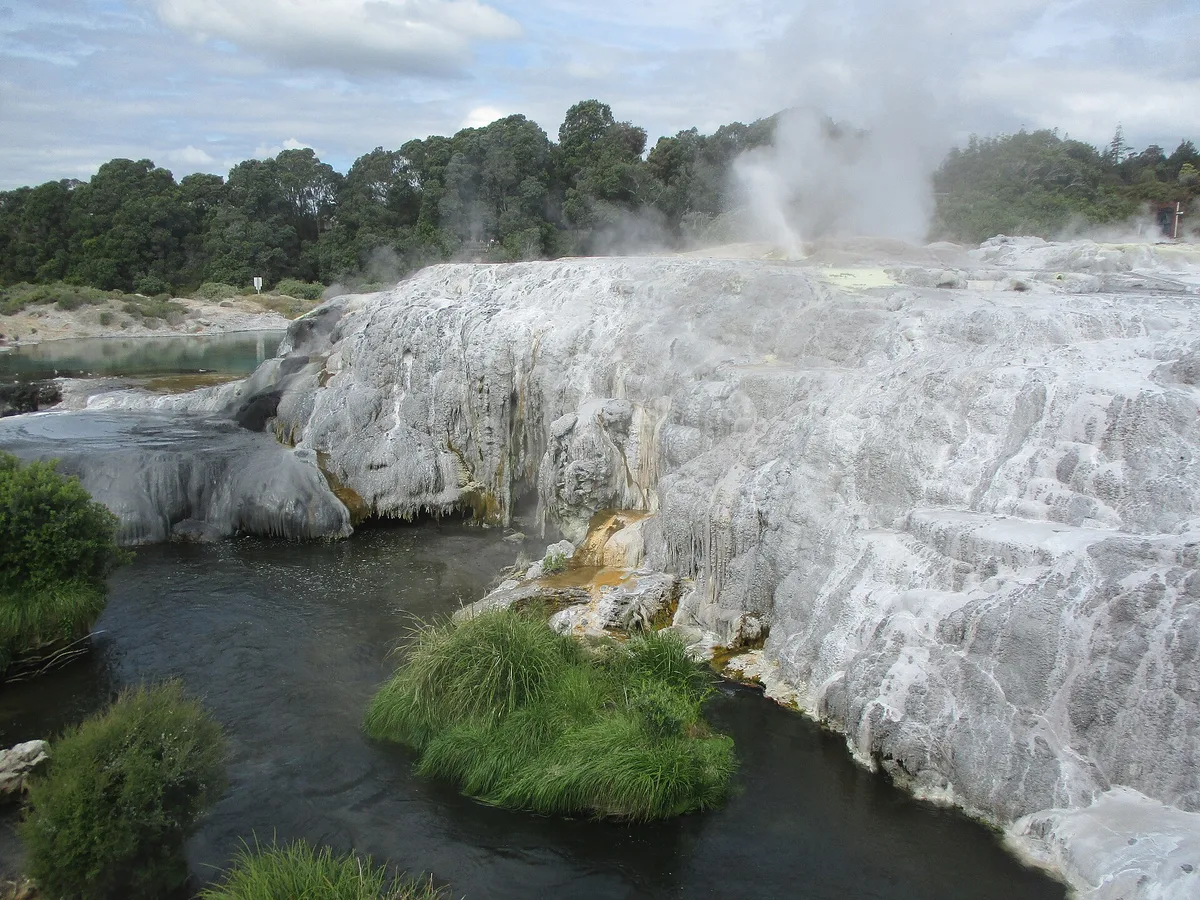
Steam is the constant here. It drifts off the silica terraces of the Whakarewarewa valley in sheets, and the ground under the boardwalk is pale, crusted and warm. Then, with very little warning, a column of boiling water climbs out of a vent in the rock and keeps climbing.
That’s Pohutu, the largest geyser in New Zealand. Its name is usually translated as “big splash” or “constant splashing”, and it lives up to both.
A geyser that keeps its own schedule
Pohutu erupts many times a day. Each eruption can reach around 30 metres and keeps going for minutes rather than seconds. It doesn’t run to a timetable, though. You wait, you watch the vent, and it happens when it happens.
The most useful clue is its neighbour. Te Tohu, better known as the Prince of Wales’ Feathers geyser, sits on the same rock shelf and tends to start up just before Pohutu does. If the smaller jet beside it starts to build, stay where you are.
Cold air makes the show bigger. On a chilly morning, the steam from each eruption billows much higher and wider than it does on a warm afternoon, because the vapour condenses so fast.
Where it is and how to get there
The geyser is part of Te Puia, which you enter at 20 Hemo Road on the southern edge of Rotorua. It’s about 3km from the lakefront and the city centre, a short drive down Fenton Street. Your options:
- Driving: follow Fenton Street south to Hemo Road. There’s parking at the Te Puia entrance.
- Walking: about 40 minutes from the city centre on flat footpaths. It’s an easy walk, mostly along Fenton Street.
- Cycling: a good choice if you’re also heading to the Redwoods Whakarewarewa Forest, which is just east across the valley.
You can’t reach Pohutu without going through Te Puia, so allow time to buy your entry at the gate or book on the official site first.
Reading the valley floor
Pohutu is the headliner, but it shares the valley with a lot of other geothermal features. The paths take you past several of them:
- Boiling mud pools: grey mud that plops and throws up rings, close enough to hear.
- Silica terraces: white and ochre mineral layers built up around the geyser vents over a very long time.
- Steaming vents and hot pools: these line the track. Rotorua’s sulphur smell is strongest down here.
The viewing decks look across at the geyser shelf from a safe distance. On a breezy day, check the wind before you settle in: if the plume is blowing toward you, you’ll get a fine, warm mist over your jacket and lenses.

Beyond the geyser at Te Puia
Te Puia is also home to the New Zealand Māori Arts and Crafts Institute. In the carving and weaving schools you can watch students at work on traditional whakairo (carving) and raranga (weaving). That’s a real reason to plan more than a quick stop, because these are working studios, not displays.
The grounds also include a kiwi house, kept dim because kiwi are nocturnal, so give your eyes time to adjust. There’s also a carved meeting-house area where cultural performances are held. Check the day’s programme when you arrive.
Allow two to three hours if you want the geyser, the valley walk and the arts institute without rushing. If you only care about the eruption, an hour on the decks is a fair bet.
Watching Pohutu without wasting the wait
The geyser can’t be booked and won’t erupt on cue, so the winning move is to be patient and positioned. Here’s how people get the most from it:
- Go to the decks first. Head straight there when you arrive and watch for a while, then walk the rest of the valley. If you hear an eruption start behind you, the decks are close enough to get back to.
- Watch the Feathers. Keep half an eye on the Prince of Wales’ Feathers geyser. When it starts building, people tend to drift toward the railings.
- Stay on the marked paths. The crust beside the boardwalk can be thin over boiling water. The barriers mark the edge of safe ground.
- Treat it as Māori land. The valley is Te Arawa land. If you’re welcomed onto the marae area or join a guided walk, follow the guide’s lead on where to stand and when to take photos.
- Ask about guided walks at the entrance. Te Puia’s guides know the valley’s stories and can point out features you’d walk straight past.
A simple “kia ora” to staff costs nothing. In a place run around Māori culture, people notice it.
Timing your visit around the light
Hours currently run 9am–4pm every day this week. The hours shift with the season, though, and Te Puia also runs evening experiences, so the official site is the place to check before you go.
Because the doors open at 9am, the first hour is your best chance of catching the morning’s big steam plumes. Arriving right at opening usually also beats the tour coaches that run day trips into Rotorua. Leave yourself plenty of time before the listed closing: an unhurried hour on the decks is what gives you the best odds of an eruption.
Rain doesn’t stop the geyser. It does make the silica paths slippery, so wear shoes with real grip.
Nearby, once the steam clears
Several good stops are close to Te Puia:
- Whakarewarewa: The Living Māori Village, just across the valley. Families there still cook in the hot pools and bathe in geothermal water, and from parts of the village you look across at Pohutu from a different side.
- The Redwoods Whakarewarewa Forest, a few minutes east, for tall Californian redwoods and the treetop walkway.
- Lake Rotorua and the Government Gardens, back toward the city centre. Kuirau Park also has free steaming pools and mud you can look at from the footpaths.
Frequently asked questions
How often does Pohutu Geyser erupt?
Many times a day, but not to a fixed schedule. If the Prince of Wales' Feathers geyser next to it starts to build, Pohutu often follows soon after. An hour on the viewing decks usually gives you a good chance of seeing it.
How do I get to Pohutu Geyser from central Rotorua?
Pohutu is inside Te Puia at 20 Hemo Road, about 3km south of the city centre. It's a short drive down Fenton Street, with parking at the entrance, or a flat walk of around 40 minutes. You enter through Te Puia's gate.
What are the opening hours?
Right now Te Puia shows 9am–4pm every day. Hours change through the year and there are separate evening experiences, so check Te Puia's official site for this month's times.
How long should I spend there?
Allow an hour if you only want to see the geyser. Allow two to three hours to also walk the mud pools and terraces, see the kiwi house, and watch the carvers and weavers at the New Zealand Māori Arts and Crafts Institute.
What else is nearby?
Whakarewarewa: The Living Māori Village sits across the valley, and the Redwoods Whakarewarewa Forest is a few minutes east. Kuirau Park and Lake Rotorua are back toward the city centre.
Plan your trip to Rotorua
New Zealand eSIM & staying connected →
Some links above are affiliate links — if you book through them, Wander Atlas earns a small commission at no extra cost to you. It's how we keep every guide free.