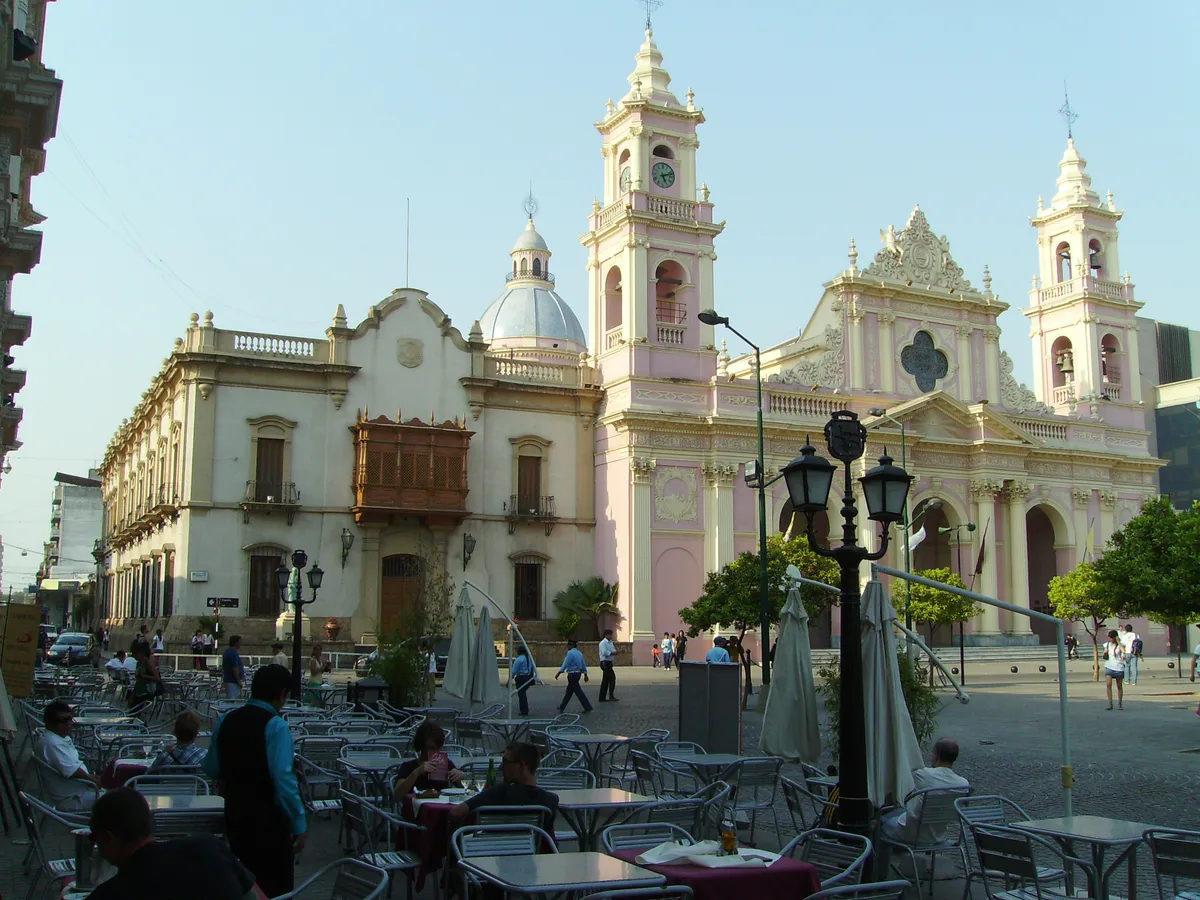
A pink front on Plaza 9 de Julio
Stand anywhere in Plaza 9 de Julio and the cathedral fills the north side. Its facade is painted a soft pink, with white columns, cornices and a pair of bell towers. Under the strong Andean sun, that colour shows up in almost every photo taken in the square.
The building you see dates from the second half of the 1800s. It replaced earlier churches on the site that earthquakes had damaged, and it is now a national historic monument. It’s still the seat of the Archdiocese of Salta. People come in to pray between their errands, so think of it as a parish church that happens to be very grand.
Gold, marble and a long central nave
The doors open onto a long nave lined with columns. Your eye goes straight to the gilded high altar at the far end. Gold leaf picks out the altarpieces, frescoed panels run along the ceiling, and side chapels open off both aisles. Each chapel has its own carved retablo and its own row of votive candles.
Give yourself 30–45 minutes if you want to walk the whole aisle slowly. A quick look from the back takes ten. Things worth finding:
- The high altar and its gilded surround
- The painted ceiling over the nave
- The side chapels, each dedicated to a different saint
- The chapel holding the images of the Señor and Virgen del Milagro
The Señor y la Virgen del Milagro
To understand Salta, find the two images in their side chapel. The crucifix of the Señor del Milagro and the statue of the Virgen del Milagro came from Spain in the late 1500s. Local tradition credits them with ending a run of earthquakes in 1692. Since then they have been the city’s most venerated religious objects.
Every September the cathedral is the centre of the Fiesta del Milagro. Pilgrims walk in from across the province, some for several days, and the city fills up. The celebration builds through the first half of the month. It peaks on 15 September, when both images are carried through the streets around the plaza in a huge procession.
Visiting in early to mid September means you see the cathedral at its most meaningful and its most crowded. Hotels go fast, and the nave can be packed from end to end. Any other month, you’ll often find the chapel with only a few people praying.

Güemes and the Pantheon
Just inside the entrance is the Panteón de las Glorias del Norte, the Pantheon of Northern Heroes. It holds the remains of General Martín Miguel de Güemes, the Salta-born leader of the gaucho forces in Argentina’s war of independence. Other figures from the independence period lie here with him.
For Salteños, Güemes is a source of real local pride. You’ll see his name on streets, schools and monuments across the city. Stop here before you go up the nave. It’s a short visit that explains a lot about the region.
Planning around the midday closure
The cathedral closes in the middle of the day, so plan your visit around that gap. At the moment it opens at 6:30am on weekdays and 7:30am on weekends. The morning session ends at 1:30pm, or 1pm on Sunday. It reopens in the late afternoon: 4:30pm on most days, 5pm on Wednesday and Friday, and 5:30pm on Sunday. These are this week’s times, and holidays and the September festival can change them.
On weekends, foot traffic is lightest between 8am and 9am and between 5pm and 6pm. On Sunday the doors don’t reopen until 5:30pm, so that afternoon window is half an hour shorter. Try not to arrive between 10am and 12pm or between 7pm and 9pm on weekends. Those are the busiest hours, partly because they overlap with services.
We don’t have weekday crowd figures. On weekdays, a visit soon after the afternoon reopening fits neatly between lunch and dinner.
Stepping in during Mass
This is a working cathedral first. A few habits will keep you on the right side of the people praying:
- Check whether a service is on. If Mass has started, stay at the back or come back later instead of walking up the aisle.
- Cover up a little. Shoulders covered and no beachwear is the norm. A light layer is useful anyway, since the nave stays cool.
- No flash, and keep your voice down. Many people only take photos outside service times.
- Leave the Milagro chapel to the faithful. People kneel there for long stretches, so give them room.
- Donations are voluntary. There’s an offering box if you want to contribute to upkeep.
A little Spanish helps if you ask a sacristan anything. The building is la Catedral, and the Pantheon is el Panteón.
Around the square afterwards
The cathedral is one stop on a compact block. You can easily fill a morning on foot:
- Cabildo de Salta: the whitewashed colonial town hall with its long arcade, on the opposite side of the plaza. It now houses a museum of northern history.
- MAAM (Museo de Arqueología de Alta Montaña): across the street on the plaza. It’s known for the Inca child mummies found on Volcán Llullaillaco.
- Iglesia San Francisco: a couple of blocks east, with a deep red and gold facade and a tall bell tower.
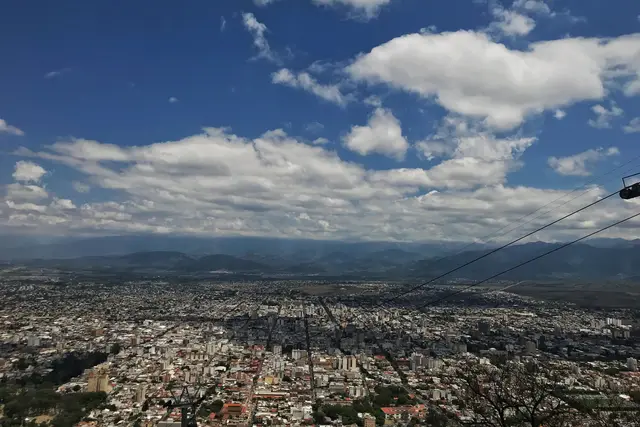
- Teleférico San Bernardo: the cable car up Cerro San Bernardo, a short walk away, with views back over the city grid.
The plaza has benches under its trees and cafés along its arcades. Sit there for a while after your visit for a good view of the pink facade.
Frequently asked questions
When is the quietest time to visit the Catedral Basílica de Salta?
On weekends it's quietest between 8am and 9am and between 5pm and 6pm. On Sunday it reopens at 5:30pm, so that window is shorter. Avoid 10am–12pm and 7pm–9pm on weekends, the busiest hours.
Is the cathedral open all day?
No. At the moment it closes at midday, from 1:30pm (1pm on Sunday) until the afternoon reopening. That's 4:30pm on most days, 5pm on Wednesday and Friday, and 5:30pm on Sunday. Times can change on holidays and during the September festival.
How long do I need inside?
Allow 30–45 minutes to walk the nave and side chapels and see the Panteón de las Glorias del Norte. A quick look from the back takes about ten.
What is the Fiesta del Milagro?
It's Salta's biggest religious festival, held each September. It honours the Señor and Virgen del Milagro, whose images are kept in the cathedral. It peaks on 15 September with a procession around Plaza 9 de Julio. Expect big crowds and book your accommodation early.
What else is near the cathedral?
The Cabildo de Salta and MAAM are both on Plaza 9 de Julio. Iglesia San Francisco is a couple of blocks east, and the Teleférico San Bernardo is a short walk away.
Plan your trip to Salta
Argentina eSIM & staying connected →
Some links above are affiliate links — if you book through them, Wander Atlas earns a small commission at no extra cost to you. It's how we keep every guide free.